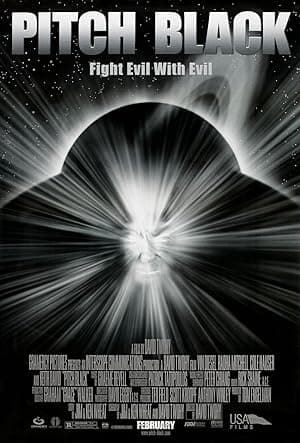
Feature presentation
Pitch Black arrives like a locked-room thriller with sand and stars: a transport ship goes down, daylight will vanish and the survivors have to make fast, ugly choices. What keeps you watching isn't only the eclipse or the monsters; it's the way Richard B. Riddick — the dangerous wildcard who can actually see in the dark — reshapes every moment he touches.
THE MOVIE
Richard B. Riddick is still the reason this movie works
Pitch Black wears its premise on its sleeve: a cryo-transport has an accident and leaves a small group stranded on a sunbaked world. Simple, brutal setup. The urgency is built-in — they’re on a clock even before the predators become a threat.
Then there’s Riddick. He’s an escaped prisoner who can see in the dark because of surgically altered eyes, which also make him painfully sensitive to light. That contradiction — menace and indispensable guide — twists how the survivors behave, who they trust and which compromises they’ll accept to stay alive.
David Twohy directed and co-wrote the picture, and contemporary notices leaned into two things: the movie’s stripped-down survival mechanics and the way Riddick, played by Vin Diesel, permanently unsettles the group’s idea of safety. It’s a creature feature with a constant moral argument in its middle.
THE SETUP
The idea that sets Pitch Black in motion
Don’t overcomplicate it: a dropship called the Hunter-Gratzner is damaged, its passengers wake up to a desert planet and the first obvious problem is simple survival. Water, shelter, direction — the usual list — except the clock isn’t just about supplies.
At an abandoned outpost the survivors find an orrery that explains the real twist: this planet orbits more than one sun and a total eclipse is on the way. When the light disappears, so does the safety the group has been relying on.
That impending blackout turns the film into a time-limited test. The danger isn’t constant; it is patiently scheduled. That makes every choice matter more — staying put, moving on, trusting the wrong person — because once the eclipse happens, everything else becomes secondary.
And because Riddick is among them — dangerous, useful and odd about light — the group's survival plan has to fold him in whether they like it or not. That dynamic keeps the story taut without spilling into needless complication.
THE CHARACTER
Why Richard B. Riddick matters
Riddick isn’t a blank antihero you’re meant to project onto; he’s a problem you can’t ignore. The film gives him a single, striking trait — eyes altered so he can hunt in the dark — and then builds social friction around it. That one detail changes the power balance in every scene.
Because he both threatens the group and holds the key to moving through darkness, Riddick forces other characters into slow, awkward negotiations. That tension — fear mixed with practical dependence — makes him central in a way that’s easier to feel than to describe.
Vin Diesel’s casting is part of this calculus: contemporary notices made a point of calling Riddick a standout presence, the sort of role that announced an actor. So the character matters on two levels: within the story as the people’s living complication, and outside the story as the figure who launched a larger franchise conversation.
THE PERFORMANCE
Why Vin Diesel's performance matters
Contemporary reviewers were quick to single out Vin Diesel for turning Riddick into something more than a one-note villain. The role worked as a calling card — not because it’s flashy, but because it’s precise.
In a film that depends on spare storytelling, the Riddick presence functions as a focal point. Reviews at the time framed Diesel’s portrayal as the element that made audiences and studios sit up and take notice.
UNDER THE SURFACE
Pitch Black has more on its mind than the plot suggests
At face value it’s a survival thriller: stranded people, dwindling options, predators closing in. But the film’s appetite is narrower and meaner in a useful way — it repeatedly asks what people will accept to live.
Fear of the dark isn’t only literal. The impending blackout makes uncertainty itself a character. It forces decisions that reveal the group’s limits: who will lead, who will follow and who will trade principle for a better chance to survive.
That’s where the reluctant-antihero idea lands. Riddick’s usefulness compels cooperation from characters who would otherwise keep him shackled. Survival becomes a negotiation that routinely demands moral compromise.
So the movie is as much about those choices as it is about chase scenes. The creatures are the immediate terror; the ethical concessions are the quieter, stickier ones that linger after the lights come back on.
THE FILMMAKING
How Pitch Black was put together
Cinematographer David Eggby gave the movie a look that reviewers noticed right away: stark, high-contrast desert images that make daylight feel both oppressive and precious. The camera work helps sell the switch from exposed daylight to absolute night.
Credits list Graeme Revell on score and Rick Shaine as editor, but the visual shorthand — broad sunlit exteriors that collapse into dense, shadowed horror — is what most viewers remember. The film’s economy of image supports the story’s time-pressure premise.
David Twohy’s direction keeps the focus tight. He doesn’t scatter the plot with side quests; the filmmaking choices steer attention towards survival decisions and the changing dynamics between characters.
PRACTICAL EFFECTS
The effects work that gives Pitch Black its physical personality
This is a movie that leans on real geography. The production shot planetary exteriors at Moon Plain and around Coober Pedy, bringing an actual, uncompromising emptiness to the desert scenes rather than painting it entirely on a screen.
For the dropship and crash moments the team used miniatures and studio-built elements alongside location work. That mix of on-site and scaled physical work gives those sequences weight — you can feel the ship as an object in a landscape, not just a digital idea.
PURE 00s
Pitch Black could not belong to any other decade
Pitch Black landed in February 2000 and arrived at a moment when small-scale genre films could still surprise as sleepers. It played like a compact, self-contained idea that then grew into something bigger.
That growth matters: the film established a franchise centered on the Riddick character, with theatrical sequels following in 2004 and later in 2013. The movie reads as a proof-of-concept that found more life once audiences noticed the Riddick figure.
There’s a distinct 00s feel in that trajectory — standalone genre picture that blossoms into a franchise as home video and word of mouth do the work. Pitch Black’s path from modest thriller to multi-entry series is very much a story of that era.
WATCHING IT NOW
What has aged — and what hasn't
There’s evidence the film still finds an audience: retrospectives, multiple home-video reissues and a 4K Ultra HD re-release tied to the twentieth anniversary have kept it visible. People keep going back to it for a reason.
What modern coverage repeatedly praises are the premise and the visuals — the eclipse idea still bites, and the sun-to-dark transition remains effective. Those are the parts that time has, largely, preserved.
Conversely, later and contemporary criticism line up on another point: some characters don’t get the depth they could’ve used, and a handful of plot elements show their limits once you look closely. The film’s strengths are obvious; its boundaries are visible too.
Put simply: the central fear-of-dark conceit and the stripped-back survival tension still hit. The things that feel thin — character development in places — are exactly the compromises the movie itself normalises.
THE LEGACY
Why Pitch Black still matters
Pitch Black matters because it launched something larger than itself: the Riddick franchise expanded into big-screen sequels, an animated short and video-game tie-ins. That afterlife confirms the character stuck with audiences and creators alike.
That persistence is also practical. The film has been repackaged and reissued in multiple home-video formats and was promoted under the Chronicles of Riddick banner in later releases. A 4K reissue around the twentieth anniversary kept it in the conversation and on contemporary shelves.
THE VERDICT
Does Pitch Black still hold up?
Yes — with a couple of sensible caveats. If you want a tightly pitched survival picture that uses a neat astronomical trick to create proper time pressure, Pitch Black still delivers. The dropship crash, the urgent scramble for resources and the orrery that spells out the eclipse are engineered to keep you leaning forward.
Riddick remains the movie's fulcrum. Vin Diesel’s turn was noted at the time as a breakout element, and the character’s night-vision/lightsensitivity contradiction forces the group into morally awkward cooperation. That uneasy alliance — outlaws and decent people making deals to stay alive — is the film’s ongoing interest.
Where it shows its age is modest and specific: a few supporting characters aren’t rounded as much as the premise might have allowed, and some plot threads are plainly functional. But those limitations are visible without wrecking the central experience.
So watch it for the eclipse and the uglily smart choices it forces, and for Riddick — a character who turned a modest genre film into a franchise starter. It still plays as a lean, effective piece of genre filmmaking: dark, occasionally uncomfortable and, crucially, honest about what survival costs.
Share this movie
Keep watching
More movies from the 00s

2002
The Pianist
A quiet life unmade by war — and a pianist who refuses to stop listening.
Read the retrospective
→
2006
Blood Diamond
A mercenary, a fisherman and a pink diamond — and a film that still asks who pays for our jewellery.
Read the retrospective
→
2003
Kill Bill: Volume 1
A yellow jumpsuit, a long list of enemies and one woman who refuses to be finished.
Read the retrospective
→