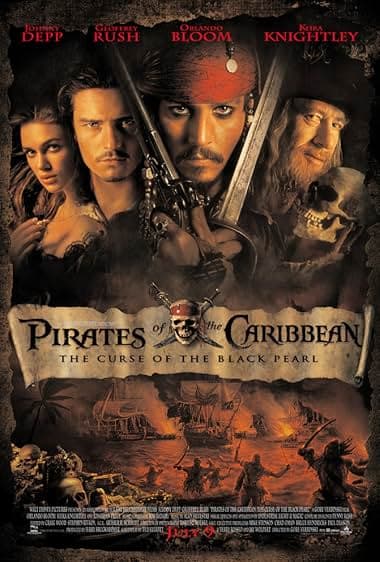
Pirates of the Caribbean: The Curse of the Black Pearl
Treasure, a curse and one very particular swagger of a captain.
Feature presentation
There are summer blockbusters, and then there’s the thing that makes everyone at the seaside arcade stop what they’re doing and agree on a new favourite pirate. Gore Verbinski’s swashbuckling romp sets a simple engine in motion—a kidnapped governor’s daughter, an undead crew and a very particular man who wants his ship back—and rides it for 143 minutes of clashing loyalties, cursed gold and theatrical showdowns. If you last saw it between school holidays and flip-phones, it’s worth the revisit.
THE MOVIE
Captain Jack Sparrow is still the reason this movie works
Pirates of the Caribbean: The Curse of the Black Pearl is the sort of movie that arrives fully formed: a straightforward adventure quest with a supernatural sting. It follows Captain Jack Sparrow and blacksmith Will Turner as they pursue the cursed crew of the Black Pearl to rescue Elizabeth Swann, but that neat sentence understates the personality the film brings to those beats.
The story kicks off with the Black Pearl’s raid on Port Royal and the kidnapping of Elizabeth Swann by Captain Barbossa and his crew, and from that moment the film keeps one eye on its treasure map and the other on its characters’ shifting loyalties. Jack Sparrow’s more immediate, selfish aim—reclaiming the Black Pearl and reestablishing himself as its captain—gives the plot a mischievous centre of gravity.
Directed by Gore Verbinski and running at 143 minutes, the film mixes swashbuckling action, fantasy curse mechanics and a leaning-towards-comedy energy that made the premise feel fresh in 2003 and still gives it a particular momentum now.
THE SETUP
The idea that sets Pirates of the Caribbean: The Curse of the Black Pearl in motion
The film’s premise is clean and theatrical enough to map onto a ride: stolen Aztec gold, a supernatural punishment and the odd detail that moonlight reveals the true nature of the curse. That mix—treasure with teeth—lets the movie move between chase, rescue and occult complication without getting lost.
At the story’s centre are two drivers: the rescue of Elizabeth Swann and the pursuit of a ship, the Black Pearl. Those objectives overlap and clash, which keeps scenes from being mere obstacles and makes every skirmish feel like it matters to more than one character.
The curse itself is a neat plot mechanic. The cursed cache renders Barbossa’s crew undead under moonlight, and the story hinges on a required blood sacrifice to lift it. It’s serviceable, tangible folklore: greed carries a literal penalty, and that rule shapes choices throughout the film.
All of this sits in a screenplay shaped by Ted Elliott and Terry Rossio under Gore Verbinski’s direction, which gives the setup a steady sense of motion—an adventure that’s conscious of its theatrical pleasures.
THE CHARACTER
Why Captain Jack Sparrow matters
At the simplest level: Johnny Depp plays Captain Jack Sparrow. That’s a fact, but it’s also the fulcrum the whole film swings around. Jack is written as a figure who complicates every plan: a pirate by trade, a performer by inclination.
Because the movie repeatedly asks who gets to choose freedom over duty—who lives by a private code and who answers to the crown—Jack matters as the living, flamboyant counterpoint to the respectable world of Port Royal. He’s a problem for the establishment and a possibility for anyone who envies a life at sea.
The film uses him to test loyalties and identities. Even when the central quest could have been played as a straight treasure-hunt, Jack’s presence keeps it theatrical: the film is interested in what people will perform to get what they want, and Jack gives that idea shape.
And his story doesn’t stop at this film—he’s a character whose life continues in the sequels, which the film’s structure leaves room for.
UNDER THE SURFACE
Pirates of the Caribbean: The Curse of the Black Pearl has more on its mind than the plot suggests
The movie wears its themes lightly, which is why they feel like surprises rather than lectures. Greed and its supernatural punishment are literal on-screen: the Aztec gold carries a curse, and the story continually reminds us that avarice comes with a cost.
That punishment stacks up against the film’s question of freedom versus social duty. Port Royal is a place of rules and rank; the sea offers escape. Will Turner and Elizabeth Swann both orbit that conflict, and Jack acts as the visible alternative to a life tied to duty.
Identity and performance ripple through the film. Characters adopt faces, play parts and hide motives; the idea that identity can be a chosen performance matters to both plot and tone.
Underpinning it all is a quieter strand about redemption and loyalty. Whether a character redeems themselves or doubles down on self-interest shapes how the curse reads—not merely as spectacle, but as a moral ledger the story keeps balanced.
THE FILMMAKING
How Pirates of the Caribbean: The Curse of the Black Pearl was put together
The film’s production leans on physical craft to make its world convincing. Production design and period-styled sets were used to create Port Royal and ship interiors; the crew even built a Port Royal fort on a bluff at Palos Verdes, California, and mixed that with location work in St. Vincent and the Grenadines.
Credits matter here because they show the kind of team involved: Dariusz Wolski is listed as cinematographer and Brian Morris as production designer, with a trio of film editors attached to the project. Those names remind you this was assembled as a serious studio adventure, not a casual pastiche.
What comes across on screen—without getting bogged down in technical jargon—is a film that favours tangible, constructed environments. That choice helps the supernatural elements feel embedded in a lived-in world rather than simply overlaid on it.
Put another way: the film looks and feels like a place you could step into, because the filmmakers built one.
PRACTICAL EFFECTS
The effects work that gives Pirates of the Caribbean: The Curse of the Black Pearl its physical personality
The cursed crew’s moonlit skeletal transformations are a clear digital effect—and the film’s principal digital visual effects were provided by Industrial Light & Magic, with John Knoll credited among the visual-effects supervisors. That sequence gives the curse its undeniable, eerie teeth.
But the production didn’t rely solely on CGI. It combined practical sets and stunt work with digital effects rather than treating everything as a digital painting. The mix allows set-piece fights and shipboard moments to land with a physical weight even when the supernatural is involved.
The result is a movie that feels tactile even in its fantasy moments: practical environment and action grounded with digital finishing when the story demands it.
That blend is part of why the film’s supernatural mechanics—like the cursed crew—read as part of the world instead of a separate layer tacked on later.
PURE 00s
Pirates of the Caribbean: The Curse of the Black Pearl could not belong to any other decade
Released in 2003, this was a very early example of the big-studio tentpole that doubled as franchise foundation. The film was a major summer blockbuster that grossed over $650 million worldwide, and that immediate commercial muscle helped turn it into a multi-film enterprise.
It also belongs to that phase of early-2000s cinema when studios were keen to reinvigorate older genres for modern audiences; here the swashbuckler was given blockbuster scale and franchise ambition, which is part of why the film feels like the start of something bigger rather than a one-off throwback.
The production’s Disneyland premiere and overt theme-park origins underline the film’s hybrid identity: it’s both a movie and a grown-up extension of an attraction, built to entertain on a grand scale.
So, while the film is grounded in age-old pirate tropes, it arrived at a moment when Hollywood was ready to spin those tropes into a long commercial life.
THE LEGACY
Why Pirates of the Caribbean: The Curse of the Black Pearl still matters
The film’s immediate legacy is structural: it launched the Pirates of the Caribbean franchise, with sequels beginning with Dead Man’s Chest in 2006. That expansion turned what might have been a one-off into a continuing narrative playground.
On a character level, Johnny Depp’s Jack Sparrow became a persistent pop-culture figure; the role generated multiple major-award nominations for Depp in 2003–2004, which is an explicit marker of how much attention the character attracted at the time.
Beyond sales and nominations, the movie left a clear footprint: it demonstrated that a studio could take a theme-park idea, build a serious production around it and create a character-led engine big enough to sustain more stories.
That combination of franchise potential and a memorable central figure is why the film still turns up in conversations about early-2000s studio cinema.
THE VERDICT
Does Pirates of the Caribbean: The Curse of the Black Pearl still hold up?
Yes—if you want an adventure that balances a solid treasure-retrieval quest with a rescue mission and a rivalry over a ship, this film still delivers the goods. The narrative threads—the raid on Port Royal and Elizabeth Swann’s kidnapping, the Aztec-gold curse that renders Barbossa’s crew undead by moonlight and demands blood to lift it—are straightforward but effective plot mechanics that keep the stakes clear.
Part of what helps is that those plot mechanics are married to recognisable motives: Jack Sparrow’s immediate aim is to reclaim the Black Pearl and reestablish himself as captain, while Barbossa is driven by greed and self-preservation as he seeks to lift the crew’s immortality. That collision—self-interest against other claims of loyalty and duty—gives action scenes a moral push.
Contemporary reviews singled out Jack Sparrow as an original, scene-dominating creation and several critics specifically praised Geoffrey Rush’s Captain Barbossa as a theatrical foil. Combine that character energy with period production design, a mix of practical sets and digital work for the supernatural moments, and the result is a film that’s entertaining on its own terms and built to be revisited.
So if you’re deciding whether to watch it now: come for the curse, stay for the contest over the Black Pearl, and pay attention to the way the film stages greed and freedom as two competing currencies. It’s a rousing opening chapter—big enough to start a franchise and small enough to enjoy as a single, satisfying adventure.
Share this movie
Keep watching
More movies from the 00s

2002
The Pianist
A quiet life unmade by war — and a pianist who refuses to stop listening.
Read the retrospective
→
2006
Blood Diamond
A mercenary, a fisherman and a pink diamond — and a film that still asks who pays for our jewellery.
Read the retrospective
→
2003
Kill Bill: Volume 1
A yellow jumpsuit, a long list of enemies and one woman who refuses to be finished.
Read the retrospective
→