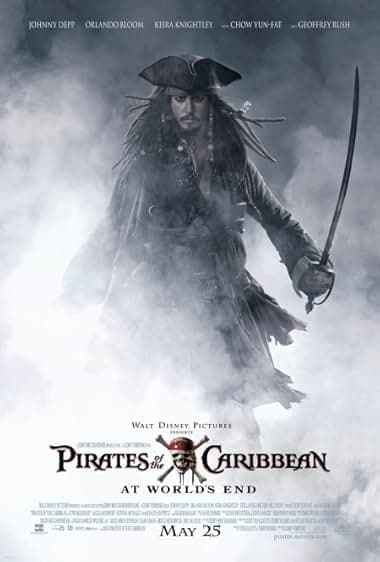
Pirates of the Caribbean: At World's End
Chaos, compass points and Captain Jack: the sea may change, but he still keeps us watching.
Feature presentation
There are two obvious reasons people still talk about Pirates of the Caribbean: At World's End. One is that it keeps turning its sprawling, globe-sized plot around Captain Jack Sparrow — the third film pushes his oddness into outright rescue-mission territory. The other is that Gore Verbinski leaned into spectacle and politics at sea: pirate lords squaring off against corporate power, with everything running to nearly three hours of swashbuckling indecision.
THE MOVIE
Captain Jack Sparrow is still the reason this movie works
If you remember one thing about At World's End it’s probably Jack Sparrow. The third film in the series makes that point literal: the plot spends a lot of its running time pivoting around rescuing him after he becomes marooned in a supernatural realm.
Gore Verbinski keeps the franchise's habit of piling on characters and complications — pirate captains convene, allegiances wobble and the East India Trading Company moves like a bureaucratic tide — but everything often funnels back to one unpredictable focal point.
It’s a big, noisy stew: a near-three-hour action-adventure fantasy that treats piracy as more than costume and cannon-fire, and that stages the clash between freebooting independence and institutional control at sea.
THE SETUP
The idea that sets Pirates of the Caribbean: At World's End in motion
At World's End begins with an idea simple enough to explain in a single sentence: allies rush to retrieve Captain Jack Sparrow from a supernatural realm while pirate captains gather to resist a corporate takeover of the seas.
That rescue — Jack trapped in Davy Jones' Locker — is the engine that gets everyone moving. Will Turner and Elizabeth Swann are among those who fan out to bring him back, and their urgency forces strange alliances and bargaining between captains who are used to betraying one another.
The broader stakes are political as much as personal. The East India Trading Company, represented by a single-minded power, is trying to impose order and property over the oceans; the pirates respond not simply with cannon-fire but with political theatre — a Brethren Court, truces and manoeuvres that look as much like diplomacy as combat.
All of this is a direct continuation of what the series set up in Dead Man's Chest: the Flying Dutchman, old bargains and personal debts carry over, so the film reads as the next chapter in an already crowded story.
THE CHARACTER
Why Captain Jack Sparrow matters
This is Jack Sparrow's franchise in the way a storm is the ocean's: when he disappears, everyone else has to react. The third film makes that structural point explicit — his stranding in a supernatural realm turns him into the goal around which alliances and betrayals orbit.
That centrality is practical as well as dramatic. A rescue mission is a tidy mechanic: it sends familiar faces into unfamiliar settings, and it asks older loyalties to be re-evaluated under pressure. In At World's End, Jack's absence forces other characters to reveal what they are willing to do for a man who has never exactly repaid a single favour with conventional gratitude.
The film's writing credits underline how many hands shape those choices: the screenplay and character credits list a team of writers, which helps explain the movie’s appetite for crowd scenes, competing agendas and theatrical declarations of pirate law.
And, yes, the cast comes back to do the heavy lifting — returning principals re-enter the fray alongside a few notable additions — so Jack remains the pivot even when the camera spins away to other captains and councils.
THE PERFORMANCE
Why Johnny Depp's performance matters
Contemporary coverage made one thing clear: Johnny Depp’s Jack Sparrow continued to dominate discussion of the film. Reviews and aggregators singled the role out as the central performance around which commentary clustered.
That isn’t to reduce every scene to Depp’s pockets of eccentricity, but it does explain why the rest of the movie is often read through Jack’s behaviour and fate — the rescue plot exists because audiences and characters alike treat him as uniquely worth saving.
So when the film takes narrative detours — into pirate courts, into supernatural bargains — they still read as variations on the question: what will become of Jack, and who will bend themselves to retrieve him?
UNDER THE SURFACE
Pirates of the Caribbean: At World's End has more on its mind than the plot suggests
Under the cannon and the corsairs, the film stages a brute conversation about freedom. Piracy here isn’t glamour alone; it’s a way of life sitting in direct opposition to the East India Trading Company's bid to make the seas a managed, taxable resource.
Leadership threads through that argument. Several characters are forced to decide whether they will take up duty or run from it, and those decisions are costly — leadership in this movie often demands sacrifice and the surrender of personal desire to a larger role.
Loyalty is slippery. Alliances shift, and betrayals are used like tools rather than moral indictments; the plot runs on characters recalculating whom they can trust and when a betrayal is merely strategic theatre.
Finally, the supernatural hangs over every choice. The Flying Dutchman, Davy Jones and other mythic elements make promises and levy consequences; the film treats those bargains as another kind of governance, ancient and inexorable, that sits alongside the modern greed of corporate power.
THE FILMMAKING
How Pirates of the Caribbean: At World's End was put together
The film lists an experienced crew in its core credits: a named director of photography, a production designer and a costume lead, which shows how much of the movie’s identity was built intentionally by craft departments.
It was also shot with Panavision cameras and lenses, and production notes point to large physical rigs being used on set. Those choices matter because they reveal how the film combined heavy-duty physical staging with the visual effects that the series depends on.
In short: Verbinski and his team treated the movie as a technical project as much as a storytelling one — a big action-adventure that needed substantial hardware to make shipboard sequences and large crowd set-pieces work.
PRACTICAL EFFECTS
The effects work that gives Pirates of the Caribbean: At World's End its physical personality
The production used full-sized ship elements and gimbals on set to stage sea and shipboard action before any digital work was added, so many big moments began as physical stunts rather than purely computer-generated sequences.
Credits and production documentation also list named gimbal foremen and special-effects shop personnel, which is a small, useful detail: it shows that practical rigging departments were part of the movie's recorded craft, not just an afterthought.
PURE 00s
Pirates of the Caribbean: At World's End could not belong to any other decade
At World's End arrived squarely in the 00s era of big studio tentpoles and planned multi-film strategies: it was produced and released as part of a back-to-back shooting plan with Dead Man's Chest, the kind of scheduling that speaks to franchise-driven production.
Released in 2007, the film epitomises the decade’s appetite for expansive franchise storytelling — sequels that pick up threads immediately rather than resetting the board.
It also played like a commercial event. The movie finished the year as the top global box-office earner for 2007, which is itself a useful period note: audiences were buying into long-form, globe-spanning adventures with frequent returns to established characters.
WATCHING IT NOW
What has aged — and what hasn't
The movie is deliberately the next chapter of a continuing story: it carries forward plotlines and relationships from Dead Man's Chest, so a modern viewing that skips the previous film will feel like joining halfway through a long argument.
That interdependence is baked into the screenplay and the character credits, which list multiple writers and contributors. The result is a very specifically continued narrative — satisfying if you enjoy long arcs, occasionally frustrating if you want a completely self-contained third act.
So what ages well is the sequence of relationships and the payoff for viewers who stayed with the story; what ages less well is the movie’s appetite for complication that assumes you already know the set of rules and debts that brought the characters to this point.
THE LEGACY
Why Pirates of the Caribbean: At World's End still matters
Part of the film’s afterlife is plain and public: it was among the highest-grossing releases of 2007 and finished the year as the world's top earner. That scale matters because it kept the franchise financially viable.
It also won industry attention: the movie received major nominations for visual effects and makeup at the Academy Awards and collected several Visual Effects Society nominations, which speaks to the level of craft invested in its big, otherworldly moments.
Finally, as the formal third film in the original run, its production and box-office performance helped shape the franchise’s future expansion, turning what began as a theme-park-inspired experiment into a long-running studio property.
THE VERDICT
Does Pirates of the Caribbean: At World's End still hold up?
Yes — with caveats. If you enjoy long, multi-threaded studio adventures and you’re invested in the Will-Elizabeth-Jack axis, there’s still a lot to enjoy: the film keeps returning to the rescue of Jack Sparrow as its emotional north, and it leans fully into the piracy-versus-corporation conflict for grand set pieces and political theatre.
The movie rewards patience; it’s the sort of third instalment that assumes prior knowledge and keeps paying forward the debts of earlier plotlines, especially the Flying Dutchman business and Will Turner’s entanglement with it.
For new viewers, the running time and tangled alliances can feel like overkill — but for fans of the trilogy’s tone the film supplies spectacle, myth and decisive payoffs, and it does so under Gore Verbinski’s steady franchise hand.
So if you want a tidy, standalone pirate yarn, this isn’t it. If you want a sprawling, noisy, slightly overstuffed chapter that treats Jack Sparrow as the axis of a much larger sea of loyalties, then yes: it still holds together well enough to be worth watching.
Share this movie
Keep watching
More movies from the 00s

2002
The Pianist
A quiet life unmade by war — and a pianist who refuses to stop listening.
Read the retrospective
→
2006
Blood Diamond
A mercenary, a fisherman and a pink diamond — and a film that still asks who pays for our jewellery.
Read the retrospective
→
2003
Kill Bill: Volume 1
A yellow jumpsuit, a long list of enemies and one woman who refuses to be finished.
Read the retrospective
→