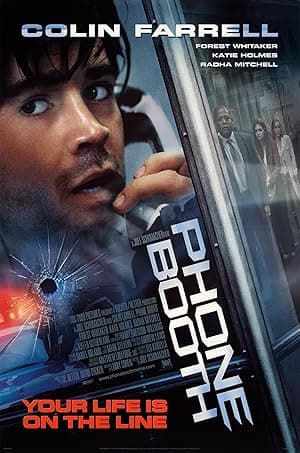
Phone Booth
A confined thriller about confession, public shame and one man’s awful timing.
Feature presentation
Phone Booth pins a cocky New York publicist in a literal phone box and watches what happens when his private life is dragged into the street. It’s a compact, almost theatrical thriller that makes its main character—the lying, ambitious Stu—do the heavy lifting. Sixty-plus minutes of moral cross-examination, and not a wasted one.
THE MOVIE
Stuart "Stu" Shepard is still the reason this movie works
There’s a neat cruelty to Phone Booth’s setup: a brazen publicist who thinks he’s untouchable ends up in the last public phone booth in Midtown and finds himself utterly exposed. The film keeps its gaze tight on that humiliation—Stu’s private decisions are suddenly everybody’s business.
That exposure is the engine. An unseen caller sits at the other end of the line and forces Stu to confess, threatening that if he hangs up or bolts he’ll be shot. The moral test—confession, atonement, accountability—turns what could be a gimmick into a relentless piece of pressure.
Joel Schumacher directs this compact psychological thriller, and Colin Farrell is Stu Shepard at the centre of it all; Kiefer Sutherland supplies the caller’s voice. At 81 minutes, Phone Booth doesn’t waste time. It asks a simple question and watches Stu squirm until he answers.
THE SETUP
The idea that sets Phone Booth in motion
Phone Booth runs almost in real time: what you see on screen unfolds in the same tight window of time that Stu endures on the pavement. That real-time rhythm keeps the tension taut—there’s no room for the audience’s attention to drift.
The other structural neatness is the way the street itself becomes part of the story. Police, news crews and curious bystanders pile in quickly, so Stu’s crisis becomes public theatre. His private misdeeds stop being a secret and are turned into a spectacle he can’t escape.
The antagonist is unusual: we rarely see him. The unseen caller controls the scene with voice alone, and that design choice keeps the focus on Stu’s reactions and choices rather than on a traditional physical villain.
A bit of production context shadows the premise: the film’s release and comparisons to other sniper/hostage stories made it feel very much of its moment, and the stripped-back concept—one man, one phone, an escalating moral test—does the heavy lifting.
THE CHARACTER
Why Stuart "Stu" Shepard matters
Stu Shepard is written as the kind of publicist who sells other people’s images for a living—ambitious, smooth-talking and not above lying to keep his life tidy. That makes him the perfect subject for a story about being forced to own up.
The plot pins him into a tiny, public place and doesn’t let him hide. The dramatic appeal of Stu isn’t that he’s inherently monstrous; it’s that he’s ordinary enough to be recognisable—and therefore easier to shame, test and, possibly, redeem.
Colin Farrell plays Stu, and the casting leans into the idea that this is a character on the edge of something—someone whose career depends on appearances, whose mistakes are private until the street makes them not. It’s the clash between image and truth that keeps Stu interesting.
In short: the movie works because Stu matters. Take him away and you’ve still got the set piece, but you don’t have the reason to care who tells the truth.
THE PERFORMANCE
Why Colin Farrell's performance matters
Contemporary reviews singled Farrell out as the film’s central actor and noted that interest in his portrayal grows as the movie progresses. In a picture this small and focused, the lead’s ability to hold attention is everything.
Because the camera rarely leaves the immediate crisis, the performance’s job is straightforward: keep us watching Stu long enough to feel the pressure. Farrell’s turn is the mechanism that allows the premise to feel urgent rather than gimmicky.
That progressive drawing-in—where the viewer’s interest deepens as Stu’s situation worsens—is precisely what critics were referring to: the part is built so that the performance must carry mounting tension.
Put simply, the film depends on its central performance to make the moral ordeal feel like something happening to a person, not just to a concept.
UNDER THE SURFACE
Phone Booth has more on its mind than the plot suggests
On the surface it’s a hostage thriller; underneath it’s a drama about forced honesty. The caller’s demand for confession turns Stu’s private lies into a moral experiment—are we willing to admit wrongdoing when it costs us everything?
The film stages a collision between private life and public scrutiny. As the police and media gather, Stu’s personal failings are no longer contained; they’re broadcast to anyone watching the street scene unfold.
There’s also a vigilante streak to the story: the caller acts as an extrajudicial judge, testing people’s willingness to accept responsibility. That raises awkward questions about who gets to decide guilt and what justice looks like outside the law.
And lurking under it all is a city-specific fear of being watched: the sniper-as-spectator idea plays on anxieties about surveillance and the loss of privacy in an urban environment.
THE FILMMAKING
How Phone Booth was put together
Phone Booth was shot under a genuinely compressed schedule: roughly ten days of principal photography with a couple of pickup days. That kind of haste forces a production to be lean and decisive.
To handle the constraints, the crew filmed with multiple cameras at once and worked ‘French hours’—a way of structuring the shoot to keep energy up while moving fast. The result is a film that feels immediate; there’s no indulgence.
Those practical choices feed the movie’s identity. The production’s speed matches the story’s urgency: brief, sharp scenes that rarely linger unless the drama demands it.
So the film’s tight runtime and the way it captures escalating panic aren’t just storytelling choices; they’re embedded in how the movie was physically made.
PURE 00s
Phone Booth could not belong to any other decade
Phone Booth arrived at a particular moment. It premiered at Toronto in 2002 and its U.S. release was pushed to April 2003 after the October 2002 Beltway sniper attacks—an awkward, direct connection between the film’s premise and real-world events that made its timing feel charged.
It’s also part of an early-2000s wave of compact, high-concept thrillers that used tight settings and real-time plotting to squeeze tension from very small ideas. That minimalism was a recognisable strand of the era’s cinema.
There’s another small but telling detail: the story depends on a public pay phone—already on the way out because of mobile phones. That cultural moment, when pay phones still mattered, is baked into the premise and makes the film feel of its time.
Finally, the movie’s origin story—Larry Cohen’s phone-booth idea having been floated decades earlier—ties the film to a longer tradition even as it wears an early-2000s coat of paint.
THE LEGACY
Why Phone Booth still matters
For a modestly budgeted film, Phone Booth did well commercially: reported box-office against its production budget shows it earned many times what it cost to make. That success helped the film stay visible beyond its initial run.
Part of its afterlife comes from the screenplay’s backstory: Larry Cohen carried the phone-booth idea for years, even discussing it with Alfred Hitchcock some decades earlier. That origin gives the film a certain storytelling pedigree.
The movie is also a staple in conversations about single-location cinema; it often appears in retrospectives and lists that examine how much strain you can put on a single setting and still tell a gripping story.
There’s even a loose offshoot: an unauthorised Telugu film has been noted in reference listings as related to Phone Booth, which shows the premise travelled in ways the film’s makers perhaps didn’t anticipate.
THE VERDICT
Does Phone Booth still hold up?
Yes—if you go in expecting a tight, idea-driven thriller rather than a sprawling action picture. The film’s real-time pressure, the public unfolding of Stu’s private mistakes and the caller’s insistence on confession give it a clear, relentless shape.
Colin Farrell’s Stu is the movie’s linchpin: the story asks him to be watchable while under interrogation, and contemporary notices picked up on how interest in his portrayal builds as the stakes rise. Without that pull, the premise would feel thin.
The film’s length helps. At 81 minutes it keeps the moral experiment sharp: police and media converge, Stu is forced to account for his infidelity and lies, and the caller’s pattern of prior ‘tests’ adds a steady escalation that makes the dilemma credible.
So should you watch it today? If you like compact psychological thrillers that trade spectacle for moral pressure—and if you’re curious to see a story where public exposure is the punishment—Phone Booth still delivers. It’s a neat, neat little trap movie: short, tight and pointed enough to leave you thinking about what you’d admit on the line.
Share this movie
Keep watching
More movies from the 00s

2002
The Pianist
A quiet life unmade by war — and a pianist who refuses to stop listening.
Read the retrospective
→
2006
Blood Diamond
A mercenary, a fisherman and a pink diamond — and a film that still asks who pays for our jewellery.
Read the retrospective
→
2003
Kill Bill: Volume 1
A yellow jumpsuit, a long list of enemies and one woman who refuses to be finished.
Read the retrospective
→