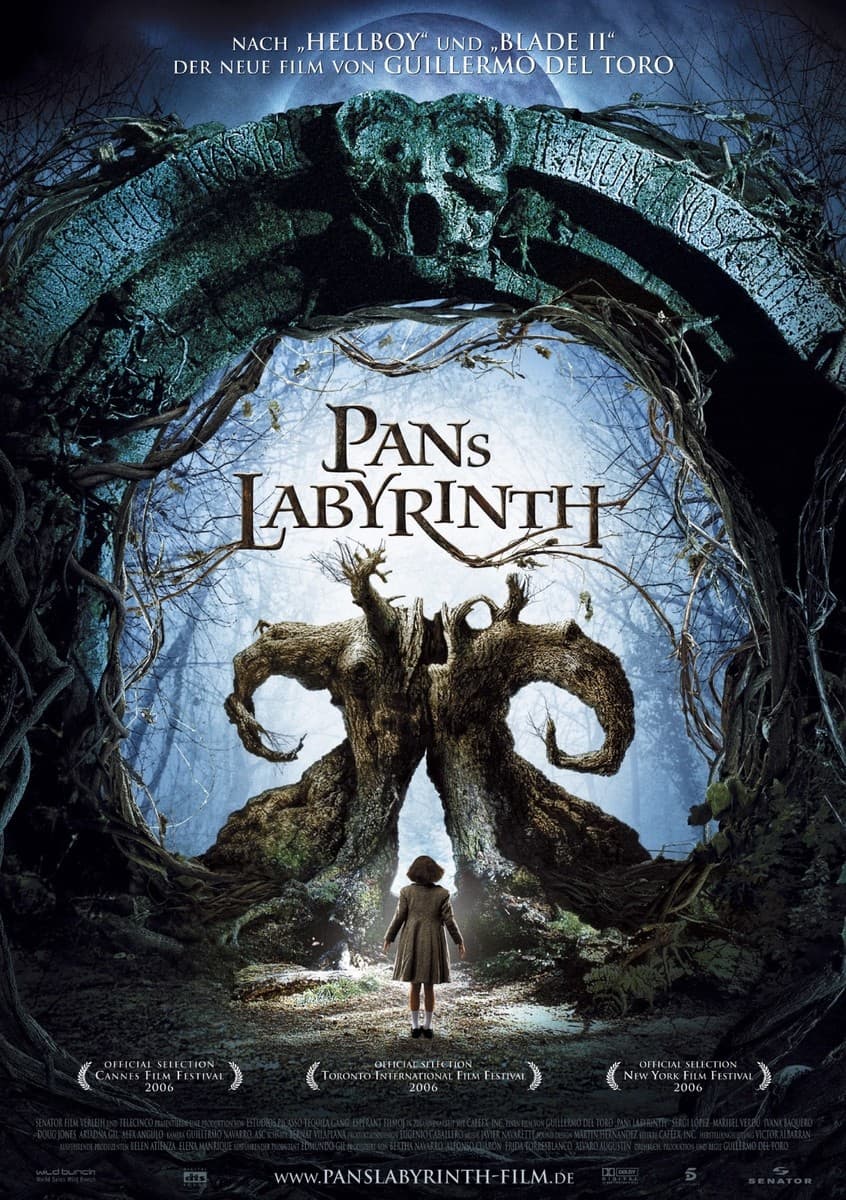
Feature presentation
You remember the girl with the book and the secret world — Ofelia, who walks between a grim military outpost and a mossy labyrinth where a faun hands out impossible tasks. Guillermo del Toro made a film that never lets the fairy tale and the repression breathe without bumping into one another. That collision is exactly why Pan's Labyrinth still pulls you in.
THE MOVIE
Ofelia is still the reason this movie works
Pan's Labyrinth sets two worlds side by side: a hard, post–Civil War reality and an interleaved fantasy that grows up out of an overgrown stone maze. The film keeps bouncing between the two until you stop asking which is 'real' and start asking why Ofelia needs one at all.
At the centre is a young girl newly arrived at her stepfather’s rural military outpost. She meets a faun who tells her she is a lost princess and gives her three tasks — a tidy structure that turns the fantasy episodes into a series of choices that echo back into the real world.
That structure matters because Ofelia isn’t just looking for adventure; she’s trying to escape, make herself known and reconcile loss. Guillermo del Toro directs the whole thing with an eye for the ugly and the strange, and the film’s visual design is still the thing people point to when they talk about it.
THE SETUP
The idea that sets Pan's Labyrinth in motion
At its simplest, the film pairs a small, repeatable fantasy mechanic with a brutal historical situation. Ofelia arrives at her new home with her pregnant mother and is told by a faun that she must complete three tasks to reclaim a lost kingdom.
That three-task pattern does useful work: it gives the fantasy sequences clear goals and a rhythm, so each made-up trial has a counterpoint in the everyday pressures Ofelia faces at the outpost.
Meanwhile the movie never lets the realism become background wallpaper. The story continually cuts back to life in 1944 Spain, where military authority and repression are the practical facts that make Ofelia’s choices urgent.
So the setup works because it balances a child’s structured quests against an adult world where consequences are immediate and violent.
THE CHARACTER
Why Ofelia matters
Ofelia is not a passive 'child in peril'. She has agency born of a desperate need to escape and to make sense of her loss, and that need turns the faun’s tests into moral forks rather than mere puzzles.
Her relationship with the faun frames the entire film: the supernatural guide hands her tasks, but the meaning of those tasks — whether they’re redemptive, delusional or morally fraught — is deliberately ambiguous.
Around her, secondary figures quietly resist: Doctor Ferreiro and others provide a practical, dangerous opposition to the stepfather’s regime. Their quiet defiance runs parallel to Ofelia’s inward bravery; two kinds of resistance, one political and the other imaginative.
Ivana Baquero’s casting puts a clear focal point on the story: the film is structured around Ofelia’s decisions and how they ricochet through the lives of those around her.
THE PERFORMANCE
Why Ivana Baquero's performance matters
All the structural choices in the film — the tasks, the cuts between worlds, the political backdrop — depend on the audience caring about Ofelia. The fact that Ivana Baquero received industry recognition for the role suggests she provided that anchor.
Baquero won the Spanish Goya Award for Best New Actress, a clear sign the film’s centre had the weight it required.
That recognition matters because the story asks a lot of its young lead: she bears the film’s moral decisions on her shoulders, and the awards response shows the industry noticed that responsibility.
Put bluntly: the whole conceit only works if you believe in Ofelia, and the Goya suggests viewers and critics did.
UNDER THE SURFACE
Pan's Labyrinth has more on its mind than the plot suggests
On the surface it’s a dark fairy tale. Underneath it’s a film about growing up in the teeth of violence — loss of innocence played against an environment that punishes small acts of defiance.
Anti-authoritarianism is baked into the setting: the militarised outpost, the repression of guerrillas and the steady pressure from the stepfather make the political stakes inescapable.
Fantasy and reality keep elbowing one another. The film uses the faun’s tasks to translate internal moral choices into external, often dangerous actions: the lovely trick is how those invented trials force real decisions in the adult world.
There’s also a braided concern with sacrifice and parenthood: the mother’s pregnancy creates urgent, tangible stakes that intersect with Ofelia’s quests, so the film doesn’t let the fairy-tale elements float free of consequence.
THE FILMMAKING
How Pan's Labyrinth was put together
A lot of the film’s pull comes from how deliberately it’s put together on a craft level. Guillermo Navarro’s cinematography was singled out with an Academy Award, and that matters because the camera work helps the two worlds feel contiguous rather than disjointed.
Production design, led by Eugenio Caballero and Pilar Revuelta, also won significant recognition. The sets and decoration make the labyrinth and the military outpost feel like places with their own histories.
Credits like Javier Navarrete on score and Bernat Vilaplana on editing complete a team effort: the film’s shape is an assembly of distinct departments pulling in the same tonal direction.
It’s no accident that critics and retrospectives keep returning to the film’s visual design and production craft as primary strengths; those elements are the scaffolding that holds the story’s strange emotional balance.
PRACTICAL EFFECTS
The effects work that gives Pan's Labyrinth its physical personality
Creature work is physical and specific here: the make-up and prosthetic teams were a major component of the film’s personality and won the Academy Award for Best Makeup.
Those creatures were realised by combining heavy prosthetics and full-body suits with live performers. Doug Jones, for example, was the physical performer in the faun and Pale Man roles.
The production deliberately matched suit performances with post-production voice work and dubbing for creature voices, so the monsters feel both tactile and oddly dislocated.
That blend — hands-on creature work plus careful post-production — is why the film’s strange figures register as immediate and unsettling instead of digital abstraction.
PURE 00s
Pan's Labyrinth could not belong to any other decade
Premiering at Cannes in 2006, Pan's Labyrinth arrived during a mid-2000s moment when internationally co-produced, director-driven fantasies were finding crossover critical attention.
That festival launch and the way the film straddled art-house pedigree and genre appetite placed it neatly in a period where audiences and critics were more willing to take risks on peculiar, adult-leaning fairy tales.
Its release pattern — an autumn opening in Spain followed by staggered North American dates — is typical of how serious international films sought both critical space and commercial reach in that era.
So the movie feels of its moment because it participates in a particular 2000s conversation about genre, authorship and international cinema rather than because of any superficial trendiness.
THE LEGACY
Why Pan's Labyrinth still matters
On a practical level the film left a paper trail: at the 79th Academy Awards it won three Oscars and received multiple major international nominations, which made it Guillermo del Toro’s most widely honoured film to that date.
It also earned BAFTA recognition, including Best Film Not in the English Language, helping solidify the director’s international reputation.
Those awards matter because they translated a strange, Spanish-language dark fantasy into a film people outside its initial audiences paid attention to.
Beyond the trophies, the characters and the very specific moral collisions — Ofelia’s tests versus Captain Vidal’s brutality, Mercedes’ quiet resistance — are the bits that keep the film in conversation.
THE VERDICT
Does Pan's Labyrinth still hold up?
Yes. The film stands because its central conceit — a child who divides her life between a brutal, militarised reality and a set of structured fairy-tale trials — remains narratively and emotionally precise. That collision is the engine of the whole film.
Ofelia’s quests (the three-task mechanic) tie the fantasy to practical choices back at the outpost, and those stakes are sharpened by the mother’s failing health and the escalating repression led by Captain Vidal. It’s a simple connective trick, but it’s brilliantly, stubbornly effective.
On top of the story, the craftsmanship is real: the cinematography, production design and makeup were recognised at the Academy Awards, and that craft keeps the film feeling tactile and purposeful rather than merely ornamental.
So if you’ve not seen it, or you’re wondering whether it’s worth revisiting, watch it for Ofelia — and for the way the film refuses to let a child’s imagination float away from politics. It’s a fairy tale that remembers where it came from.
Share this movie
Keep watching
More movies from the 00s
2002
The Pianist
A quiet life unmade by war — and a pianist who refuses to stop listening.
Read the retrospective
→
2006
Blood Diamond
A mercenary, a fisherman and a pink diamond — and a film that still asks who pays for our jewellery.
Read the retrospective
→
2003
Kill Bill: Volume 1
A yellow jumpsuit, a long list of enemies and one woman who refuses to be finished.
Read the retrospective
→