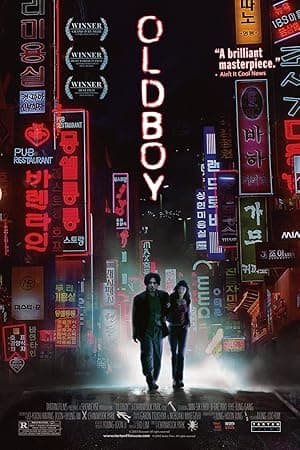
Oldboy
Fifteen years locked away, one man with a clock and a grudge — Oldboy still refuses to let you look away.
Feature presentation
There’s a simple, savage hook at the centre of Park Chan-wook’s Oldboy: a salaryman imprisoned for years, released with a countdown and forced to chase the person who ruined his life. That premise — revenge as a puzzle that keeps getting more personal — is why the film keeps drawing people back. Oh Dae-su’s hunt is the movie; everything else is the clever, ugly machinery that makes it compulsive.
THE MOVIE
Oh Dae-su is still the reason this movie works
You can sum Oldboy up in one image and still miss the point: a man waking up after years in a private cell, given only a limited time to find the shadow who put him there. But Oh Dae-su isn’t a prop for a twist. He’s the whole engine — a guy stripped of life, then pushed into a hunt that’s as much about answers as it is about revenge.
Park Chan-wook built a film that starts with confinement and turns the search for a captor into a personal odyssey. The setup — a salaryman held without explanation for fifteen years and then abruptly released — is tidy enough to explain at a pub table, but messy enough to pull in thriller, drama and action instincts and refuse easy sympathy.
That mixture of mystery, moral messiness and sheer pressure is Oldboy’s personality. It runs for two hours, and it never stops making you weigh what you’d do with the information, or how far a person can go when everything they know has been taken from them.
THE SETUP
The idea that sets Oldboy in motion
Don’t let the twists distract you from the central prop: Oh Dae-su is released and handed a deadline. He has to find who kept him locked up and why. That clock changes everything — it turns investigation into obsession and forces the story to move at the speed of vengeance.
Rather than a cop procedural, Oldboy plays like a mystery-quest where each discovery ramps up the moral stakes. Clues arrive through people who link Dae-su’s present with a past he barely recognises, and every revelation tightens the noose on both him and the film’s quieter questions.
Because the plot is a personal hunt and not a police case, the film keeps retreating from easy answers and offering complications instead. That’s why the setup works: the central rule — find the captor, learn the motive — is simple, but what it uncovers is anything but.
So the movie’s momentum isn’t just about solving a crime. It’s about discovery as punishment and the way knowing something can become another kind of imprisonment.
THE CHARACTER
Why Oh Dae-su matters
Oh Dae-su is memorable because the film refuses to let him be just a victim. Fifteen years in a private cell removes the everyday trappings of identity, and the movie makes the aftermath the point: what does a man rebuild when his past has been taken and his future is a deadline?
He’s driven by answers and revenge — simple motives that grow more complicated as the story folds in people from his life and the life he once led. Those supporting characters are not just props; they are the threads that connect Dae-su’s present to actions he may have already half-forgotten.
Mi-do’s growing closeness to Dae-su matters because it entangles his private hunt with intimacy; she becomes part of the puzzle rather than an optional love interest. And across the film, the antagonist’s scheme is explicitly tied to events in Dae-su’s past, so every revelation lands as both shock and reckoning.
Finally, the fact that the role is anchored in a single performer matters: the story asks us to follow a man who is alternately broken, furious and bewildered. The character’s moral weight — his ability to force the audience into an uncomfortable position — is why Oldboy keeps conversations going long after the credits.
THE PERFORMANCE
Why Choi Min-sik's performance matters
Choi Min-sik is the face and voice through which Oldboy asks its hardest questions. The role sits at the centre of everything the film wants to do: to unsettle, to demand answers and to force moral calculation.
Whatever else you say about the movie, his work was recognised at home: he received several major Korean Best Actor awards after Oldboy’s release. That national recognition underlines how central that single performance is to the film’s ability to carry weight.
Put simply: the movie depends on one actor convincing you he’s been transformed by confinement and then convincing you to keep following him as he seeks vengeance.
For viewers approaching Oldboy now, Choi’s casting is a reminder that the film’s intensity springs from its human centre as much as from its ideas.
UNDER THE SURFACE
Oldboy has more on its mind than the plot suggests
On the surface Oldboy is a revenge thriller. Pull the surface back and the film starts to look like a study of what revenge does to memory and identity — how punishment and secrecy can reshape a life until the self is hard to recognise.
Memory is not just a device for plot twists here; it’s the currency of guilt and the thing that links captor and captive. The story’s revelations are never merely ‘‘who did it?’’ but ‘‘what did you do, and how will you live after knowing?’’
Confinement operates on two levels: the obvious physical captivity and the subtler psychological imprisonment that comes from being defined by an act or by not knowing. Those states push the characters toward decisions that feel inevitable and awful at the same time.
And running through all of it is the moral question of revenge — its lure, its costs and the way it insists on more than retribution. The film refuses a neat moral comfortable for the audience; it prefers complexity and consequence.
THE FILMMAKING
How Oldboy was put together
Oldboy’s look and rhythm come from choices behind the camera as much as in front of it. The film credits Chung Chung-hoon as cinematographer and Kim Sang-bum as editor — names that anchor the movie’s visual and temporal shape.
That pair’s contribution helps the film hold together as it swings between compressed, claustrophobic moments and broader, more kinetic sequences. The film’s ability to move from private interior crises to scenes that feel almost ritualistic is a product of how it was shot and cut.
Park Chan-wook’s direction trusts these collaborators to carry the film’s tonal shifts. The result is a movie that feels deliberate even when it’s hurtling toward a revelation.
Mentioning the crew is not a footnote: their work is part of why Oldboy remains a distinct experience rather than just another revenge story.
PRACTICAL EFFECTS
The effects work that gives Oldboy its physical personality
When Oldboy turns violent it tends to do so in single, extended bursts rather than quick, chopped edits. That approach meant the action sequences — most famously the hallway hammer fight — relied on choreography and practical stunt performance carried out in long takes.
Those long-take set pieces do more than thrill; they force the viewer to stay with the blows and the bruises in a way that edited, rapid-cut violence often doesn’t. It’s a physical strategy that keeps the consequences visible, obvious and uncomfortable.
Because the film emphasises actual stunt performance and extended takes, the action feels anchored in bodies and spaces rather than in montage. That makes the fights register as events you watch rather than graphic fantasies you skim past.
In short: the movie’s physical personality owes a good deal to the decision to stage violence as continuous, hard-earned movement.
PURE 00s
Oldboy could not belong to any other decade
Oldboy arrived in 2003 at a moment when South Korean genre cinema was increasingly visible overseas, and it helped make Park Chan-wook a name beyond national borders. The film’s timing — and the way it mixed arthouse nerve with genre drive — made it hard to ignore.
Its success on the international festival circuit, culminating in the Grand Prix at Cannes, pushed contemporary South Korean films further into global conversations about cinema in the early 2000s.
The film also sits in a clear local conversation: it’s commonly grouped with films immediately before and after it as part of Park’s loose Vengeance Trilogy, a thematic run that made the director’s preoccupations feel like a continuing project across the decade.
So Oldboy feels of its moment because it both emerged from and amplified a growing international curiosity about what South Korean filmmakers were doing in the 00s.
THE LEGACY
Why Oldboy still matters
A big part of Oldboy’s continued visibility is factual: the film won the Grand Prix at Cannes, which significantly raised its international profile and introduced many viewers to Park Chan-wook’s work.
Beyond prizes, the film is frequently discussed in surveys of 2000s world cinema and is commonly described as the director’s international breakthrough — a label that points to how it changed where audiences looked for striking, serious genre work.
Its memorable central characters and the moral complications they carry — from Oh Dae-su’s search to the antagonist’s carefully arranged scheme — are the narrative reasons people return to talk about the film, while later reinterpretations show it continues to be a useful reference point for other filmmakers.
Put simply: Oldboy matters because it made a global conversation open up to certain kinds of bold, uncomfortable storytelling coming out of South Korea in the 2000s.
THE VERDICT
Does Oldboy still hold up?
Yes — but with a rider. Oldboy is not light viewing, and it never promised to be. The central conceit remains arresting: a man abducted and held for fifteen years, released with a ticking clock to find the person who ruined him. That setup still carries a lot of force because the film makes the mystery feel personal rather than procedural.
The movie’s pleasures and shocks come from the way the narrative hinges on uncovering a secret tied to the protagonist’s past and from the escalating personal and moral stakes the investigation produces. If you enjoy stories that make you squirm while you admire the craft, this one still delivers.
There’s also a clear, physical element that keeps Oldboy watchable: the film’s long-take action moments — most famously the corridor fight — and the concentrated use of visual and editorial choices give it a compact, relentless identity. Add in the fact that Choi Min-sik’s central role earned significant national recognition, and you have a movie that still feels built rather than slapped together.
So should you watch it today? If you’re prepared for a thriller that asks uncomfortable questions and doesn’t let you off the hook, yes. Oldboy still forces you to decide not just who deserves punishment, but what happens when punishment is handed to someone who’s already paid in a way only they can understand.
Share this movie
Keep watching
More movies from the 00s

2002
The Pianist
A quiet life unmade by war — and a pianist who refuses to stop listening.
Read the retrospective
→
2006
Blood Diamond
A mercenary, a fisherman and a pink diamond — and a film that still asks who pays for our jewellery.
Read the retrospective
→
2003
Kill Bill: Volume 1
A yellow jumpsuit, a long list of enemies and one woman who refuses to be finished.
Read the retrospective
→