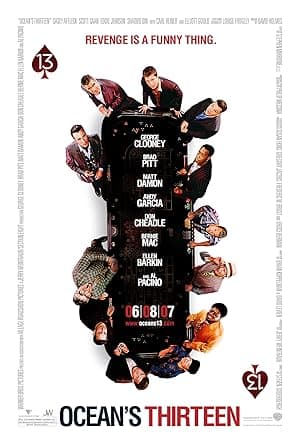
Feature presentation
Ocean's Thirteen is the sort of movie that asks you to enjoy the company as much as the caper. Directed by Steven Soderbergh and fronted by Danny Ocean — the crew’s planner and glue — it stages a gleeful, cooperative take on revenge in a very shiny Las Vegas. If you like clever sabotage wrapped in ensemble charm, this is where the trilogy settles into its groove.
THE MOVIE
Danny Ocean is still the reason this movie works
What keeps Ocean's Thirteen alive in conversation is simple: Danny Ocean brings everyone back together and gives them a very particular reason to be brilliant. When their friend Reuben is swindled and left hospitalized, Ocean becomes the organiser of a theatrical, personal kind of payback.
That payback is deliberately social — not a lone wolf smash-and-grab but a group trick that uses charm, timing and skill to humiliate a casino mogul and protect one of their own. The whole film hangs on that promise: a plan driven by loyalty and orchestrated by a leader the crew trusts.
Steven Soderbergh steers the whole thing, and the familiar faces — George Clooney’s Danny, Brad Pitt’s Rusty, Matt Damon’s Linus among them — make the ensemble feel like a club you’ve been a member of for years. It’s a glossy heist, but its engine is plainly the gang and their code.
THE SETUP
The idea that sets Ocean's Thirteen in motion
You don’t need a blow-by-blow to get the film’s engine: Danny Ocean reunites his crew because Reuben has been cheated and hurt. That personal wound turns a routine con into a vendetta.
The opponents are clear-cut — Willy Bank, the casino owner who double-crosses Reuben, and, for a while, a master thief who complicates the team’s timing. Those one-on-one tensions keep the stakes human rather than abstract.
The movie’s tricks are practical and social: seduction and impersonation, rigging casino machines, planted law enforcement and fiddling with public reputation through televised appearances. It’s a heist that works as theatre as much as theft.
All of this sits within the trilogy’s continuity — Ocean's Thirteen picks up the ensemble’s arc from the earlier films and channels familiar character dynamics into a new, revenge-driven scheme.
THE CHARACTER
Why Danny Ocean matters
Danny Ocean isn’t just the face of the operation; he’s the person the others believe in. He puts the crew together, sets the moral terms — loyalty to Reuben, rules about who gets hurt — and then trusts them to make it work.
That trust is crucial. The film frames the heist as a collective act of retribution rather than a quick-money job, and Danny’s role is to be the planner and guarantor of that promise. His presence is what turns a bunch of skilled operators into a team with a purpose.
Because the stakes are personal, Danny’s leadership keeps the scheme feeling like something more than technical skill: it’s a favour returned, a club protecting one of its own. That’s what makes him stick in the memory.
THE PERFORMANCE
Why George Clooney's performance matters
Contemporary reviews singled out George Clooney’s screen presence as the glue for the whole ensemble. That’s a useful shorthand: the film needs someone who can make a room of stars feel coherently led, and contemporary critics noticed Clooney doing exactly that.
Put simply, Danny Ocean has to read as both strategist and steady hand, the one who calms the chaos and keeps the plan credible. The attention paid by reviewers to Clooney suggests he supplies that ballast.
So when the crew commits to a rather theatrical revenge, Clooney’s part helps the audience accept the gamble: it’s the plan of a leader the team follows.
UNDER THE SURFACE
Ocean's Thirteen has more on its mind than the plot suggests
On paper, it’s a heist. Underneath, it’s about revenge that feels collective rather than solitary. The crew’s retaliation is organised through con artistry; the joy of the film is watching meticulous teamwork deliver payback.
Camaraderie matters here. These are long-standing collaborators who share history and obligations, and the film treats those bonds like currency. Reuben’s injury isn’t a plot itch — it’s the reason the team behaves like friends rather than contractors.
There’s also a running interest in reputation. The plan targets not only the casino’s coffers but its public standing: if you can make the house look foolish, you take away its power. In a town built on image, that’s as effective as stealing money.
Finally, it’s quietly political about advantage. The film enjoys the irony of turning the house’s usual edge on its head; myriads of small, legal-adjacent tricks combine to reverse institutional advantage.
THE FILMMAKING
How Ocean's Thirteen was put together
Steven Soderbergh didn’t hand off the look entirely; he’s credited under a cinematography pseudonym, and the editing credit goes to Stephen Mirrione. That’s a tidy way of saying the director kept a close creative grip on the film’s visual and rhythmic decisions.
What that yields on screen is a movie that feels deliberately composed and paced — not a raw thriller but a polished, measured piece of summer entertainment. The credits reflect a production where the director remained intimately involved in the film’s craft.
PRACTICAL EFFECTS
The effects work that gives Ocean's Thirteen its physical personality
A chunk of the movie’s personality comes from what was built for it. Interiors of The Bank were constructed on studio stages rather than filmed entirely on location, which let the production stage large, controlled sequences.
That control extended to the casino props: card shufflers and slot machines were rigged and used in coordinated on-set sequences as part of the plot. The result is a tactile sense that the crew are manipulating real-world machinery, not just digital stand-ins.
Those choices keep the film feeling grounded even when the plot gets theatrical — the practical setups make the audience believe in the mechanics of the con.
PURE 00s
Ocean's Thirteen could not belong to any other decade
This is very much a mid-2000s creature: a star-led, big-budget ensemble heist that rides the era’s appetite for glossy, clever-as-possible summer pictures. The trilogy identity established earlier in the decade feeds directly into the film’s tone.
Studios in that period loved the safety of an all-star cast and a recognisable director. Ocean's Thirteen wears that model on its sleeve — a franchise instalment that feels like a tentpole but is still guided by an auteur’s hand.
Production choices reinforce that: large built sets, location shoots in Las Vegas and high-profile cameos were all part of the mid-2000s playbook for glossy releases. The film was shot in 2006 and released in 2007, squarely within that moment.
In short, it’s a movie designed to be both comfortable and slick, a product of its industry moment rather than a throwback or an experiment.
WATCHING IT NOW
What has aged — and what hasn't
On a modern viewing the film’s polish and its ensemble’s chemistry still read well. That smoothness — the look, the rhythm and the pleasure of a bunch of professionals doing what they do — is a durable part of the movie’s appeal.
Where it shows its age is in the lighter character work: some critics have pointed out that beyond the central vendetta the characters don’t always get deep development, which can make parts of the 122-minute running time feel decorative rather than essential.
One plot strand that underlines this is the use of televised appearances in the scheme; the film treats public reputation as a manipulable commodity, which still feels logically neat even if it’s presented without heavy moral interrogation.
THE LEGACY
Why Ocean's Thirteen still matters
Part of the film’s afterlife comes from being the trilogy closer: it’s the last time this particular gang of characters takes the stage together in a Soderbergh-directed instalment, and that endpoint gives it a certain finality.
The series’ later expansion — notably a female-led spin-off in Ocean's 8 — shows the franchise’s staying power as a recognizable cinematic brand and marketing lineage.
Industry conversation after 2007 continued to mention potential continuations, which keeps the film in the orbit of franchise talk. In short: it matters because it’s both an ending and a bridge in a series that studios and audiences kept returning to.
THE VERDICT
Does Ocean's Thirteen still hold up?
Yes — with a rider. If you watch for clever, socialised revenge, ensemble comfort and the slick pleasure of a con pulled off in public, it still delivers. The crew reunites to punish Willy Bank after Reuben is cheated and hurt, and the two-part plan (undermine reputation and reverse the casino’s odds) plays like an elegant piece of theatre.
The film frames crime as choreography: rigged machines, impersonations, planted law enforcement and media manipulation all add up to a single aim — to tip the institutional advantage on its head. That conception still reads smart and enjoyable.
Danny Ocean’s organising role is crucial; the movie wants a leader you trust, and contemporary critics picked out George Clooney’s presence as the anchor that makes the ensemble plausible. Rusty as his operational second keeps the field work believable as well.
So, should you watch it? If you find the idea of a group caper driven by loyalty rather than pure greed appealing, then absolutely. It isn’t trying to be a deep character study; it’s a polished, starry piece of mid-00s entertainment that knows what it is and does that thing very well.
Share this movie
Keep watching
More movies from the 00s

2002
The Pianist
A quiet life unmade by war — and a pianist who refuses to stop listening.
Read the retrospective
→
2006
Blood Diamond
A mercenary, a fisherman and a pink diamond — and a film that still asks who pays for our jewellery.
Read the retrospective
→
2003
Kill Bill: Volume 1
A yellow jumpsuit, a long list of enemies and one woman who refuses to be finished.
Read the retrospective
→