Feature presentation
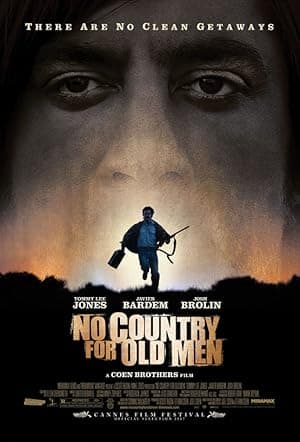
No Country for Old Men doesn’t do flashy moralising. It sits you in a wide, dry landscape and makes you listen — to footsteps, to the hollow click of a coin, to a man who keeps asking why the world has become stranger than he can follow. Revisit it for the characters who carry that quiet weight, and for the ways the Coen brothers turn chance and obsolescence into a thriller that still refuses easy answers.
THE MOVIE
Ed Tom Bell is still the reason this movie works
No Country for Old Men starts with a simple, terrible choice: a man finds a case full of cash after a drug-violence shootout and pockets it. That moment — opportunism meeting a landscape that doesn’t care — is the engine the Coen brothers adapted from Cormac McCarthy’s novel and set rolling through West Texas.
But the film doesn’t belong to just one man. It’s a three-way universe: Llewelyn Moss’s grab, a relentless killer with a coin and a philosophy of chance, and an ageing sheriff who keeps turning over what’s left in his hands. Tommy Lee Jones’s Ed Tom Bell supplies the framing voice that keeps pulling us back from the hunt, asking whether the country he remembers still exists.
Directed and edited by Joel and Ethan Coen, No Country for Old Men runs tight at 122 minutes and refuses to trade its questions for tidy endings. The coin tosses, the quiet voiceovers, the decisions that feel like luck — those are the shorthand the film uses to keep asking why people do what they do.
THE SETUP
The idea that sets No Country for Old Men in motion
At its core the film is easy to describe and hard to shrug off: set in the desert borderland around 1980, a botched drug deal leaves bodies, a satchel of money and a serious moral mess. Llewelyn Moss discovers the aftermath, pockets the cash and, in doing so, makes himself the centre of a very personal manhunt.
That hunt isn’t one straight line. It’s a pressure from three directions: Moss trying to get away with the money; a hired killer who treats violence like an appointment to be kept; and Sheriff Ed Tom Bell, an old lawman trying to make sense of the sudden, escalating brutality on his patch.
Anton Chigurh’s ritual coin tosses give the chase an odd, grim grammar: chance is formalised into a recurring decision-making device that other characters have to heed. The Coens keep enough of McCarthy’s moral fog to mean you’re watching consequences and questions, not just a thriller’s mechanics.
Finally, the film deliberately avoids a conventional close-up-of-victory resolution. That withholding keeps the story proving a point — it’s more interested in the emotional and ethical residue of violence than in neatly tying off the plot.
THE CHARACTER
Why Ed Tom Bell matters
Tommy Lee Jones’s Ed Tom Bell is not just the conscience of the piece; he’s the film’s human gauge for how much the world has moved on. His voiceover reflections are the lens through which we measure events, and they’re the place the movie returns to when the hunt gets too senseless to bear.
He’s an ageing lawman — baffled, exhausted and moral in a way that isn’t showy. That mounting sense of obsolescence gives the film its emotional anchor: while others scramble, Bell keeps trying to understand what those acts mean for a life spent trying to keep order.
Because Bell frames so much of what we see, his bewilderment matters. The movie’s questions — about luck, responsibility, what counts as justice — land harder because they’re being asked by someone whose tools and certainties feel out of date.
And because the Coens let Bell speak those questions rather than answer them for us, the character becomes less a repository of tired wisdom and more a person still learning to read the map of a country that has changed.
THE PERFORMANCE
Why Javier Bardem's performance matters
Contemporary critics singled out Javier Bardem’s Anton Chigurh as a chilling presence — a hired killer who treats fate and violence like professional tools. That response wasn’t just hot air: the performance was widely praised at the time.
The industry recognised that praise formally: Bardem won the Academy Award for Best Supporting Actor for the role. That acknowledgement is part of how the character sits in the film’s architecture — an almost elemental force of chance and consequence.
What matters for the movie is how Chigurh’s behaviour — especially the coin tosses — becomes a recurring, unsettling motif. The critical attention paid to Bardem’s portrayal helps explain why those moments register so strongly.
Seen inside the film’s three-way pressure, Chigurh’s presence keeps shifting the stakes from personal greed and survival to something more abstract: the collision of choice, randomness and a kind of bureaucratic, inhuman violence.
UNDER THE SURFACE
No Country for Old Men has more on its mind than the plot suggests
On the surface it’s a chase about stolen cash. Underneath, the film keeps circling a handful of stubborn ideas: whether lives are steered by fate or by small personal choices, how violence has become ordinary, and what happens to lawmen when the rules change.
Violence in the film is presented as banal and sudden rather than theatrical. That pragmatic brutality makes the world feel colder: murder isn’t a spectacle here, it’s a matter-of-fact interruption with messy consequences.
The borderland setting does more than provide scenery; it’s a place where law is porous and histories collide. That sense of a shifting landscape — legal, moral and social — helps explain why Sheriff Bell’s old certainties keep failing him.
Put together, these elements — chance versus choice, routine brutality, the erosion of older forms of authority — give the film its moral tension. It’s not about clean answers; it’s about watching characters try to hold onto their principles when the ground keeps moving.
THE FILMMAKING
How No Country for Old Men was put together
The Coen brothers adapted, wrote, directed and even handled the editing together, crediting that work under their long-used pseudonym. That tight authorial involvement keeps the movie feeling like a coherent whole rather than a laundry list of technical flourishes.
Roger Deakins served as director of photography and Jess Gonchor handled production design — choices that root the film in a dry, lived-in desert aesthetic. Those decisions support the Coens’ deliberate, realist approach: nothing feels staged to impress, everything looks as if it belongs where it sits.
The production details — location shooting in the U.S. Southwest and design that avoids glam — are part of the film’s identity. When the Coens compress and reorganise McCarthy’s material for the screen, those craft choices let the story breathe without losing the novel’s philosophical weight.
That editing and visual restraint help the movie hold onto tension without resorting to noise. The filmmakers’ cumulative decisions keep the focus on decisions, consequences and the quiet terror of ordinary brutality.
PURE 00s
No Country for Old Men could not belong to any other decade
Released in 2007, No Country for Old Men arrived at a moment when American cinema was rethinking the West: filmmakers were reworking Western tropes into contemporary, morally messy stories. The film sits squarely in that neo-Western conversation.
That placement mattered in 2007 because it was discussed alongside other contemporary films that examined violence and landscape in West Texas. The awards season that year treated these movies as part of a shared moment, and No Country for Old Men became one of that season’s focal points.
The film’s timing — premiering at Cannes and arriving in the November release window — meant it was both a critical talking point and an industry presence. Being part of that 2007 crop helps explain how it came to be talked about not only as a thriller but as a work with broader questions about the American frontier and its afterlives.
So while the story itself could be read as timeless, its release made it part of a decade-long conversation about how violence, the landscape and national narratives get reshaped for contemporary times.
THE LEGACY
Why No Country for Old Men still matters
The film’s awards haul is part of its continued visibility: it won four Academy Awards, including Best Picture and Best Director for the Coens, and Best Supporting Actor for Javier Bardem. Those wins are a tidy way of explaining why the film kept being discussed after its first run.
Beyond trophies, the movie reinforced reputations. It helped cement the Coens’ standing for precise, purposeful filmmaking and bolstered Roger Deakins’ profile for cinematography that supported the story’s realist spine. That craft recognition keeps the film in festival and scholarly conversations.
Institutional attention has followed: respected preservation and home-video curators have released high-quality restorations and essays, which shows that the film is being kept in circulation with care rather than left to fade.
Put together, awards, craft recognition and preservation efforts make it clear why the film remains part of the cinematic conversation: people keep studying and releasing it because it’s perceived as a work worth keeping around.
THE VERDICT
Does No Country for Old Men still hold up?
Yes — and not because it offers comforting answers. It still works because its structure and choices invite you to sit with uncertainty: a man takes money, a killer converts fate into a ritual, and an old sheriff keeps returning to questions he can’t neatly resolve. That three-way pressure is the engine, and it doesn’t lose power with time.
The film’s refusal to deliver a conventional thriller resolution is one of its strengths. By holding back tidy closure the Coens force the audience to reckon with consequences and the emotional cost of violence rather than giving narrative catharsis.
Tommy Lee Jones’s Ed Tom Bell keeps the film honest; his bewilderment and worn certainties make the stakes feel human. Opposite him, Javier Bardem’s Anton Chigurh — a performance singled out by critics and awarded with an Oscar — continues to unsettle. The coin tosses remain a memorable shorthand for the film’s meditation on chance.
Finally, the Coens’ control of form — their joint authorship, the restrained score and the precise attention to sound and design — means the movie still reads as a complete, carefully made object. If you haven’t seen No Country for Old Men, watch it for a thriller that’s as interested in the residue of violence as in the chase. If you have, it’s worth a revisit: the questions it asks are stubborn, and that stubbornness is why it endures.
Share this movie
Keep watching
More movies from the 00s

2002
The Pianist
A quiet life unmade by war — and a pianist who refuses to stop listening.
Read the retrospective
→
2006
Blood Diamond
A mercenary, a fisherman and a pink diamond — and a film that still asks who pays for our jewellery.
Read the retrospective
→
2003
Kill Bill: Volume 1
A yellow jumpsuit, a long list of enemies and one woman who refuses to be finished.
Read the retrospective
→