National Treasure: Book of Secrets
A big, silly puzzle about family, secrets and a man determined to clear his name.
Feature presentation
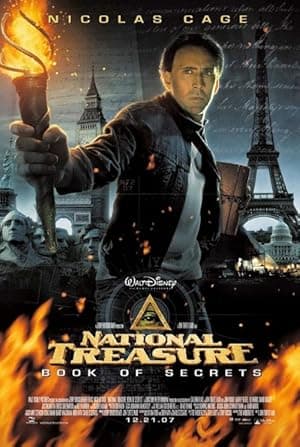
National Treasure: Book of Secrets is unapologetically a treasure-hunt movie with a family-shaped heart. It springs from one simple spark — a newly surfaced page that seems to accuse Ben Gates' ancestor of being tied to Lincoln's assassination — and then refuses to stop following the trail. Jon Turteltaub returns to steer another globe-trotting, landmark-hopping caper where the stakes are both national and deeply personal.
THE MOVIE
Benjamin 'Ben' Gates is still the reason this movie works
What keeps National Treasure: Book of Secrets moving isn’t the monuments or the gadgets; it’s the premise that bangs on Ben Gates’ front door and won’t leave. A missing page from John Wilkes Booth’s diary turns up and looks like it pins a Gates ancestor to Lincoln’s murder — and Ben treats that accusation like a matter of family honour rather than an academic puzzle.
That personal grievance is smart. It lets the film double as a globe-trotting treasure hunt — clues that run from Paris and London back to Washington — and as a story about someone who defines himself through family reputation and historical curiosity. Those two impulses, private and public, tether the spectacle to something you can care about.
Jon Turteltaub directs a sequel that knows what the first one was: a crowd-pleasing, clue-driven adventure. Nicolas Cage returns as the man at the centre of it all, and the production leans on historic sites and set-piece sequences to make the hunt feel big enough to matter.
THE SETUP
The idea that sets National Treasure: Book of Secrets in motion
The film opens with a tidy hook: a newly surfaced Booth diary page that appears to implicate Ben’s great-great-grandfather in the assassination of Abraham Lincoln. That accusation is the engine — Ben isn’t chasing treasure for the thrill so much as to clear his family name.
From there the plot alternates between private motive and public chase. Ben’s quest to vindicate his ancestor sends him and his team across an international chain of clues, with Paris and London providing the overseas beats before the hunt returns to American soil.
What gives the story its shape is a particular kind of puzzle logic: institutional secrets and restricted items act as clue-objects. The missing plank from the Resolute desk, and a fabled presidential scrapbook called the Book of Secrets, are the kind of locked-away artefacts that force the characters to work around rules and into set pieces.
One of the film’s key gambits is to involve the highest level of government. Ben and his allies pursue access to the President’s restricted material, which leads to a high-stakes moment where the sitting President is temporarily taken out of protective detail so the book can be consulted — an audacious plot choice that raises the tension between private inquiry and public procedure.
THE CHARACTER
Why Benjamin 'Ben' Gates matters
Nicolas Cage plays Benjamin 'Ben' Gates, a man for whom history is not an abstract interest but a family business. The movie makes his pride and curiosity the engine of everything that happens; when a shred of evidence threatens the Gates name, Ben treats it like a personal emergency.
The familial angle helps the film avoid being only a string of puzzles. Ben isn’t an anonymous adventurer; he’s someone trying to rescue a reputation passed down through generations. That gives his quest an emotional shape even when the story leans into globe-trotting set pieces.
The people around him exist to expose different sides of that obsession. His father stands for wounded pride and scepticism about Ben’s methods, while allies like Riley provide the research and comic relief that translate clues into action. Abigail Chase functions as the inside contact whose institutional access and expertise keep the investigation honest.
Put simply: Ben matters because the film asks us to follow a man who believes family history is worth fighting for. The puzzles are fun, but they gain weight because they’re about a Gates family story rather than a random hunt for treasure.
UNDER THE SURFACE
National Treasure: Book of Secrets has more on its mind than the plot suggests
Underneath the chase and the puzzles, the film is quietly interested in what family names mean. The idea that a single document can tarnish an ancestor’s reputation is treated as a crisis of identity — for Ben, clearing that blot is about who he is, not just what he knows.
It’s also a movie fascinated by secrecy on a national scale. The notion that governments collect and hide information — a secret presidential scrapbook among them — feeds into a bigger pleasure: the fantasy that ordinary people might discover what officials keep locked away.
Historical mythmaking is another thread. The plot turns on how fragments of the past can be read, misread, weaponised or redeemed. The movie enjoys the detective work of piecing together meaning from artifacts and legends, even when the logic gets a little theatrical.
All of this boils down to one simple tension the film likes to play: when private history collides with public truth, whose version wins? The hunt becomes as much about stories we tell about the past as it is about the gold at the end of the trail.
THE FILMMAKING
How National Treasure: Book of Secrets was put together
This sequel keeps the machinery of a big studio adventure ticking with a straightforward credits list that tells you what kind of film it is. Cinematography duties were shared between two experienced operators, and the editing room was split between two hands as well — a sign that the production was orchestrated to move quickly between set pieces and locations.
That shared crediting suggests a production built to scale: multiple crews and post-production voices collaborating to deliver a smooth, multiplex-ready rhythm. The result is a film that emphasises clarity and forward motion over formal experimentation.
Jon Turteltaub’s steady direction guides those pieces; the movie’s identity comes from how those craft choices serve the puzzle-adventure at the centre rather than from any single flashy technical trick.
If you want to know what the film is trying to be, look at the credits. Two cinematographers, two editors — it’s a big-team job designed to keep the story sprinting from clue to clue.
PURE 00s
National Treasure: Book of Secrets could not belong to any other decade
This is very much a mid-to-late-00s studio sequel: a family-friendly, producer-driven adventure designed for multiplexes and broad holiday audiences. It slots neatly into the era’s appetite for tentpole franchise fare carried by recognisable stars and glossy production values.
Released in December 2007, the film was positioned as a mainstream holiday entertainment — the kind of crowd-pleaser aimed at families looking for an easy, slightly brainy outing between school and Christmas. That timing tells you how the studio viewed it: not niche, but as wide as the multiplex could handle.
It’s also part of an early-2000s storytelling lineage: a direct follow-up to the 2004 National Treasure, keeping the same basic puzzle mechanics and creative team. The sequel mentality — bigger, broader, a little more audacious — is classic 00s franchise thinking.
Put another way: this film is a product of its moment, created to fit into a certain slot in the calendar and the marketplace, and it wears that pedigree plainly.
WATCHING IT NOW
What has aged — and what hasn't
If you revisit the film now you’ll likely notice the same split that greeted it on release: critics tended to find the plot’s leaps implausible, while audiences warmed to the family-friendly puzzle-adventure on offer. That divide still explains a lot about why people either enjoy it as harmless entertainment or roll their eyes at its contrivances.
Where it holds up best is in the family angle. Ben’s desire to clear his ancestor’s name keeps the action grounded; that personal throughline still makes the stakes feel human rather than purely mechanical.
What feels more dated is the film’s willingness to ask viewers to accept large procedural shortcuts for the sake of spectacle. If you’re inclined to pick apart plot logistics, the movie gives you plenty to object to. If you prefer to ride the puzzle and the landmarks, it mostly delivers.
Ultimately, the film’s appeal today depends on what you want from it: a clever conspiracy thriller, or a roomy, good-natured holiday adventure built around family and history.
THE LEGACY
Why National Treasure: Book of Secrets still matters
For better or worse the movie kept the franchise visible: it was the second theatrical entry and remained the series’ biggest earner at certain points in later assessments. That commercial footprint matters when studios decide whether a property deserves more pages in its life.
Disney also pushed the story into younger formats, publishing a junior novelisation and other youth novels that expanded the Gates family world — a sign that the film’s appeal reached beyond adults in cinemas and into children’s reading lists.
Years on, the brand migrated to streaming in the form of a Disney+ series, which extended the Gates mythology and proved the basic idea still had mileage beyond the two feature films.
So the legacy is practical rather than artistic: the movie helped keep a franchise alive and find new formats and audiences after its theatrical run.
THE VERDICT
Does National Treasure: Book of Secrets still hold up?
If you want tight logic and a mystery that never asks you to forgive a giant plot lurch, this won’t be your cup of tea. The film’s inciting image — a Booth diary page that seems to implicate Ben’s ancestor — sets up a premise that requires big leaps and institutional shortcuts, and the movie obligingly takes them.
But if you’re after a roomy, family-sized adventure where the emotional motor is a man trying to clear his family name, it still works. The personal objective — clearing an ancestor’s reputation — keeps the treasure hunt more than cosmetic, and the use of restricted presidential artefacts (a missing Resolute desk plank, the Book of Secrets) gives the puzzles a flavour of conspiracy and gatekeeping that the film enjoys unpacking.
There’s pleasure in the way the story bounces between private grievance and public spectacle: Ben drags an investigation from Paris and London back to the United States, and at one point even involves the President to get at a locked book. It’s audacious and occasionally absurd, but the audacity is the point.
So yes — watch it for the chase and the family angle. It’s silly in the most deliberate, self-aware way: an extravagant holiday puzzle that knows what it is and asks you to come along for the ride.
Share this movie
Keep watching
More movies from the 00s

2002
The Pianist
A quiet life unmade by war — and a pianist who refuses to stop listening.
Read the retrospective
→
2006
Blood Diamond
A mercenary, a fisherman and a pink diamond — and a film that still asks who pays for our jewellery.
Read the retrospective
→
2003
Kill Bill: Volume 1
A yellow jumpsuit, a long list of enemies and one woman who refuses to be finished.
Read the retrospective
→