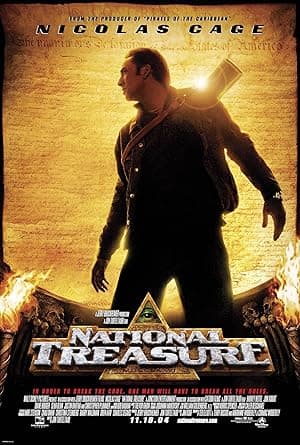
National Treasure
A madcap hunt for a hidden fortune, held together by one very determined history nerd.
Feature presentation
National Treasure is the kind of blockbuster that wears its map on its sleeve: equal parts puzzle, family story and conspiracy thriller. It’s the film you remember for the sight gag in the archives and the way one man’s obsession drags half of Washington, D.C. into a chase — and yes, it was directed by Jon Turteltaub and released in 2004.
THE MOVIE
Benjamin Franklin Gates is still the reason this movie works
National Treasure is one of those films that sells itself on a single, slightly ridiculous idea: a centuries-old hoard tied to the Founding Fathers, secret societies and a trail of hidden clues. It’s an adventure built around puzzles and conspiracies rather than gadgets or superheroes.
What gives the film personality is its protagonist: Benjamin Franklin Gates — a historian and self-styled 'treasure protector' whose family obsession pushes the story forward. The inciting spark is cheeky and unmistakable: he and his team find evidence that a map to the treasure is hidden on the back of the Declaration of Independence.
That premise is played at feature length. Jon Turteltaub directs, the movie runs to just over two hours, and it’s pitched as an action-adventure with heist and thriller beats. That mix — family legacy, puzzle-solving and open-door conspiracy — is why people still pull this one out when they want something fun, a little silly and oddly earnest.
THE SETUP
The idea that sets National Treasure in motion
At its heart the film is a treasure-hunt built like a capped bottle: twist the top and an entire string of historical clues pops out. Ben Gates pursues a legendary cache connected to Knights Templar lore, the Founding Fathers and Freemasons, and the story moves from clue to clue like a scavenger hunt with bigger stakes.
Those clues are literal plot mechanics: ciphers, historical breadcrumbs and location-based puzzles that create episodic set-pieces. Each solution feels like a small victory before the next problem arrives, which keeps the movie moving without ever pretending the whole thing is a realistic academic enquiry.
The personal stakes come from a rivalry turned ugly. Ian Howe, once Gates’ ally, becomes the antagonist who will break the rules to seize the prize. That former-friend-turned-foe setup gives the hunt a human centre: it’s not just about treasure, it’s about what the obsession does to people.
Then there’s the grab that flips the movie into full-throttle chase mode: Gates actually steals the Declaration of Independence from the National Archives. It’s a chest-beating set-piece that turns a historical-mystery into a manhunt, and from there the film is happily propelled into a series of action-driven puzzles.
THE CHARACTER
Why Benjamin Franklin Gates matters
Ben Gates exists at the junction of family duty and obsession. He’s not a casual hobbyist — treasure-hunting is a handed-down identity, something his family has treated as mission rather than pastime. That inherited compulsion drives the plot in a way that a mere love of adventure never could.
His role is also practical: the treasure needs someone with stubborn belief to follow a breadcrumb trail others dismiss. Without Ben’s single-mindedness the string of ciphers and clues becomes background noise; his determination is what converts historical trivia into action.
The character also creates friction. Dr. Abigail Chase, an archivist, embodies institutional responsibility and the rules Ben is willing to break. Back home, his father Patrick Henry Gates stands for sceptical caution and generational tension — the family voices that question whether the hunt is noble or foolish.
That constellation — obsessed son, doubtful father, principled outsider — makes Gates more than a code-cracking hero. He’s the emotional lever for the movie: the treasure matters because it means something to him and to the Gates family.
THE PERFORMANCE
Why Nicolas Cage's performance matters
Contemporary reviews quickly identified Cage as the film’s centre of gravity — the part that keeps an otherwise implausible story from tilting into nonsense. Reviewers noted his offbeat delivery and how that sits against the movie’s broadly comic, adventurous tone.
That observation matters because National Treasure asks its lead to be both credible and a touch ridiculous. The plot requires someone who can sell obsession without turning it into despair, and contemporary coverage suggested Cage’s particular energy gave the film a reliable focal point.
There’s a balancing act throughout: the story’s theatricality needs an anchoring personality, and critics at the time pointed to the lead role as providing that anchor. It’s less about subtleties and more about a recognisable, sustained centre that keeps the plot’s sillier manoeuvres wearable.
Put simply: the film’s tone depends on the lead being allowed to be big and slightly odd, and early reaction singled out Cage as the performance that provided that steady, oddball heartbeat.
UNDER THE SURFACE
National Treasure has more on its mind than the plot suggests
On the surface it’s all puzzles and heists; underneath there’s a story about inheritance — not of money but of obsession. The Gates family history turns the treasure hunt into something personal: the quest is a way of honouring and carrying on a narrative the family has been telling itself for generations.
That inherited compulsion gives the film emotional ballast. The treasure is a MacGuffin, but the thing that keeps us interested is seeing how far people will go for a story they believe about themselves.
The movie also plays with ideas of hidden history and patriotic myth-making. It’s happy to toy with conspiratorial possibilities linked to secret societies and famous names, and that fascination fuels the film’s episodic clues and set-pieces.
Lastly, because it’s a family-friendly adventure, the film keeps its questions light. It isn’t trying to rewrite history so much as entertain with the intoxicating possibility that beneath the familiar national story there might be one last, ridiculous secret.
THE FILMMAKING
How National Treasure was put together
On paper National Treasure reads like a studio picture built to be sleek and unobtrusive. The production credits give a sense of that: cinematography by Caleb Deschanel and editing by William Goldenberg appear on the main listings, names that signal professional craft rather than showy experimentation.
The design side mirrors that intention. Production designer Norris Spencer is credited, and the film mixes built sets with on-location shooting across U.S. locales. That combination lets the movie feel grounded even when the plot goes slightly bonkers.
The practical choice to blend studio construction with real places gives the film a workable texture: it’s recognisably set in a world that looks like the one we know, which helps sell the more fanciful ideas.
In short, the filmmaking choices aim to keep the audience oriented: competent, readable craft that foregrounds plot and puzzle rather than auteur flourishes.
PRACTICAL EFFECTS
The effects work that gives National Treasure its physical personality
Some of the movie’s most memorable moments come from physical craft rather than pure CGI. The treasure-room sequences and their related models and miniatures drew industry notice — in fact the film received a Visual Effects Society nomination for outstanding models and miniatures.
That nomination points to a production decision to use real-world models and constructed sets alongside digital enhancements. The film deliberately blends these techniques so the big, theatrical beats feel tactile.
Which matters because tactile effects change the way scenes read on screen; when a set piece uses a built miniature or a constructed prop the audience gets a different kind of solidity than with fully digital work.
National Treasure’s mix of models, miniatures and practical sets — supported by digital effects in key moments — gives the movie a slightly old-fashioned, hands-on personality that suits its puzzle-film ambitions.
PURE 00s
National Treasure could not belong to any other decade
Arriving in 2004, National Treasure sits neatly in the early-2000s appetite for historical-conspiracy entertainment. It’s the sort of crowd-pleasing, family-friendly adventure a Jerry Bruckheimer production was built to deliver — big concept, brisk pace and a wink for anyone who likes puzzles.
At the time it was often mentioned in the same breath as other puzzle-heavy thrillers. Critics and coverage compared it to The Da Vinci Code and similar works that mixed secret-society myth with popular-history hooks.
That cultural moment — when audiences were happy to suspend disbelief for a clever conspiracy premise — is part of why the film landed when it did. It wasn’t trying to be subtle; it was attempting to translate a plausible-sounding mystery into a multiplex-scale romp.
And it left room to grow: the movie established a franchise blueprint that led to a direct sequel in 2007 and eventually a TV spinoff many years later, which underlines how the film fit the studio’s early‑00s commercial instincts.
WATCHING IT NOW
What has aged — and what hasn't
Approached today, National Treasure is still a serviceable piece of family entertainment: broadly entertaining and engineered to keep viewers turning pages on its mystery. Modern retrospectives note that plainly — it remains fun in its way.
That said, the same coverage also flags the things that show their age. The film’s willingness to take liberties with history and its sometimes formulaic plotting are the points where modern viewers can be less forgiving.
Importantly, the family-story element still holds up. The Gates-family through line — obsession passed between generations — gives emotional shape to the puzzles, and that human tether is less likely to feel dated than the pop-historical gloss.
So while the thrills may read as genre-sturdy rather than groundbreaking, the personal stakes and the movie’s appetite for a good, old-fashioned hunt continue to work for many viewers.
THE LEGACY
Why National Treasure still matters
The clearest mark of the movie’s afterlife is commercial: it was successful enough to spawn a direct theatrical sequel in 2007 and later a television spinoff, which shows the studio saw it as a durable, multi-format property.
On a craft level the film picked up industry recognition. Trevor Rabin’s score earned a BMI Film Music Award, and the effects work — especially the models and miniatures used for the treasure-room sequences — received a Visual Effects Society nomination.
Those pieces of recognition don’t make the picture a classic, but they do underline that the film was more than a throwaway: it was built with professional care and components that other practitioners noticed.
Ultimately its legacy is pragmatic: National Treasure proved the marketplace for family-friendly, puzzle-heavy blockbusters existed, and that was enough to keep the Gates family in business for another instalment and later spin-offs.
THE VERDICT
Does National Treasure still hold up?
Yes — with a qualifier. National Treasure still works as a rollicking, family-friendly adventure. If you’re in the mood for a film that delights in puzzles, a touch of conspiracy and a hero whose family history is as much treasure as any chest, this delivers.
The film’s engine is specific and uncomplicated: a map hidden on the Declaration, a sequence of ciphers to crack and a set-piece that involves stealing that document and running for cover. Those elements keep the plot propulsive and easy to follow.
Characters matter here. Ben Gates’ obsession gives everything purpose; Riley Poole supplies the tech savvy and comic foil, while Dr. Abigail Chase provides the moral counterweight of institutional responsibility. Even the sceptical father adds texture to the hunt.
So if you want high drama spun from historical clues, and a two‑hour-plus romp that doesn’t ask for deep disbelief, National Treasure is still worth the trip. It’s not subtle, but it is consistent: a film built around a charmingly stubborn lead and a very particular idea of what a treasure hunt should feel like.
Share this movie
Keep watching
More movies from the 00s

2002
The Pianist
A quiet life unmade by war — and a pianist who refuses to stop listening.
Read the retrospective
→
2006
Blood Diamond
A mercenary, a fisherman and a pink diamond — and a film that still asks who pays for our jewellery.
Read the retrospective
→
2003
Kill Bill: Volume 1
A yellow jumpsuit, a long list of enemies and one woman who refuses to be finished.
Read the retrospective
→