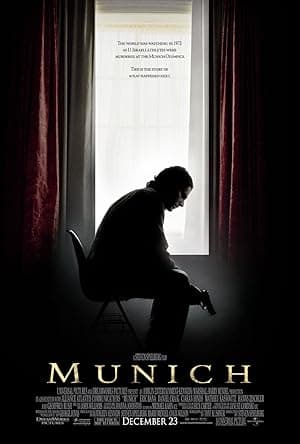
Feature presentation
Munich is the kind of Spielberg picture that refuses easy comfort. It follows Avner Kaufman — an Israeli agent handed a dirty, highly secret job after the 1972 Olympic murders — and turns what could have been a tidy revenge thriller into an uncomfortable interrogation of consequence. Watching it again feels less like revisiting a classic and more like sitting down for a long, morally awkward conversation.
THE MOVIE
Avner Kaufman is still the reason this movie works
If you remember Munich for anything, remember Avner. The film sets him up as the quiet centre — an Israeli operative picked to lead a small, clandestine team after the on-screen recreation and archival presentation of the Munich massacre jolts the story awake.
Spielberg stages the mission as state-sanctioned retribution: a commissioned series of strikes that blur into something wearier and stranger the more Avner sees. The drama pivots not on the kills themselves but on the doubt that follows them; the larger question — retribution versus justice — hangs over every operation.
It's also a film that wears its politics in its bones. Directed by Steven Spielberg and running at 157 minutes, Munich is part spy thriller, part moral reckoning, and it remains a movie people return to because the central tension — whether violence can be answered without becoming the same thing it fights — still refuses tidy answers.
THE SETUP
The idea that sets Munich in motion
Munich doesn’t hide the engine that drives it: a secretive Israeli response to the murders at the 1972 Games. Once the film stitches archival footage into its opening, the government commissions a small team — and Avner is put in charge.
From there the plot is pragmatic and mercilessly procedural. Avner and his group move across cities, using a French informant called Louis and a fixer known as Papa to find names, places and opportunities.
The film keeps the mechanics lean on purpose. Tracking, identifying and attempting to kill suspects becomes the day job, and the routine of those operations slowly exposes the emotional tax they exact.
That modest setup is what lets Munich operate as both a spy drama and a moral study: it gives Spielberg a template for missions, mind-numbing repetition and the creeping uncertainty that follows every listed target.
THE CHARACTER
Why Avner Kaufman matters
Avner is the film’s steady fulcrum. He’s not a caricature of righteousness or a one-note action hero; he’s presented as a competent Mossad operative who, crucially, doesn’t arrive at his job already numb to the consequences.
That reluctance is important. The movie uses Avner’s position as leader to show how the mission corrodes certainty: orders are followed, mistakes happen, and doubt begins to push through the professionalism.
Personal life anchors the stakes. Avner’s marriage and the presence of his mother provide small domestic touchstones that make the fallout feel intimate rather than abstract.
So Avner matters because the film asks you to live with the aftermath through one person’s shifting moral ledger — not to adjudicate the politics from afar, but to feel the cost up close.
THE PERFORMANCE
Why Eric Bana's performance matters
Contemporary reviews singled out Eric Bana’s central turn as the film’s emotional anchor, and that matters because Munich depends on a believable interior unraveling. The cast could have been window dressing — instead Bana’s Avner is the audience’s handle on the moral trouble at the story’s core.
You don’t need to call the role flashy to appreciate its function. The film asks us to register subtle shifts: a decision made, a sleep interrupted, a private admission. Reviews at the time pointed to Bana’s gradual loss of certainty as the thing that keeps the picture humane.
Put simply: Munich’s argument about retribution works only if you can watch one man start to doubt what he’s been asked to do. Contemporary response suggested Bana supplied that necessary thread.
UNDER THE SURFACE
Munich has more on its mind than the plot suggests
At face value Munich is about missions and targets. Underneath, it’s asking sharper questions: is vengeance the same as justice, and can a state use violence without inheriting the sins it seeks to repel?
The film insists on the moral ambivalence of state violence. Operations authorised at the highest levels are dramatized alongside the human mistakes and civilian costs they produce, which complicates any tidy reading of right and wrong.
It’s also a story about personal cost. The domestic scenes — Avner’s marriage, occasional returns home — are small but crucial. They show the erosion of ordinary life that happens when a person keeps stepping into sanctioned violence.
Finally, Munich deals in uncertainty and contested history. The screenplay repeatedly foregrounds questions about intelligence and identity; Avner spends as much time seeking proof as he does executing plans, and those gaps matter to the film’s ethical weight.
THE FILMMAKING
How Munich was put together
Munich’s construction is deliberately anchored to real images. Michael Kahn’s editing weaves archival broadcast footage of the 1972 crisis into staged scenes so the drama sits beside, not apart from, historical material.
That editorial choice matters because it keeps the viewer aware that this is dramatization rubbing up against recorded reality, rather than a purely invented thriller.
Contemporary reviewers also noted the cinematography’s effort to feel of its moment: the grainy, 1970s-style realism reported at the time gives the picture a weathered texture that supports its moral ambiguity.
The film’s technical craftsmanship — editing, score, cinematography — was widely recognised: Munich picked up five Academy Award nominations that included Best Film Editing and Best Original Score, among others.
PRACTICAL EFFECTS
The effects work that gives Munich its physical personality
Munich’s most obvious practical technique is a simple, effective one: it blends archival television footage into the opening sequences and matches staged recreations to that material.
That approach is less about spectacle than tonal fusion — it forces the reenacted drama to sit in the same visual world as the original broadcasts, which keeps the viewer oscillating between fiction and record.
It’s a practical decision with an ethical echo: the film is asking you to watch these characters operate under the constant reminder of real events, and the seams between footage and fiction are intentionally visible.
So the physical effect here is not fireworks but friction — a practical method that helps the film feel both cinematic and tethered to documentary traces.
PURE 00s
Munich could not belong to any other decade
Munich arrived in late 2005 and could hardly avoid being read through the post‑9/11 lens. Reviewers at the time linked its interrogation of counterterror tactics to contemporary debates about Western policy and the moral costs of fighting terror.
That timing gave the film extra urgency: it wasn’t only looking back at the 1972 massacre, it was also speaking into a present where questions about reprisal, intelligence and civilian harm felt freshly political.
In that sense Munich fits neatly in the mid‑2000s conversation alongside other films wrestling with terrorism and moral ambiguity — it’s a historical drama that doubled as a political mirror for its moment.
The result is a movie that reads like a 2000s film in intent: historically set, but casting clear questions back onto the decade that produced it.
THE LEGACY
Why Munich still matters
Munich’s lasting footprint is complicated. On one hand the film earned serious industry recognition — it was nominated for five Academy Awards, including Best Picture and Best Director — which underlines how seriously it was taken on release.
On the other hand, the movie provoked sustained public debate about the reliability of its primary source and the historical accuracy of particular incidents, which kept it from settling into comfortable consensus.
That controversy is part of why Munich remains discussed: it’s a film that invited historians, journalists and former intelligence figures into the conversation, rather than sitting above it.
Critics also continue to cite Munich when talking about post‑9/11 political cinema; it’s often brought up in debates about how films should treat terrorism, reprisal and the messy ethics of state violence.
THE VERDICT
Does Munich still hold up?
Yes — with a caveat. Munich remains a gripping piece of moral theatre because it refuses to turn its premises into propaganda. The film dramatizes the Israeli government’s covert response after the Munich murders and then spends most of its running time making the audience live inside the consequences.
Much of the plot is operational: Avner and his small team move through cities, using informants and local contacts to track suspects. But the screenplay is careful to foreground uncertainty about intelligence and identity; Avner is often looking for proof he rarely finds, and that lack is the film’s engine.
Eric Bana’s Avner is the key to whether the film works for you. Contemporary reviewers pointed to Bana as the movie’s emotional centre, the man whose dawning doubt and paranoia turn reprisals into personal burden. That human throughline — the domestic returns, the frayed certainties — is why Munich feels urgent rather than merely rhetorical.
So watch it if you want a spy film that doesn’t pretend violence solves everything. Munich is long, serious and sometimes uncomfortable, and it earns that discomfort: it keeps asking who gets to call an act of violence ‘justice’ when the methods look so much like the enemy’s.
Share this movie
Keep watching
More movies from the 00s

2002
The Pianist
A quiet life unmade by war — and a pianist who refuses to stop listening.
Read the retrospective
→
2006
Blood Diamond
A mercenary, a fisherman and a pink diamond — and a film that still asks who pays for our jewellery.
Read the retrospective
→
2003
Kill Bill: Volume 1
A yellow jumpsuit, a long list of enemies and one woman who refuses to be finished.
Read the retrospective
→