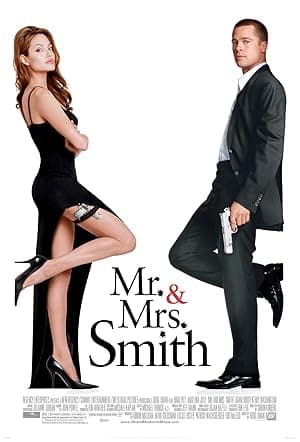
Mr. & Mrs. Smith
Marriage as camouflage: domestic boredom meets freelance assassination.
Feature presentation
Mr. & Mrs. Smith is the kind of film that keeps pulling you back — not because it invented anything new, but because it pairs a very particular idea with two very particular stars. It’s a suburban marriage played like an undercover op, and the result is a romcom that keeps tripping over its own explosions in the best possible way. This piece revisits why that premise — and John Smith himself — still makes the film worth a look.
THE MOVIE
John Smith is still the reason this movie works
Right away Mr. & Mrs. Smith makes a tidy, mischievous promise: this is a marriage that isn’t what it looks like. Both John and Jane Smith are suburban partners by day and highly trained contract assassins for entirely different organisations by night, and that private/professional split is the whole game the film wants to play with.
The movie’s inciting mischief comes when both are assigned to the same job — the transfer of a prisoner known as Benjamin ‘The Tank’ Danz — and stumble across each other on the job. That collision turns private deception into full-on domestic crisis: suddenly the question is not whether they can hide who they are but whether one of them will try to kill the other.
Doug Liman directs a 120-minute film that deliberately treats the Smiths’ marriage as a crafted public façade, using cover identities and spy tradecraft as metaphors for the anxieties inside a relationship. With Brad Pitt as John and Angelina Jolie as Jane, the movie sits at the crossroads of action and screwball romantic comedy, and that mixture — marriage as cover, secrecy and the tug between suburban life and professional danger — is why people still bring it up.
THE SETUP
The idea that sets Mr. & Mrs. Smith in motion
The film’s starting point is simple and clever: two people who have signed up for a conventional suburban life are secretly professionals who lie about everything, including the most intimate thing of all — who they are to each other. That dual life fuels the plot rather than merely decorating it.
When the Smiths unexpectedly run into one another while both on assignment, that accidental encounter doesn’t just complicate a single job; it ruptures the trust that underpins their marriage. Each assumes the other used the marriage as a cover, and that suspicion flips the script from domestic tedium to lethal paranoia.
From there the film turns familiar spy mechanics into marital metaphors: cover identities, surveillance tricks and tradecraft arrive in the middle of dinner-table fights and therapy sessions. There’s a prolonged dinner scene where the couple’s professional secrets surface, and later they are forced to fight together against outside assassins — a classic action climax that’s been earned, narratively, by the domestic breakdown.
It’s worth noting that the filmmakers chose to keep that marital conflict front and centre: production commentary explains that some villain-focused material was trimmed in editing to stop the film becoming about an external conspiracy and to keep it about the couple.
THE CHARACTER
Why John Smith matters
Brad Pitt’s John Smith matters because he is the hinge between two lives: the man who wants a conventional suburban cover and the operator who has to remain competent and evasive in the field. That tension is baked into the premise — John isn’t just secretive for drama’s sake; his behaviour is shaped by the need to perform ordinary marriage while keeping his professional self tightly shut away.
That split is the engine of the film’s interpersonal conflict. When both spouses discover one another’s realities, John’s fear — that his marriage has been a ruse and that he might be eliminated by his partner — drives the escalation from passive-aggressive domestic argument into property-destroying shootouts.
John’s role also anchors the film’s tonal balancing act. He’s the figure who moves the story between screwball-marital bickering and the film’s action beats, and that makes him the character the rest of the movie can bounce off.
There’s a supporting note in the cast list — Keith David plays Father — which sits quietly in the background of John’s life and helps frame him as someone who’s chosen, or been chosen into, this double life.
THE PERFORMANCE
Why Brad Pitt's performance matters
We can’t evaluate every acting nuance here, but contemporary reviews singled out a clear, measurable thing: the onscreen chemistry between Brad Pitt and Angelina Jolie was widely noted as the film’s central asset. For a movie built around a married couple whose biggest issue is secrecy, believable spark matters — and reviewers at the time flagged that spark as the element that sells many of the film’s choices.
Put simply: when a plot depends on the audience accepting both the intimacy and the deception between two characters, the pair’s electricity is the glue that makes improbable moments feel watchable.
UNDER THE SURFACE
Mr. & Mrs. Smith has more on its mind than the plot suggests
On the surface it’s a romp that pairs domestic bickering with explosions. Under the surface, the screenplay is deliberately running the same conceit through different registers: marriage as cover, secrecy and dual identity, and the collision between suburban roles and covert professional identities.
That constructed marriage façade isn’t just a neat twist; it’s the film’s organising idea. The characters live double lives and the film keeps asking whether their domestic persona is authentic or merely another disguise. The metaphor holds because every piece of tradecraft in the film also reads as a marital manoeuvre — secrecy, performance, surveillance.
Because the film mixes romantic-comedy rhythms with action, it borrows from screwball dynamics: quick banter, escalating absurdity and a sense that an argument can flip into farce or violence with almost no warning. Those shifts allow the movie to treat therapy beats and heist-style set pieces in the same tonal neighbourhood.
So while you can enjoy it like a plain action picture, the film’s real interest is in how genre-mixing lets it stage relationship problems as operational failures — and vice versa.
THE FILMMAKING
How Mr. & Mrs. Smith was put together
Doug Liman, coming off a recent action picture, leaned into a brisk hybrid of romcom and thriller here. One concrete production choice helps explain the movie’s shape: during editing some villain-focused scenes were reduced or cut so the story stayed focused on the central marital conflict.
That trimming explains why the film rarely loses its domestic throughline even when it leans hard into action. The cuts kept the emotional centre — the couple and their secrets — ahead of an overcomplicated conspiracy plot.
The result is a film that feels edited toward relationship beats as much as spectacle; decisions in cutting therefore aren’t only about pace, they’re about keeping the premise intact.
So when you notice the movie returning quickly to couples therapy or to kitchen-table fights between shootouts, that’s as much an editorial choice as it is a tonal one.
PURE 00s
Mr. & Mrs. Smith could not belong to any other decade
This is very much a 2005 film in how it arrived and how it travelled. It opened wide in June 2005 as a major summer studio release and topped its opening weekend, which matters because the movie was built to be a star vehicle as much as an idea movie.
Its production and publicity dovetailed with intense mainstream attention on its two leads — the pairing of Pitt and Jolie became a sustained point of interest during the 2000s, and that shaped how people talked about the film beyond the screen.
The property also developed a life beyond the cinema: an ABC pilot followed in 2007 (not picked up to series), and much later the title was reimagined as an Amazon Prime Video series in 2024 produced in part by people from the original film — evidence the concept kept pulling interest across decades.
There are other period markers in the film’s making: Simon Kinberg sold the original spec in 2000 off an idea that grew from conversations about couples attending marriage therapy, and John Powell’s score and the separate soundtrack releases place the film firmly inside the studio-era, cross-promotional machine of the mid-00s.
THE LEGACY
Why Mr. & Mrs. Smith still matters
Part of the film’s afterlife is inseparable from its casting: it launched sustained mainstream interest in the Pitt–Jolie pairing and is often mentioned in popular accounts of that relationship. The couple’s off-screen profile fed back into how audiences watched the on-screen couple.
The property proved durable enough to generate attempts at small-screen reconception: an ABC pilot was filmed in 2007 but didn’t go to series, showing that television producers saw series potential even then.
More recently the idea was revisited as a reimagined Amazon Prime Video series in 2024, produced in part by some of the film’s original producers. That revival underlines the concept’s lasting brand value: a domestic life doubling as an operational cover continues to be a story producers want to tell.
So the legacy isn’t just about a single film but about a premise that kept getting reshaped and re-sold as different formats, across years.
THE VERDICT
Does Mr. & Mrs. Smith still hold up?
Yes — but with a useful rider. If you come for the idea of a marriage doubling as a professional cover, the film delivers: the premise that both spouses are secret operatives is sustained from the inciting clash over Benjamin ‘The Tank’ Danz through to the climactic moment when they must fight common enemies together.
The movie works best when it keeps that marital question at the front: who are you when you don’t have to perform for your neighbours? The screenplay consciously frames domestic problems — poor communication, boredom and passive aggression — inside an action-thriller structure, so the film succeeds when those two modes remain tied together.
A large part of the film’s hold comes from its leads: Brad Pitt as John Smith and Angelina Jolie as Jane Smith anchor the movie, and contemporary reviews singled out their chemistry as the central asset that makes big tonal jumps feel liveable. If that pairing clicks for you, the film’s mix of screwball back-and-forth and set-piece spectacle still lands.
So should you watch it today? If you enjoy a romcom that is impatient with its own civility and happy to puncture a suburban façade with literal explosions, then yes. Mr. & Mrs. Smith is at its best when it remembers it’s a movie about two people pretending — and then has fun revealing how spectacularly that pretending can go wrong.
Share this movie
Keep watching
More movies from the 00s

2002
The Pianist
A quiet life unmade by war — and a pianist who refuses to stop listening.
Read the retrospective
→
2006
Blood Diamond
A mercenary, a fisherman and a pink diamond — and a film that still asks who pays for our jewellery.
Read the retrospective
→
2003
Kill Bill: Volume 1
A yellow jumpsuit, a long list of enemies and one woman who refuses to be finished.
Read the retrospective
→