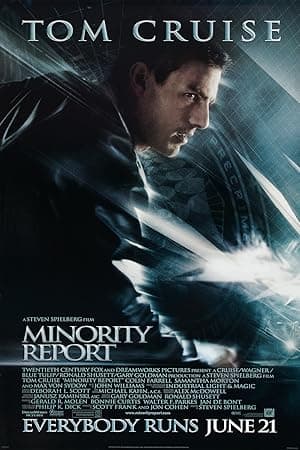
Minority Report
A high-speed thriller about a man who trusted a machine until the machine pointed a finger at him.
Feature presentation
Minority Report still snaps the head up. It’s not just Spielberg’s future toys or the rain-slick chases; it’s the fact that the story gives us a cop who built a whole career on a system and then wakes up to find it accusing him. That collision — belief versus betrayal, action versus uncertainty — is why the film is worth revisiting.
THE MOVIE
Chief John Anderton is still the reason this movie works
Think of Minority Report and you imagine technology on parade: gestural screens, slick previews of crimes, a police system that arrests people before they strike. That’s the film’s surface — spectacular and busy — but it’s not where the engine lives.
The engine is Chief John Anderton: the head of PreCrime who spends the film scrambling after the system that suddenly lists him as a future killer. He isn’t a cipher; he’s a man whose grief over his missing son and his faith in the program shape every choice he makes once the program points the finger at him.
Spielberg directs, Tom Cruise plays Anderton, and the film repeatedly stages the bigger question that sits behind the action: are futures fixed, or can they be changed? That tension — a personal crisis wired into institutional certainty — is what keeps Minority Report interesting long after the effects have had their moment.
THE SETUP
The idea that sets Minority Report in motion
The film rests on a single, brave conceit: a police unit—PreCrime—arrests people for murders predicted by three clairvoyant precogs. The future is presented to the authorities as a manipulable preview, and the whole society is organised around those previews.
That arrest-before-crime mechanic does two jobs. It gives Spielberg visually arresting ways to stage action — the previews, the raids, the chases — and it forces the story into ethical territory. If you can see a crime before it happens, what responsibility do you bear for stopping it, and what responsibility does the system bear when it’s wrong?
The plot kicks when Anderton himself becomes the system’s suspect. His decision to abduct Agatha, the lead precog, is a pointed plot device: by taking the person who sees the future, he tries to find a dissenting vision — a 'minority report' — that might clear him.
What started as Philip K. Dick’s short story is broadened into a full murder-mystery-thriller here, with new characters and institutional politics layered around that central speculative question.
THE CHARACTER
Why Chief John Anderton matters
Anderton is not just a plot pulley; he’s a living contradiction. As head of PreCrime he has spent his career trusting a system that promises certainty. When that system names him a killer, everything he believed in collapses around his private grief.
That grief — his missing son — isn’t window dressing. It’s the emotional lever that makes his faith in the machine comprehensible and his reaction to its betrayal believable. He’s acting from love and loss as much as from survival.
The movie frames his flight as investigation as much as escape. He runs not merely to save himself but to prove that the system can be wrong — and to find out why it named him in the first place.
And that mixture of personal stakes and institutional critique is what fixes the audience to the story: you’re following a man with a very particular history, not an archetypal action hero.
THE PERFORMANCE
Why Tom Cruise's performance matters
Contemporary critics singled out Cruise’s central performance as providing the film’s emotional engine. That’s a specific, useful point: the movie asks us to care about a man whose certainties have been stripped away, and the performance is the mechanism that makes that emotional journey readable.
Put simply: the plot’s philosophical puzzles work better when you feel what’s at stake for one particular character. Cruise’s presence is the short route to that feeling.
That doesn’t mean the film depends on star power alone. It layers institutional drama, technocratic spectacle and ethical questions around the character. But when the film needs you to care about the choice between fate and freedom, it invites you to do it through Anderton.
So the performance matters because it turns abstract dilemmas into human risk — and the contemporary critical response recognised that central contribution.
UNDER THE SURFACE
Minority Report has more on its mind than the plot suggests
You can watch Minority Report as a techno-thriller and enjoy the set pieces. But underneath, it’s asking recurring moral questions: is the future fixed, or do people get to choose? The film stages that free-will question repeatedly, and that repetition keeps nudging the story back toward ethics.
Closely tied to that is surveillance and privacy. PreCrime depends on legibility: it insists that future acts can be rendered visible and therefore stoppable. That raises the obvious question — who gets to look, and what happens when that looking goes wrong?
The movie foregrounds the ethics of preemptive justice. Arresting people for crimes they haven’t yet committed sounds clean on paper; in motion, it becomes messy, political and personal as we see what’s traded away in the name of security.
And finally, there’s grief. Anderton’s private loss explains why he trusted the system so fiercely and why its accusation cuts so deep. The film also balances technological spectacle against human cost: all the future toys are exciting, but they land only if you remember the person at the centre.
THE FILMMAKING
How Minority Report was put together
A big part of the film’s identity is its insistence on a unified future world. Production designer Alex McDowell created a detailed '2054' bible that the whole production used — a single source to keep the film’s visual and practical choices speaking the same language.
That consistency is furthered by the way the production leaned on early large-scale digital previsualization. Previz wasn’t just about planning stunts; it let the design and effects teams think through sequences together before they were shot, which is why the film’s big set pieces feel choreographed and precise.
On the crew side, Janusz Kamiński photographed the pictures and Michael Kahn edited them, a pair who gave the film a classical studio backbone even as it pushed into technological spectacle.
Those choices — an integrated design bible, heavy previz and a seasoned cinematography/editing team — are what make Spielberg’s future feel like a place you can move through, not just a catalogue of clever props.
PRACTICAL EFFECTS
The effects work that gives Minority Report its physical personality
The film combined digital and physical work to make its world feel tactile. Industrial Light & Magic supplied much of the digital visual-effects work and coordinated the teams that composited and matched the digital pieces to filmed plates.
That digital pipeline didn’t operate in isolation. Practical makeup and prosthetic fabrication — credited here to KNB Effects Group — provided physical elements that the cameras could catch in-camera and the VFX teams could integrate.
Multiple visual-effects vendors collaborated with the production to stitch digital environments into photographed sets and plates. That patchwork approach was necessary to make the imagined 2054 live alongside real actors.
So the film’s personality comes from a hybrid: digital teams building scope and practical crews keeping it grounded.
PURE 00s
Minority Report could not belong to any other decade
The film’s production sits at an interesting technical crossroads. Between 2000 and 2002 the industry was learning how to use large-scale digital previsualization in blockbuster planning, and Minority Report was built around that way of working.
Public conversation around the film’s themes also landed in a particular moment. Released in 2002, its debates about predictive policing and surveillance arrived in the immediate post-9/11 context when questions of security and civil liberties were especially prominent.
Designerly details from the film — especially the gestural interfaces and data-visualisation screens — were noticed early and entered broader conversations about how real products might borrow diegetic ideas from movies.
So the film reads as very much of its moment: technically forward-looking in how it was made, and thematically tuned to the political anxieties of the early 2000s.
THE LEGACY
Why Minority Report still matters
When it opened in June 2002 the film was a major commercial success, earning a substantial global box office that helped keep its questions in circulation beyond the cinemas.
Industry recognition followed: the picture picked up awards attention for its sound work and received BAFTA nominations for its visual-effects work, which underlines how seriously the craft community took its technical achievements.
Perhaps most lasting is the film’s depiction of gestural interfaces and layered data screens; designers and technologists have repeatedly pointed to those moments as noteworthy examples of diegetic prototyping — using story props to sketch real design possibilities.
Put together, those elements explain why the film keeps being mentioned: it worked as spectacle, it had craft cred, and it planted visual ideas that outlived the movie’s initial run.
THE VERDICT
Does Minority Report still hold up?
Yes — and with a useful rider. The film’s central idea remains arresting: a police force built on three precogs whose visions function as previews of crimes. When that system points at its own leader, the plot gives us a very human way into thorny philosophical questions.
Much of the movie’s continuing pull rests on the particulars: Anderton as a man whose grief and faith make the stakes feel personal; his choice to abduct Agatha in search of a dissident vision; the way PreCrime’s previews let Spielberg turn abstract dilemmas into physical action set pieces.
There’s also value in the film’s balancing act. It’s a thoughtful thriller that pairs ethical argument with spectacle and places an inquisitive investigator — Danny Witwer — against an institutional machine. That mix still makes it worth watching rather than merely scanning as a tech-demo.
So watch it for the questions and for the way the questions are embodied in a single troubled figure. Minority Report still works because it asks you to care about a person forced to choose between what he knows and what he hopes can be changed.
Share this movie
Keep watching
More movies from the 00s

2002
The Pianist
A quiet life unmade by war — and a pianist who refuses to stop listening.
Read the retrospective
→
2006
Blood Diamond
A mercenary, a fisherman and a pink diamond — and a film that still asks who pays for our jewellery.
Read the retrospective
→
2003
Kill Bill: Volume 1
A yellow jumpsuit, a long list of enemies and one woman who refuses to be finished.
Read the retrospective
→