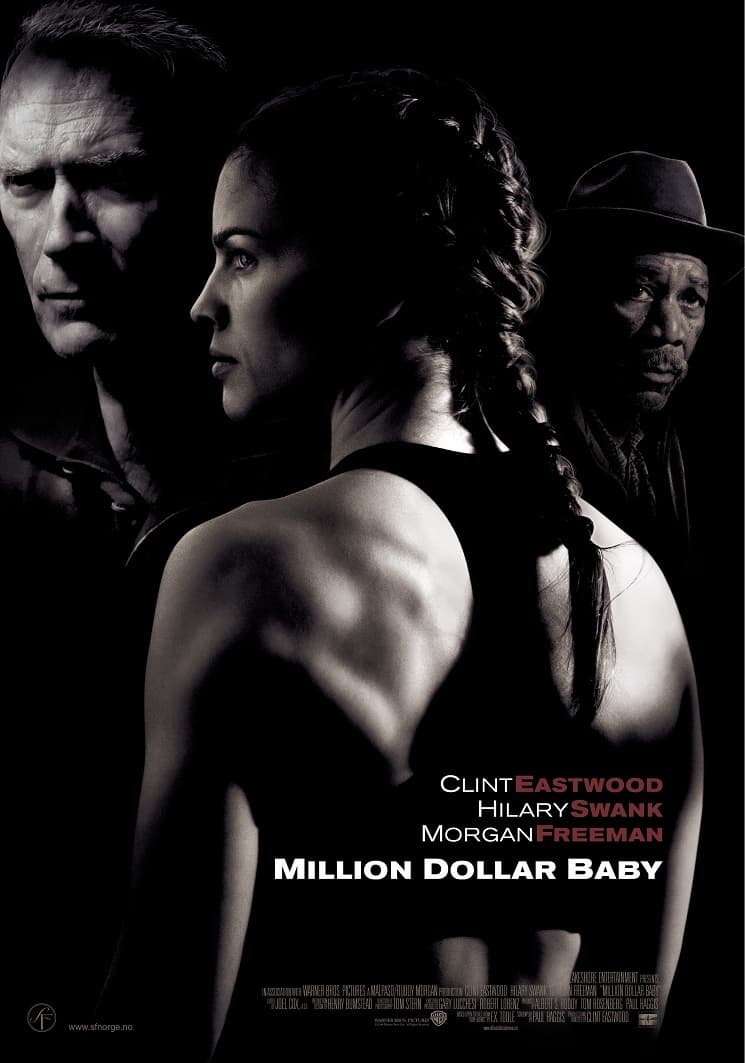
Million Dollar Baby
A boxing story about punches, promises and the cost of keeping them.
Feature presentation
Million Dollar Baby is the sort of film that arrives at the corner of sport and sorrow and refuses to look away. It's a movie about a stubborn woman who wants to fight, and the hard‑edged trainer who becomes the only person willing to take her seriously — and that stubborn bond is why the film still draws attention.
THE MOVIE
Frankie Dunn is still the reason this movie works
You know the shape of this movie before the credits finish: a thirty‑something waitress shows up at a rundown gym and asks a veteran trainer for a chance. Maggie Fitzgerald wants to box professionally; Frankie Dunn refuses, then — characteristically, reluctantly — changes his mind. That single request is the crude chemistry on which the whole film runs.
Frankie matters because he carries the film’s moral weight. He’s a solitary man who keeps fighters safe by sticking to a personal code; when Maggie insists, it’s his code that gets tested. The trainer–trainee setup gives the drama a very particular gravity — it’s sports cinema with a persistent, private ache at its centre.
Clint Eastwood directed Million Dollar Baby and also plays Frankie, while Hilary Swank is Maggie and Morgan Freeman narrates as Eddie. The movie is as much about the ties people build in a hard place as it is about wins and losses in the ring — surrogate family, ambition and difficult moral choices sit at its heart.
THE SETUP
The idea that sets Million Dollar Baby in motion
At its simplest: Maggie asks to be trained. Frankie says no. She keeps asking. He eventually agrees. That compact exchange is both a plot engine and an emotional promise — the film then watches what happens when a cautious man lets someone into the life he has carefully guarded.
From there the story tracks Maggie’s push to become a professional boxer, and how the gym’s regulars reconfigure around that ambition. The fights do more than move the score along; they measure how the characters change as Maggie rises.
Crucially, the drama pivots when a severe ring injury forces the film away from competition and towards questions of care and responsibility. The story begins as an underdog sports tale and then becomes a much grimmer meditation on what we owe people we have chosen to love.
THE CHARACTER
Why Frankie Dunn matters
Frankie isn't background colour; he's the film's moral fulcrum. As a world‑weary, solitary trainer, his whole life is organised around protecting fighters and keeping a hard‑won code intact. When that code is stretched by Maggie, the emotional stakes of the story become very specific and personal.
The film pairs Frankie with Eddie 'Scrap‑Iron' Dupris, a former fighter who works at the gym and acts as friend, narrator and conscience. Their long friendship sketches a small community around Frankie and shows how rare real loyalty looks in these characters' lives.
Secondary figures — fellow fighters, family members, a priest — give the audience the social texture that explains why Frankie is so isolated to begin with. In that sense, the movie is less interested in the glamour of victory and more interested in what relationships do to and for a man who has learned to keep his feelings quiet.
UNDER THE SURFACE
Million Dollar Baby has more on its mind than the plot suggests
On the surface it’s a boxing drama, but the film keeps nudging you towards human attachments. Surrogate family and father–daughter dynamics quietly reshape what might have been a routine sports movie into something that cares about belonging and responsibility.
Ambition and perseverance power Maggie’s trajectory — she wants out of her class‑bound life and sees boxing as a route to self‑respect. That drive changes the gym’s dynamics and forces characters to confront what they will and won’t sacrifice for another person.
Importantly, the narrative also becomes a moral puzzle about care. After the injury, the plot centres on dependency and the agonies of making irreversible choices on someone else’s behalf — medical ethics and assisted‑death questions sit at the film’s uneasy core.
There’s also an old‑school masculinity at play: Frankie’s choices are filtered through a life that prizes stoicism and redemption by service. The film stages those ideals against the human cost they can demand.
THE FILMMAKING
How Million Dollar Baby was put together
Tom Stern served as director of photography, and the film’s look deliberately stays low on flash. The visual approach favours restraint: nothing in the frame screams for attention, which keeps the focus on the people and the choices they make.
Henry Bumstead’s production design gives the gym and domestic spaces a lived‑in, worn quality. Those interiors do a lot of quiet work, reminding the audience of the characters’ economic realities without spelling them out.
Behind the camera, Joel Cox handled the editing, and the whole package aims for a realist mood rather than spectacle. That restraint makes the later moral confrontations hit harder because the movie has spent so long building believable everyday stakes.
PURE 00s
Million Dollar Baby could not belong to any other decade
Released at the end of 2004, Million Dollar Baby became an awards heavyweight in early 2005. Its timing and reception placed it squarely in the sort of adult‑themed drama that dominated awards conversations at the time.
It also fits into Clint Eastwood’s early‑2000s directorial phase — a stretch of films where he favoured moral dramas aimed at grown‑up questions rather than franchise cinema. That phase helps explain the film’s unflashy, serious tone.
Equally, the film’s handling of severe disability and assisted‑death themes sparked organised criticism and public statements from disability‑rights groups in 2005. Those debates became part of the picture’s cultural afterlife and show how the movie touched on larger public conversations of the decade.
THE LEGACY
Why Million Dollar Baby still matters
Part of the film’s enduring footprint is institutional: it won four Academy Awards, including Best Picture, Best Director, Best Actress and Best Supporting Actor, and it appeared on multiple year‑end top‑ten lists. That level of recognition made it impossible to ignore at the time.
But its legacy is also argumentative. The organised protests and public statements from disability‑rights organisations in 2005 are an explicit piece of the movie’s afterlife — people continued to argue about what the film was saying long after the credits rolled.
Between formal acclaim and public debate, Million Dollar Baby remains a film people return to because it raises uncomfortable questions while refusing neat answers. That tension — between award recognition and ethical controversy — is a large part of why it keeps being discussed.
THE VERDICT
Does Million Dollar Baby still hold up?
Yes — with a careful caveat. If you want a sports drama that also asks heavy questions about obligation and the cost of keeping promises, this is still one of the cleanest executions of that idea. The film is built around the clear, compelling engine of Maggie asking to be trained and Frankie, who eventually accepts her, and it follows where that choice leads.
The structure — training, fights, then the traumatic injury that reroutes the plot into care and moral decision‑making — is purposeful. It makes the emotional consequences feel earned rather than tacked on, because the characters have been living in this world long enough for the stakes to feel real.
However, be prepared for the film to put you in an argumentative mood. Its handling of assisted‑death and disability is explicit enough that it generated organised criticism at the time, and those are the exact conversations it will prompt now.
So should you watch it? If you’re ready for a drama that blends the ring with wrenching moral choices and a focus on human ties rather than spectacle, it’s worth your time. Million Dollar Baby asks you to sit with uncomfortable answers, and for better or worse, it still makes that sitting matter.
Share this movie
Keep watching
More movies from the 00s

2002
The Pianist
A quiet life unmade by war — and a pianist who refuses to stop listening.
Read the retrospective
→
2006
Blood Diamond
A mercenary, a fisherman and a pink diamond — and a film that still asks who pays for our jewellery.
Read the retrospective
→
2003
Kill Bill: Volume 1
A yellow jumpsuit, a long list of enemies and one woman who refuses to be finished.
Read the retrospective
→