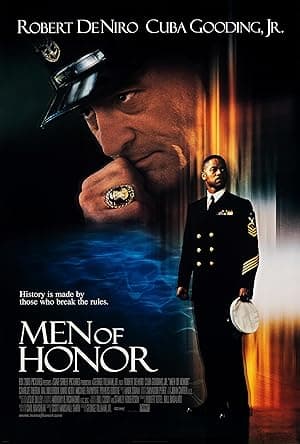
Men of Honor
A true-life dive into stubbornness, authority and what it costs a man to be allowed to belong.
Feature presentation
Men of Honor is the kind of turn-of-the-millennium biopic that likes its struggles straightforward and its stakes tangible. George Tillman Jr. tells Carl Brashear’s climb out of poverty into the Navy diving world as a series of tests — physical, institutional and reputational — and the film hangs on that climb. If you’re deciding whether to revisit it, start with what it puts at the centre: a man who will not accept his assigned place.
THE MOVIE
Carl Brashear is still the reason this film works
Men of Honor takes a simple, stubborn premise and refuses to let go: a Kentucky sharecropper’s son decides he will be a Navy diver and will not be stopped. That stubbornness is not phrased as vague heroism; it’s a career plan with teeth — the film follows his rise toward the Navy’s highest enlisted diving qualification and the costs that come with it.
George Tillman, Jr. stages Brashear’s story as a series of practical hurdles — training, salvage operations, a devastating injury — rather than theatrical moralising. The result is an engine of perseverance that keeps the film moving across its 128 minutes.
And because the story is grounded in a real life — Carl Brashear’s — the personal stakes remain apparent throughout. Gooding plays Brashear; De Niro turns up as the hard-nosed Master Chief who stands in for the institutional resistance Brashear faces. It’s a movie about climbing, and about what gets in the way of the climb.
THE SETUP
The idea that sets Men of Honor in motion
At its most basic, the film tracks a climb: Brashear leaves rural poverty to train as a Navy diver and keeps moving forward despite being blocked at almost every turn. That forward momentum — a chain of entry exams, classroom drills and brutal field exercises — is what structures the story.
Tillman treats those procedural moments as story mechanics. The training sequences, the salvage dives and the tests of endurance are not window dressing; they are the beats that measure Brashear’s progress and mark the Allies and opponents he meets along the way.
Threaded through the practical work is the film’s account of institutional racism: the obstacles Brashear faces are both personal and structural, so the training ground becomes a stage for larger social friction without the film losing sight of the immediate, physical demands placed on him.
That combination — a concrete professional goal plus recurring, high-stakes tests — keeps the drama legible. You always know what Brashear is trying to achieve and precisely how he’s being measured.
THE CHARACTER
Why Carl Brashear matters
What makes Carl Brashear memorable in the film is how precise his aim is. He’s not chasing vague dignity; he wants the professional recognition and practical escape that being a Navy diver promises. That clarity keeps his character grounded and easy to follow.
The film constantly returns to what Brashear must do to belong: pass the tests, survive the dives, endure the institutional pushback. His single-mindedness turns the plot into a succession of clear challenges rather than an inward psychological mystery.
He’s not alone on screen — Gwen and Jo give the story its personal axis, negotiating family life and the pressures that come with Brashear’s career. Their presence reminds us that his choices ripple beyond the diving pool and into the relationships that matter to him.
Finally, the movie frames much of Brashear’s opposition through a composite character, the Master Chief, who stands in for the institutional resistance Brashear encountered. That shapes the drama as a duel between determined individual and guarded institution, which is where the film draws most of its heat.
THE PERFORMANCE
Why Cuba Gooding Jr.'s portrayal matters
Contemporary reviewers singled out Cuba Gooding Jr.’s earnest turn as a stabiliser for the film. That phrasing tells you what his contribution is: he makes Brashear’s determination legible and central, so the story’s forward motion has a believable human engine.
Gooding’s casting matters because the film relies on a straightforward, sympathetic centre — Brashear’s resolve — and the performance anchors the audience to that clarity. When the film asks you to root for someone to pass another test, it’s easier to do because that someone feels real in the moment.
Put simply: the movie depends on Brashear being convincing as a man who will not accept second best, and contemporary commentary identified Gooding as the actor who supplied that credibility.
UNDER THE SURFACE
Men of Honor has more on its mind than the plot suggests
On the surface it’s a string of training scenes and salvage missions. Underneath, the film is about perseverance — not abstract moralising but the daily, often boring grind of refusing to be sidelined. That grind is the film’s point of view.
Institutional racism is the context those trials take place in. The obstacles Brashear faces are not only interpersonal slights; they are built into the system he is trying to join, so the story keeps switching between personal stubbornness and systemic blockage.
There’s also a persistent conversation about masculinity and professional identity: being a diver is shown as a form of belonging that confers status and self-respect. Brashear’s fight is as much about claiming that professional identity as it is about individual survival.
And because the film stages those conflicts through authority figures and rivals — the tough old Master Chief among them — mentorship and rivalry becomes another way to explore how institutions police who belongs and who doesn’t.
THE FILMMAKING
How Men of Honor was put together
A big part of the film’s feel comes from where it was built. The production put together a constructed Bayonne Dive School on the Columbia River, a three-acre campus used for the training scenes. That decision lets the film create a contained, believable training world rather than stitching together disparate locations.
The collaboration with the Navy on period set dressing gave those environments an institutional authenticity that supports the story’s emphasis on procedure and rank. When the film shows the training grind, it looks like a functioning training community, not a collection of movie sets.
Those practical production choices — building a campus, working with the Navy on detail — help the film sell its premise: this is a profession with its own rituals, and Brashear’s struggle is fought inside those rituals.
George Tillman, Jr. returned from Soul Food to direct this more overtly procedural, star-led biopic, which gives the film a mainstream, straightforward approach to its material.
PRACTICAL EFFECTS
The effects work that gives Men of Honor its physical personality
When the film needs to sell danger under the surface, the production didn’t fake it: a 270,000-gallon tank was constructed inside a Long Beach airplane hangar for the underwater and training sequences. That commitment to a physical water environment shapes how those scenes read — they feel like work, not visual shorthand.
The deck-accident scene was filmed aboard the USS Navaho standing in for the real ship, which again roots the film’s crises in tangible, practical settings rather than digital trickery.
For the story’s most intimate physical moment — Brashear’s injured leg and amputation — effects and makeup supervisor Susan Zwerman developed multiple prosthetic appliances to chart the injury’s progression. That on-body attention keeps the medical reality present in the drama.
The underwater work also relied on experienced diving consultants and an award-winning underwater cinematographer, which explains why the dives read as disciplined operations rather than generic action set pieces.
PURE 00s
Men of Honor could not belong to any other decade
This film is very much a product of its moment: a mainstream, star-led biographical drama released in November 2000. Fox 2000 backed a straightforward human story with established names and an emphasis on procedural clarity — a late-1990s/early-2000s approach to biography.
At the turn of the millennium Hollywood was returning again and again to mid-20th-century stories about race and institutional change, and Men of Honor fits neatly into that cycle. It trades in the recognisable structure of a heroic climb through a resistant institution.
George Tillman Jr. came to Men of Honor after Soul Food, and the film represents his move into larger-scale, star-centred drama — the sort of studio project that used a familiar narrative template to make a real-life story accessible to broad audiences.
Put bluntly: the film’s decision to make the plot procedural and the lead plainly sympathetic feels of-the-moment for 2000 — mainstream, earnest, and built around a recognisable dramatic engine.
THE LEGACY
Why Men of Honor still matters
One clear piece of evidence: the film helped broaden public awareness of Carl Brashear’s life. His story has continued to be referenced in naval histories and museum material since the film’s release, so the movie did more than dramatise — it amplified a life into public conversation.
That amplification connects to real institutional acknowledgements. The Navy later honoured Brashear in ways that keep his name in service memory — including naming a dry cargo ship after him and holding events that recall his story — so the film’s imprint exists outside cinema as well.
In short, Men of Honor matters because it turned an individual story into a touchpoint for institutional memory; the film functions as one of the ways many people first learn Brashear’s name and why it matters.
That afterlife — a film that feeds into institutional recognition — is a tidy illustration of how cinema and public memory can intersect.
THE VERDICT
Does Men of Honor still hold up?
Yes — with caveats. If you come to Men of Honor for a clear, character-driven account of someone who refuses to be shoved aside, it still delivers. The film follows Brashear from a Kentucky sharecropper’s son to a man who fights for professional recognition within the Navy, and that through-line is satisfying and straightforward.
Its strengths are the film’s discipline: the story is organised around the dive school, the recurring procedural tests and a major onboard accident that reshapes everything. Those mechanics keep the drama honest — you can see the next goal, and you can feel what it will cost to reach it.
The interpersonal friction is sharpened by a purposeful antagonist: Billy Sunday is written as a hard-nosed Master Chief whose initial hostility stands in for the institutional barriers Brashear faced, and that invented composite helps the film concentrate its conflict without losing sight of reality.
And crucially, the film’s centre holds. Cuba Gooding Jr. plays Brashear, and contemporary commentary identified his portrayal as a central strength. If you want a film that wears its earnestness plainly and trusts a simple, human story of perseverance, Men of Honor remains worth watching.
Share this movie
Keep watching
More movies from the 00s

2002
The Pianist
A quiet life unmade by war — and a pianist who refuses to stop listening.
Read the retrospective
→
2006
Blood Diamond
A mercenary, a fisherman and a pink diamond — and a film that still asks who pays for our jewellery.
Read the retrospective
→
2003
Kill Bill: Volume 1
A yellow jumpsuit, a long list of enemies and one woman who refuses to be finished.
Read the retrospective
→