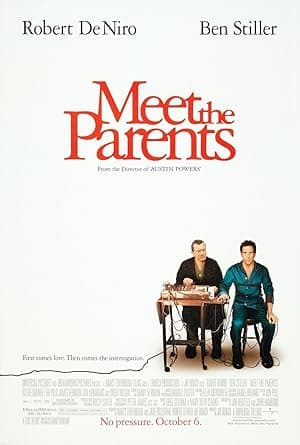
Meet the Parents
Awkward, anxious, and alarmingly watchable — Greg Focker meets the in‑laws, and nothing is the same again.
Feature presentation
If you can feel your palms sweating at the thought of meeting your partner’s parents, Meet the Parents will feel uncomfortably familiar — and often very funny. Jay Roach’s 2000 comedy places a well‑intentioned, hapless man in the orbit of a suspicious ex‑intelligence father and then lets social panic do the rest. It still speaks to the small, humiliating tests that decide whether you belong in a family.
THE MOVIE
Greg Focker is still the reason this movie works
Meet the Parents hooks you immediately by putting one man’s life ambitions (to propose, to be accepted) through the grinder of in‑law scrutiny. The setup — Greg Focker arriving at his girlfriend’s family home and trying to win the father’s stamp of approval — is comedy built from a single, universal awkwardness.
What keeps that awkwardness interesting is how Greg’s insecurity and clumsiness repeatedly bounce off Jack Byrnes’s intelligence‑trained suspicion. Every mistake matters because it’s not merely embarrassing; it’s evidence in the court of family judgement.
Directed by Jay Roach and released in 2000, the film runs a tight 108 minutes and surrounds Ben Stiller’s Greg with a cast of characters who together turn the private terror of being judged into a comedy of escalating mishaps.
THE SETUP
The idea that sets Meet the Parents in motion
The film’s engine is economical: Greg, a male nurse, travels to meet Pam’s parents intending to propose, but first he must navigate the gauntlet of family approval. That simple premise funnels everything into a single question — can he persuade them he belongs?
Conflict arrives naturally because Jack Byrnes is introduced as a wary former intelligence operative; his background makes suspicion feel like a believable, built‑in device rather than a contrivance. Once suspicion is on the table, ordinary accidents turn into catastrophic evidence.
The screenplay riffs on this by seeding the movie with details — cherished objects, surveillance habits and small domestic rules — that it returns to as complications. Those callbacks are what turn isolated gags into a steadily escalating problem for Greg.
Because the story keeps the stakes domestic and specific, the payoffs feel earned: it’s not a war of grand gestures but a slow, relentless interrogation of a man trying very hard to be acceptable.
THE CHARACTER
Why Greg Focker matters
Greg Focker matters because the whole movie is calibrated to his nerves. He’s trying to be a good partner and a decent future son‑in‑law, but his insecurity and a knack for clumsiness keep turning his intentions into evidence against him.
That combination — well‑meaning ambition plus social awkwardness — gives the film its forward motion. Greg isn’t interesting because he’s perfect; he’s interesting because every attempt to show competence becomes an opportunity for humiliation.
Pam occupies the central emotional position between Greg and her parents, which is why Greg’s need for approval feels urgent rather than petty: he’s not just worried about etiquette, he’s worried about being trusted by the person he wants to marry.
Complicating matters, the household is full of other people — siblings, ex‑boyfriends, neighbours — whose rivalries and expectations amplify the pressure. Greg never faces Jack in a vacuum; he’s being measured against an entire domestic ecosystem.
UNDER THE SURFACE
Meet the Parents has more on its mind than the plot suggests
On the surface it’s a string of embarrassments; underneath it’s a movie about family judgement and the rites that decide who belongs. The comedy rides on the familiar terror of being evaluated by someone whose approval matters.
Masculinity and social competence are quietly under the skin. Greg’s profession and behaviour are repeatedly read as tests of manliness and reliability, and those tests are cartoonish but insistently linked to real anxieties about role and respect.
A second seam is surveillance and mistrust: Jack’s background and habits make the home feel like a place where you are always being assessed. Suspicion turns the ordinary into evidence — a lost cat, a misplaced object — and the film mines that for laughs.
Finally, the movie cares about honesty versus presentation. Greg is often trying to perform the right thing to win approval, and the comedy asks whether pretending competence is a betrayal or simply a practical survival skill in the world of in‑laws.
THE FILMMAKING
How Meet the Parents was put together
This is a studio comedy that trades on tight construction as much as comic beats. Cinematographer Peter James and editors Jon Poll and Greg Hayden are credited for shaping the film’s rhythm, and you can feel that craft in how jokes are set up and paid off.
Production designer Rusty Smith’s domestic interiors do the heavy lifting for a lot of the humour: the house isn’t just a backdrop, it’s a stage of family status and rules where sight gags and discoveries can be planted and retrieved.
That staging matters because the screenplay depends on the environment to turn small details into recurring complications. The filmmaking choices keep the film focused on the family as a functioning machine of judgement.
Randy Newman’s involvement as composer is another production credit that places the film in a broadly commercial, character‑driven comedy tradition rather than a niche gag‑film experiment.
PURE 00s
Meet the Parents could not belong to any other decade
Released in 2000, Meet the Parents fits the era’s appetite for star‑led, broadly marketed studio comedies. It’s built around familiar names and a simple premise that could sell on poster copy and TV spots.
The casting of a serious dramatic actor in a high‑profile comic role — Robert De Niro as Jack Byrnes — is very much of the period. That kind of switch helped market the film beyond the usual comedy crowd by promising unexpected confrontations.
At the same time, the movie’s focus on domestic anxieties rather than edgier culture wars positions it squarely in the mainstream romantic‑comedy mode studios favoured at the turn of the millennium.
Finally, the fact that the story continued into sequels reflects how studios at the time were ready to extend character‑based comedies into franchises when audiences responded.
THE LEGACY
Why Meet the Parents still matters
Part of the film’s afterlife is simply practical: it created a multi‑film franchise that kept returning to Greg and the Byrnes clan, which means the characters have had a longer shelf life than most single comedies.
Another strand of legacy is musical: Randy Newman’s original song from the soundtrack earned an Academy Award nomination, which is a tidy reminder that the film registered formally as well as commercially.
Beyond those concrete facts, the movie remains a useful shorthand for the terror of meeting the in‑laws — a social experience that hasn’t gone away and is why the characters get mentioned when people talk about awkward family comedies.
It’s not that everything about it changed comedy forever; it’s that the film captured a persistent situation with clarity and a cast of characters built to carry it forward.
THE VERDICT
Does Meet the Parents still hold up?
Yes — if you’re after a compact, well‑engineered comedy about being judged by family, it mostly still works. The premise remains sharp: Greg goes to win approval before proposing and every klaxon of suspicion makes a small disaster matter hugely.
What helps is discipline: the film introduces household rules and objects early and brings them back as complications, so jokes accumulate rather than repeating themselves. That kind of structural care keeps the escalating awkwardness satisfying.
The movie’s strongest thread is the collision between Greg’s earnestness and Jack’s investigative distrust. When those two forces line up, the stakes — social, not life‑or‑death — feel real enough to make the comedy land.
If you watch now, you’ll see a studio romantic comedy of its moment, neatly made and still funny in the way it maps family judgement and social competence onto everyday life. For a night when you want equal parts cringe and craftsmanship, bring Greg Focker along.
Share this movie
Keep watching
More movies from the 00s

2002
The Pianist
A quiet life unmade by war — and a pianist who refuses to stop listening.
Read the retrospective
→
2006
Blood Diamond
A mercenary, a fisherman and a pink diamond — and a film that still asks who pays for our jewellery.
Read the retrospective
→
2003
Kill Bill: Volume 1
A yellow jumpsuit, a long list of enemies and one woman who refuses to be finished.
Read the retrospective
→