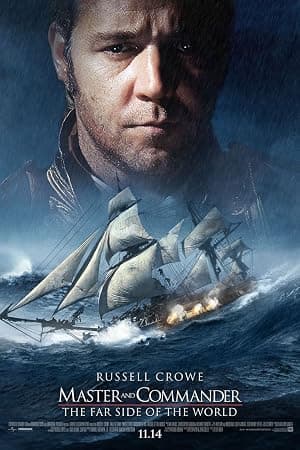
Master and Commander: The Far Side of the World
Tall ships, harder choices — and Jack Aubrey at the helm.
Feature presentation
There’s a particular kind of pleasure to seeing a captain who treats seamanship like a language. Master and Commander: The Far Side of the World is first and foremost Russell Crowe’s Jack Aubrey — an officer whose appetite for duty and combat drags everyone else along, whether they like it or not. Peter Weir’s 2003 take on Patrick O’Brian’s sea stories keeps its eye on the chase, but it’s the human friction aboard HMS Surprise that makes the film worth revisiting.
THE MOVIE
Jack Aubrey is still the reason this movie works
Master and Commander: The Far Side of the World is the sort of film that announces itself with a mission: Captain Jack Aubrey takes HMS Surprise after a larger, better-armed French ship and refuses to let the story go. That chase — literal and professional — supplies the engine, but it’s Aubrey’s appetite for duty and combat that actually steers the picture.
Peter Weir’s 2003 adaptation stitches together episodes from Patrick O’Brian’s novels, letting the naval pursuit sit beside quieter daily life aboard a single vessel. The screenplay keeps the plot lean enough to let character tensions breathe: leadership under pressure, friendship pulled taut by professional obligation, practical shipboard logistics.
It’s the human scale that keeps the film from feeling like a museum piece. Crowe and Paul Bettany’s pairing is the centrepiece, and the production backs that intimacy with big, tangible filmmaking — full-size ships, studio tanks, location shoots and a visual-effects pipeline that dresses those practical bones. A film this invested in craft still rewards close attention.
THE SETUP
The idea that sets Master and Commander: The Far Side of the World in motion
Keep this simple: Aubrey is an officer with orders and an appetite for action. When Admiralty business sends him to intercept a French privateer, the film becomes a prolonged ship-to-ship pursuit that carries the story across oceans.
That chase gives the movie shape, but most of the drama is manufactured inside the confined, repeating world of a single warship. Daily routines, discipline, repairs and the unglamorous logistics of keeping a vessel afloat are central story mechanics — and the filmmakers treat them as dramatic material rather than background colour.
The screenplay borrows from several of Patrick O’Brian’s Aubrey–Maturin novels, which helps explain the episodic feel: action scenes punctuate long stretches of shipboard life, and those stretches are where character choices matter most.
Finally, the setup lets two kinds of priority clash: Aubrey’s pursuit of martial reputation versus other concerns aboard ship. That tension — between orders and other goods — is where the simple chase becomes something with emotional weight.
THE CHARACTER
Why Jack Aubrey matters
Jack Aubrey is the lever that moves the whole film. He isn’t a vague heroic type; he’s a captain whose career, reputation and appetite for combat shape every decision the Surprise makes. When he chooses pursuit, the ship follows — not because of abstract heroism, but because that’s his job.
That single-mindedness is dramatic fuel. It creates conflict on board, pressures Maturin’s different priorities and turns ordinary ship life — repairs, discipline, logistics — into moral and narrative pressure points.
Aubrey’s importance isn’t just about action. His relationship with the ship’s surgeon and naturalist, Dr. Stephen Maturin, supplies the counterpoint: friendship that keeps bumping up against professional duty. The film centres on that friction as much as on the chase.
In short: you remember Master and Commander because it gives you a captain who makes hard choices, and then lets the consequences ripple through a small, contained world.
THE PERFORMANCE
Why Russell Crowe's performance matters
Contemporary critics singled out the central performances as one of the film’s stabilising forces. The casting decision anchors the narrative’s scale: the story never feels like a spectacle that forgot its people.
The point worth noting is the film’s human measurement. Reviews at the time emphasised how the relationship between the captain and his ship’s surgeon gives the chase emotional grounding, and that rapport is repeatedly mentioned as key to the picture’s success.
So when you watch it again, pay attention less to bravura moments and more to how the central pairing keeps the rest of the ship honest. That’s the performance thread commentators singled out for praise.
In other words: the performances were a critical reason the film felt like more than a naval romp, and that remains a fair shorthand for why the acting still matters when you revisit it.
UNDER THE SURFACE
Master and Commander: The Far Side of the World has more on its mind than the plot suggests
On the surface it’s a chase. Underneath, the film keeps circling a handful of ideas: leadership under sustained pressure, the clash between friendship and professional duty, and a blunt man-versus-nature reality about sailing warships.
Life aboard a ship is small and intense, which means leadership isn’t abstract — it’s decisions about food, repair, morale and whether to risk the crew for glory. That practical confinement turns command into a moral test.
There’s also a quieter theme about scientific curiosity during wartime. The film pairs military urgency with a character whose interests pull in another direction, and that tension helps the movie avoid single-note heroics.
Those are tidy, human themes. They keep the film from being only about cannons and rigging; instead it becomes a drama about choices that have both professional and personal costs.
THE FILMMAKING
How Master and Commander: The Far Side of the World was put together
There’s a tangible seriousness to the production choices. The film lists Russell Boyd as cinematographer, Lee Smith as editor and William Sandell as production designer — names that signal a craft-first approach to a physical, demanding shoot.
That care translated into awards: the film won the Academy Award for Best Cinematography and for Best Sound Editing, and it collected several other top-category nominations. Those recognitions underline how the technical work was central to the film’s identity.
Weir’s production favours material texture over spectacle for spectacle’s sake. The filmmaking is arranged to support the story’s enclosed world, so every technical decision feels like it’s helping the ship feel lived in.
Put plainly: this isn’t a glossy, lightweight adventure. The production credits and awards reflect a film built to be felt as much as watched.
PRACTICAL EFFECTS
The effects work that gives Master and Commander: The Far Side of the World its physical personality
A lot of the movie’s personality comes from its practical approach. A full-scale replica of HMS Surprise (the tall-ship Rose) was used for open-sea work, and many action and storm sequences were shot in large studio water tanks — including a gimbal-equipped stage — to get those close, physical beats right.
At the same time, Weta Workshop built highly detailed miniature ships for long shots. Those models were composited with live-action water plates and other elements, so the film blends tactile craft with optical integration.
Visual-effects work grew during production and ultimately involved several vendors combining miniatures, matte paintings, water plates and some digital water. The result is a hybrid approach: practical foundations augmented by effects where needed.
That mixture gives the film a very hands-on feel. The maritime business of the movie is built from things you can almost touch, with VFX used to sell scale and danger rather than replace it.
PURE 00s
Master and Commander: The Far Side of the World could not belong to any other decade
The film is very much a product of the early 2000s industry: a mainstream picture that married large practical builds with an expanding visual-effects pipeline rather than going all-digital. That hybrid approach was characteristic of the period.
Part of that meant repurposing serious facilities — the production made use of the large Fox Baja water tanks originally built for Titanic — which shows how the era favoured reusing big practical infrastructure for ambitious period work.
There was also contemporary sensitivity around certain adaptation choices; AFI documentation notes that the film changed the enemy from American in the books to French on screen, a production decision discussed in its time and tied to early-2000s context.
The film’s 2003 release places it in a moment when studios were still prepared to back large-scale, craft-driven historical dramas — an appetite that suited Peter Weir’s hands-on style.
WATCHING IT NOW
What has aged — and what hasn't
If you’re watching Master and Commander today, its technical craft still reads well. Retrospectives and home-video write-ups continue to point to the cinematography, production design and the blend of practical and digital effects as elements that hold up.
The film’s focus on friendship versus professional duty also retains emotional traction. The central relationship between Aubrey and Maturin still feels like the movie’s beating heart, and that human thread is resilient to changing tastes.
Where it might feel dated is less to do with effects and more with the industry moment it represents: a type of studio confidence in long-form, detail-heavy period storytelling that is rarer now. But the story mechanics that depend on enclosed-ship life — discipline, logistics, repairs — remain oddly immediate.
In short: the craft and the character tensions age better than any particular production fashion, and that keeps the film watchable for modern audiences.
THE LEGACY
Why Master and Commander: The Far Side of the World still matters
The film’s awards season recognition is part of why it hasn’t drifted into oblivion: it won Academy Awards for Best Cinematography and Best Sound Editing, and it picked up multiple nominations including Best Picture and Best Director. Those honours signalled that critics and institutions took its craft seriously.
It also found its way into several year-end top-ten lists and received nods from organisations like the American Film Institute and the National Board of Review in 2003. That level of recognition cemented it as more than a novelty historical stunt.
The soundtrack release the same year also helped give the film a proper cultural package; it was a production that presented itself as a complete, carefully assembled piece of cinema.
All of which adds up to a legacy based on craft and seriousness: not necessarily a blockbuster franchise footprint, but a durable example of what large-scale, character-driven period filmmaking could look like in the early 2000s.
THE VERDICT
Does Master and Commander: The Far Side of the World still hold up?
Short answer: yes — if you’re interested in a shipboard drama that privileges character choices as much as naval spectacle. The film’s setup is straightforward (Aubrey chasing a larger French privateer into the Pacific), but the screenplay’s use of multiple Patrick O’Brian episodes lets the long chase carry smaller human conflicts along with it.
The confined reality of life aboard HMS Surprise — the routines, repairs and logistics — still pays dividends for modern viewers because those details are where leadership and duty become tangible. The film’s dramatic engine runs on small decisions as much as it does on cannon fire.
Russell Crowe’s Aubrey and Paul Bettany’s Maturin remain the viewing anchors. Contemporary critics singled out the central performances for how they kept the picture measured, and that human rapport is the reason the movie’s emotional beats still land.
If you want big-sea excitement, historical texture and a film that remembers people while it stages action, this is one to watch. It’s not lightweight entertainment, but that’s precisely the point: Master and Commander rewards attention, and it still has the ballast to keep you interested.
Share this movie
Keep watching
More movies from the 00s

2002
The Pianist
A quiet life unmade by war — and a pianist who refuses to stop listening.
Read the retrospective
→
2006
Blood Diamond
A mercenary, a fisherman and a pink diamond — and a film that still asks who pays for our jewellery.
Read the retrospective
→
2003
Kill Bill: Volume 1
A yellow jumpsuit, a long list of enemies and one woman who refuses to be finished.
Read the retrospective
→