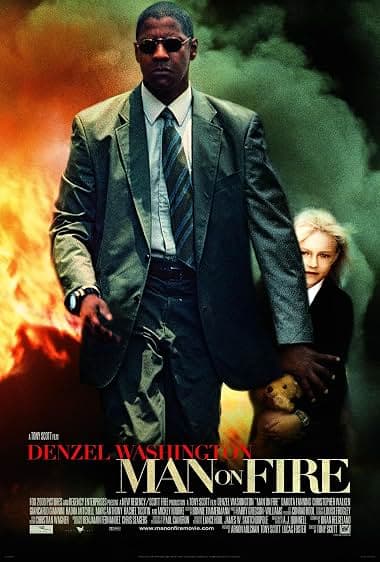
Man on Fire
A burnt-out guardian, a bright little girl and a very short list of people to forgive.
Feature presentation
Man on Fire is the sort of movie that announces itself through mood and relationship more than plot mechanics: a damaged man finding a reason to live, and then a reason to burn. Tony Scott’s 2004 take pairs that stark, sentimental kernel with elbow‑nudge violence and a relentless, watch‑this‑guy-get-even pulse — and it still makes for a compelling, slightly uneasy watch.
THE MOVIE
John W. Creasy is still the reason this movie works
There’s a single relationship at the heart of Man on Fire that does all the heavy lifting. Creasy, a burned‑out former operative, is hired to look after nine‑year‑old Lupita Ramos; the way his life begins to matter again because of that tiny human is the film’s emotional engine.
Tony Scott directs this 2004 adaptation of A. J. Quinnell’s novel, relocating the story to Mexico City and steering the whole thing through nearly two and a half hours of mood shifts, montage and slow, cold retribution.
Put simply: the movie lives or dies on Creasy. His turnaround — from suicidal, alcoholic loner into someone who will stop at nothing for the child who trusts him — gives the picture both its warmth and its menace. That contradiction is what keeps people talking about Man on Fire.
THE SETUP
The idea that sets Man on Fire in motion
The film’s inciting strike is mercilessly simple: Lupita is kidnapped while Creasy is meant to be watching her. That single moment rearranges everything and converts a private, quiet redemption into a very loud mission.
From there the story becomes a hunt. Creasy’s task is not a courtroom or a police investigation so much as a one‑man campaign to find everyone tied to the abduction and make them pay — and the film frames that hunt against a system riddled with corruption and networks that treat kidnapping as an industry.
Brian Helgeland’s screenplay doesn’t deliver Creasy’s past in a neat, linear package. Instead it uses flash‑forwards, on‑screen text and montages to feed us pieces of his interior life and moral reasoning. The effect is to keep the viewer slightly off‑balance — which suits a film about a man unravelling and then snapping back into furious focus.
That setup works because it keeps the centre small and human while the stakes escalate: a private relationship becomes the emotional fulcrum that explains why Creasy’s campaign of retribution will be absolute.
THE CHARACTER
Why John W. Creasy matters
Creasy is not a blank avenger. He arrives as a man who’s given up — alcoholic, with the look of someone who has already decided his life has a short sell‑by date. Hiring on as a bodyguard is the first honest thing he’s done in a long while; Lupita’s company wakes him in a way nothing else can.
That slow re‑engagement is the clever part. The film lets a child’s trust be the turning point, so when Creasy pivots into violence it feels like a perverse kind of devotion rather than cold bloodlust. The film makes him a surrogate father‑figure first, then a man with a score to settle.
That tension — caregiver and avenger in one body — is what makes Creasy memorable. He’s a character built to justify the movie’s tonal whiplash: tenderness followed by an almost ritualistic tallying of sins committed against the people he loves.
And because Denzel Washington plays him, the role sits at the centre of the whole enterprise: Creasy’s personal thread is the lens through which the story’s themes of family, redemption and revenge are all filtered.
THE PERFORMANCE
Why Dakota Fanning's performance matters
Contemporary reviewers repeatedly pointed to the chemistry between Denzel Washington and Dakota Fanning as a key reason the film’s emotional half registers. That’s the only reason we need to pay attention to Lupita’s role beyond plot mechanics.
Lupita isn’t just there to be kidnapped. She’s the catalyst — the small bright point that pulls Creasy out of self‑destruction — and the onscreen dynamic with Washington gives those moments genuine weight, according to the coverage at the time.
Saying that the chemistry matters isn’t an attempt to explain every beat; it’s simply to note that the film’s redemption story depends on the viewer believing their connection. Contemporary notices mostly agreed that it did.
So when Lupita smiles or trusts Creasy, the movie’s emotional logic clicks into place; remove that trust and you lose the reason he becomes what he becomes.
UNDER THE SURFACE
Man on Fire has more on its mind than the plot suggests
On its surface Man on Fire is a revenge picture. Peel it back one layer and it’s about redemption achieved through caring for another person — the very thing that makes Creasy both vulnerable and fierce.
The film also sits squarely in the vigilante tradition: extrajudicial revenge is not just a narrative convenience here, it’s the movie’s moral engine. Creasy’s private justice is presented in direct contrast to a corrupt system that makes formal justice look toothless.
That sense of corruption — of kidnapping as an organised, transactional business and of officials who sit awkwardly between law and expediency — gives the revenge a grim texture. Retribution isn’t theatrical so much as pragmatic, aimed at networks and enablers as much as the immediate villains.
So thematically the film ties together surrogate family, vengeance and a world where institutions have failed. That knot is what gives Man on Fire more to chew on than shootouts and set pieces alone.
THE FILMMAKING
How Man on Fire was put together
On paper the craft credits read like a straightforward team: Paul Cameron as director of photography, Christian Wagner in the editor’s chair, with Chris Seagers and Benjamín Fernández on production design. Those are the names that built the movie’s look and rhythm.
Listing the credits is not the same as explaining choices, but it is a practical reminder: the film’s mood and pacing come from a collaboration between camera, editing and design, not from one lone auteurial hand.
Tony Scott’s direction and those collaborators combine to create a film that deliberately juggles quiet domestic moments and ruthless payback. Knowing who occupied those roles helps you hear where the film’s beats come from — the measured textures, the cuts, the staging of small human moments next to large, organised violence.
In short: the movie’s identity is a craft assembly. Those credited craftspeople are the scaffolding that lets the story switch from gentle to ferocious without collapsing.
PURE 00s
Man on Fire could not belong to any other decade
Man on Fire belongs to an early‑2000s strain of mainstream action that favoured aggressive, MTV‑style flourishes and heightened editorial choices — cinema that wanted to feel urgent and slightly fractured rather than smooth and classical.
It also fits a production trend of relocating familiar material to different global settings; the 2004 film resets the novel’s original Italy to Mexico City and was largely shot there, a choice that felt current for studios trying to broaden scope without losing a central, intimate story.
Even the music sits with the era: Harry Gregson‑Williams’ score was recognised the following year with a BMI Film Music Award, the sort of acknowledgement that quietly underlines how the film packaged emotion for mainstream audiences.
Taken together — the stylised editing, the international setting and the conspicuous score — Man on Fire reads like an early‑00s movie through and through: confident, slightly showy and determined to make the viewer feel something very forcefully.
WATCHING IT NOW
What has aged — and what hasn't
A quick practical point: some of Tony Scott’s period techniques — including cross‑processing and other photo‑chemical manipulations that his later work became known for — have a visible stamp. Those choices can feel of their moment rather than timeless.
The emotional architecture, however, has held up more sturdily. The surrogate‑family element — a grown man rescued from his own despair by a child’s simple affection — remains an effective and recognisable dramatic engine.
The film’s relationship to earlier versions of the story is also part of how it ages: this is explicitly a reimagining of the novel’s material, relocated and recalibrated for different audiences, and that sense of deliberate reinvention helps it avoid feeling like a dusty period piece.
So expect a film that looks and edits like an early‑00s picture in places, but whose central human thread — the redeemer‑and‑redeemed dynamic — still lands.
THE LEGACY
Why Man on Fire still matters
Part of the film’s footprint is simply structural: it’s a remake‑style reworking of Quinnell’s novel and shares some production lineage with the earlier 1987 picture, which gives it an explicit place in a chain of adaptations.
The music left a small but concrete mark — Harry Gregson‑Williams’ score earned a BMI Film Music Award in 2005, a tidy reminder that the film’s soundscape was a notable part of its package.
The 2004 version also prompted regional responses: it helped generate local remakes in India in 2005 and became part of broader conversations in the early‑00s about films that treated kidnapping and vigilante retribution as centrepieces. That ripple effect is a modest but real legacy.
So Man on Fire’s staying power is a mix of measurable afterlives — awards, remakes and continued conversation — tied to the movie’s narrow, stubbornly human core.
THE VERDICT
Does Man on Fire still hold up?
Yes — with a rider. If you respond to stories in which a personal bond redeems a damaged life, this one still delivers in a big way. Creasy’s relationship with Lupita is the engine; it’s what turns a revenge film into something that feels, at least at first, human and urgent.
At the same time, this is a picture that deliberately embraces an American vigilante/revenge lineage. Once the kidnapping occurs and Creasy’s campaign begins, the film commits to extrajudicial justice played out against corrupt networks. If that premise sits awkwardly with you, the movie won’t win you back.
Formally, its screenplay structure — the flash‑forwards, on‑screen text and montage — keeps the narrative charged and explains why the film sometimes feels like a mood piece rather than a straight procedural. The choices give the 146‑minute running time momentum if you’re prepared for the film to hop and jolt.
In short: Man on Fire remains watchable and often gripping because its central human relationship is intact and persuasive. But it’s also unmistakably a Tony Scott‑led 2004 film — stylised, impatient and ready to turn affection into fury. If you can live with that bargain, it’s worth revisiting.
Share this movie
Keep watching
More movies from the 00s
2002
The Pianist
A quiet life unmade by war — and a pianist who refuses to stop listening.
Read the retrospective
→
2006
Blood Diamond
A mercenary, a fisherman and a pink diamond — and a film that still asks who pays for our jewellery.
Read the retrospective
→
2003
Kill Bill: Volume 1
A yellow jumpsuit, a long list of enemies and one woman who refuses to be finished.
Read the retrospective
→