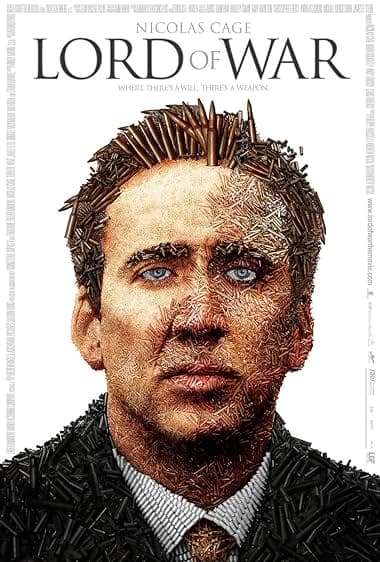
Lord of War
An arms dealer with a witty conscience: cynical, funny and still a little unnerving.
Feature presentation
Lord of War is the sort of movie that makes you chuckle, then wince. Andrew Niccol’s globe-hopping drama fixes its lens on Yuri Orlov — a salesman of weapons whose narration turns the business of killing into something bureaucratic and disturbingly ordinary. Revisit it and you’ll see why Yuri’s voice still drags the film through satire, sibling messiness and moral fog.
THE MOVIE
Yuri Orlov is still the reason this movie works
Most good movies have a centre you can point to. Lord of War’s is a man who talks to you like a salesman and thinks like an accountant. Yuri Orlov narrates the film — he’s the friendly, rational voice that explains how guns become cargo, customers and profit. That steadiness gives the whole thing its personality.
The film doesn’t treat violence as mythic. It treats it as trade: a product to be moved, priced and managed. Watching Yuri convert weapons into balance sheets is the movie’s grimly comic engine, and that choice stops it being a straight thriller and makes it a satire with teeth.
Andrew Niccol ties those ideas together in a globe-hopping, episodic shape that follows Yuri’s rise, the breakdown of his relationship with his brother and the legal pressure from an Interpol agent. Put simply: you stay for Yuri, and the film stays interesting because it keeps asking what happens when killing becomes just another market.
THE SETUP
The idea that sets Lord of War in motion
At its simplest, Lord of War is a career story: it traces Yuri Orlov as he builds an international business out of selling weapons. That premise gives Niccol two useful toys — the instinctive drama of a rise-and-fall arc, and the chance to show the mechanics of an illicit trade.
The film opens on an attention-grabbing note: a sequence that follows a single bullet from the factory floor into a battlefield. It’s a compact primer on the movie’s repeated point — ammunition and arms are part of a supply chain, not just instruments of death.
From there the screenplay strings together episodic, globe-spanning set pieces. These vignettes exist to demonstrate how Yuri actually moves product: falsified cargo manifests, multiple passports and a network of intermediaries that let him thread around embargoes and red tape.
That practical focus is why the setup works. You’re not just watching a criminal’s swagger; you’re watching a business model in motion, and the film asks, gently and often wryly, what it means to run that business when the commodity is violence.
THE CHARACTER
Why Yuri Orlov matters
Yuri is memorable because he lets you watch moral reasoning happen in real time. He’s presented as a pragmatic, multilingual entrepreneur who treats his trade like any other market opportunity — which is unnerving because it makes his choices feel reasonable, even administratively tidy.
That pragmatism is where the movie’s conflicts seed themselves. Yuri’s business is run with a kind of clinical efficiency, and that distance from emotion is what the film keeps testing: family, loyalty and the collateral cost of his deals keep creeping back in.
Vitaly — his younger brother and erstwhile partner — is the human counterweight. Vitaly’s instability and addiction produce personal crises that force Yuri into compromises he might otherwise avoid. The brother dynamic turns the film from a case study into something with human casualties.
So Yuri matters because he’s not just an archetype of evil; he’s a believable operator whose rationalisation of harm is the story’s main moral puzzle. The film asks you to watch how a man’s business decisions ripple out into other people’s lives.
THE PERFORMANCE
Why Nicolas Cage's performance matters
Contemporary critics singled out Nicolas Cage as the film’s anchor, and you can see why: the role needs someone to carry a tonal balance between dark comedy and moral unease, and the reviews noted Cage provided that steady presence.
Because Yuri narrates much of the movie, the central performance is doing double duty — explaining the business and keeping the audience engaged with an unsettling kind of charm. That anchoring quality is what lets the film be witty and grim in the same breath.
Put another way: the film depends on there being a recognisable centre to come back to, and critics at the time argued Cage supplied that through a sustained, central presence that steers the movie’s register.
So whether you find Yuri likeable, repellant or fascinating, that reaction starts with the way the central role holds the film together — which contemporary coverage said was the chief reason the movie worked for many viewers.
UNDER THE SURFACE
Lord of War has more on its mind than the plot suggests
On the surface this is a crime drama about an arms dealer. Under the surface, it’s a film about treating violence as commerce. The movie keeps pulling back to show weapons as tradable goods — items that move through markets, paperwork and profit calculations.
Alongside that comes a persistent suggestion of state complicity. The screenplay leaves little doubt that governments, contractors and officials are part of the wider system that makes the trade possible, which complicates the idea of a lone villain and points to broader hypocrisy.
Moral ambiguity sits at the heart of the whole exercise. Yuri rationalises and compartmentalises; the film invites you to watch those mental gymnastics and decide whether responsibility stops at intent or extends through consequence.
And then there’s family. Yuri’s loyalty to Vitaly and the collateral damage that loyalty causes keeps the themes personal. Business decisions in this film aren’t abstract; they have human fallout, and the movie uses that to remind you what’s being priced and who pays.
PRACTICAL EFFECTS
The effects work that gives Lord of War its physical personality
The film’s opening — the life-of-a-bullet sequence — isn’t a simple cutaway. It blends live-action elements with computer graphics so you can feel the object move through different environments, from manufacturing to use.
That mix was achieved by combining physical set pieces with CG reconstructions, allowing the camera to 'dive' into tight mechanical spaces while keeping foreground action grounded in real-world elements.
Production used visual-effects previz and re-projections to match live-action foregrounds to computer-generated backgrounds, which is why the sequence feels both tactile and uncomfortably thorough.
In short: the sequence sells the film’s central idea by making the bullet’s journey literal, and it does so through a careful blend of photographed elements and digital work rather than by leaning on one technique alone.
PURE 00s
Lord of War could not belong to any other decade
Lord of War landed in 2005 at a moment when political thrillers liked to point at recent global conflicts and ask awkward questions. It treats the post–Cold War weapons glut as a market opportunity — a subject the mid-2000s found fertile for films that mixed politics with genre.
The movie’s production story also flags the era. It was financed through multinational channels after major U.S. studios passed, a route typical of politically edged dramas in that period and a reminder of how certain mid-2000s films were wrestled into existence outside studio comfort.
That positioning — topical politics, indie-style financing, and a willingness to satirise international systems — gives Lord of War a period feel that’s more about concerns and market realities than fashion or visual trends.
So when you watch it as a 2005 film, you’re seeing a particular cinematic appetite of the decade: stories that wanted to interrogate contemporary global mechanics while still delivering the beats of drama and action.
WATCHING IT NOW
What has aged — and what hasn't
A number of commentators still point to the film’s satirical frame and its refusal to soften the systemic picture as reasons it resonates now. Watching a story that treats arms trading as a supply chain feels, if anything, only more relevant.
That said, some viewers remain split over the film’s tonal balance. Mixing dark comedy and thriller elements is a tricky business, and critics have stayed divided about whether the film always lands that mixture cleanly.
The personal threads — Yuri’s relationship with his brother, and the cost of those loyalties — are among the parts that keep the movie human when the scale gets abstract. Those throughlines give the film something to hold on to for modern audiences.
Finally, the screenplay’s deliberate nod to a figure like Oliver North (via the Colonel Oliver Southern character) keeps the movie anchored to real-world conversations about state involvement, which helps it read as more than just a stylised crime picture.
THE LEGACY
Why Lord of War still matters
The film keeps getting mentioned in conversations about fictional portrayals of global arms dealing because it aimed to dramatise the trade’s systems rather than just glamorise the dealer. The screenplay drew on real-world figures for texture, presenting Yuri as a composite inspired by actual cases.
That grounding — treating fiction as a lens on real mechanisms — is part of why the movie remains a reference point when people talk about how cinema can narrate ugly international businesses without turning them into pure pulp.
And the ongoing news about a sequel underlines the story’s continuing pull: industry pieces in recent years have reported Niccol and Cage returning, which suggests the original still has narrative and commercial value in the marketplace.
So its afterlife is less about trophy-room status and more about the fact that the movie keeps being treated as a useful story for talking about how the arms trade looks when you take away the glamour and leave the logistics.
THE VERDICT
Does Lord of War still hold up?
Yes — with a caveat. Lord of War remains worth watching because it gives you Yuri Orlov: a narrated, business-minded view of violence that turns moral horror into paperwork and invoices. That framing still feels smart and uncomfortable in equal measure.
The film’s mechanics — the opening bullet sequence, the step-by-step look at falsified manifests and multiple passports, and the episodic globe-trotting structure — give it a clear shape. You see how the trade operates, which keeps the story from being merely sensational.
The more intimate throughlines matter too. Yuri’s long-term relationship with Ava and his fraught role as brother and guardian to Vitaly make the consequences of his choices feel real, and the presence of an idealistic Interpol foil and brutal customers reminds you this isn’t just a morality play in the air.
If you’re deciding whether to watch it now: go for the stubbornly precise idea at its centre — that killing can be commodified — and for the way the film refuses easy answers. It doesn’t tidy up Yuri’s culpability, and that refusal is what makes Lord of War linger after the credits roll.
Share this movie
Keep watching
More movies from the 00s

2002
The Pianist
A quiet life unmade by war — and a pianist who refuses to stop listening.
Read the retrospective
→
2006
Blood Diamond
A mercenary, a fisherman and a pink diamond — and a film that still asks who pays for our jewellery.
Read the retrospective
→
2003
Kill Bill: Volume 1
A yellow jumpsuit, a long list of enemies and one woman who refuses to be finished.
Read the retrospective
→