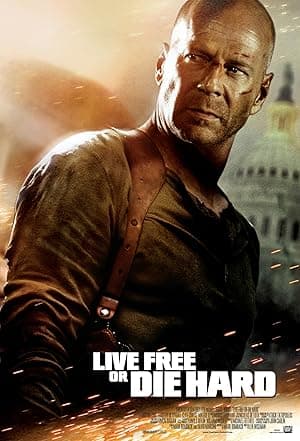
Live Free or Die Hard
An analogue cop in a digital war — and he still gets the job done.
Feature presentation
Live Free or Die Hard is the kind of sequel that knows its main asset: John McClane. Len Wiseman's 2007 return trades skyscraper-siege logistics for a nationwide cyber-attack, but it still funnels everything through one stubborn, streetwise cop. That stubbornness — and the film's awkward, enjoyable pairing of analogue grit with online menace — is the reason to revisit it.
THE MOVIE
John McClane is still the reason this movie works
Live Free or Die Hard drops John McClane into the most modern threat the Die Hard franchise had seen by 2007: a national cyber-attack engineered by Thomas Gabriel. It’s a big, unpleasant idea — everything that makes a city run put at risk — but the film gates that scale through one familiar figure.
That figure is the experienced, streetwise cop who will not back down. The film repeatedly asks what an old-school detective does when the danger arrives as code and networked systems; instead of handing McClane a laptop, it insists he use instincts. That friction is what gives the movie teeth.
Len Wiseman directs the whole thing with an eye for summer-action pacing, and he surrounds McClane with a cast including Justin Long and Timothy Olyphant so the old-school vs digital dynamic has actual people to bounce off. So yes: people still talk about Live Free or Die Hard because it remembers who the story belongs to — and refuses to let the spectacle swallow the man at its centre.
THE SETUP
The idea that sets Live Free or Die Hard in motion
At its centre the movie is a straightforward engine: John McClane is drawn into a sophisticated plot — a staged, multi-stage cyberattack nicknamed a 'fire sale' — that aims to knock out transport, communications, finance and utilities. It’s big-scale danger dressed up in internet terms.
To make that threat manageable on-screen the story pairs McClane with Matt Farrell, a programmer whose code matters to the antagonist. That pairing isn’t just a convenience; it’s the film’s organising principle. Old-school policing meets modern hacking, again and again.
The screenplay’s roots in an earlier WW3.com draft and its conversation with contemporary reportage on cyberwarfare give the spectacle a narrative spine: the filmmakers weren’t inventing a villainous tech fantasy from scratch, they grafted a franchise hero onto a then-current fear.
You get disaster at scale, yes, but it’s repeatedly translated into scenes where McClane can do what he does best: improvise, chase, argue and break things until the immediate problem is solved.
THE CHARACTER
Why John McClane matters
John McClane isn’t a blank tough-guy template; he’s a cop defined by practical instincts and the kind of stubbornness that makes disaster movies tolerable. The film keeps handing him problems that could be solved with servers and teams, and he solves them with grit.
Crucially, the national-scale crisis is tied back to the personal: McClane’s estranged daughter appears in the story, so the stakes aren’t only abstract. That father-daughter thread keeps the plot from becoming a pure tech thriller and reminds us why McClane is still worth following.
This is the fourth theatrical instalment and the movie leans on series continuity without turning into fan-service. The point is simple: give McClane reasons to move, and he’ll move in a way that feels recognisably him.
THE PERFORMANCE
Why Bruce Willis's performance matters
Contemporary reaction singled out Willis’s return as a clear asset. Aggregated criticism described his presence as a commanding element that steadies the film when the set-pieces get loud.
That’s an important, specific point: in a movie where digital threats and big stunts fight for attention, having a familiar, steady lead keeps the story anchored. The consensus around the performance gives McClane permission to be himself and the film permission to keep him there.
UNDER THE SURFACE
Live Free or Die Hard has more on its mind than the plot suggests
On the surface it’s a big summer action movie about stopping a villain. Underneath it’s wrestling with the idea that an entire nation can be made vulnerable by lines of code — cyber-terrorism is the obvious theme, and the film treats that threat as something both technical and deeply destabilising.
The movie also stages a generational argument: old-school methods versus digital solutions. That tension isn’t shown as a simple defeat of one by the other; the story forces cooperation. The analogue and the digital have to meet, and sometimes they don’t like it.
There’s a political itch here too — the plot imagines a systemic threat that isn’t easily punched away. But the film balances that by keeping the action human: a father worried about his daughter, a cop who refuses to let schematic threats feel abstract.
Put together, those ideas give the film a little more to chew on than pure spectacle. It’s an action film that wants to remind you that infrastructure can be personal, and that a single person’s stubbornness can still matter against a faceless system.
THE FILMMAKING
How Live Free or Die Hard was put together
The production leaned into then-current tech by shooting principal photography on Panavision Genesis high-definition cameras. That decision helped the film sit comfortably among the sharper, more digital-looking blockbusters of the mid-2000s.
Shooting took the cast and crew out of studio isolation at times — there was location work in Baltimore alongside soundstage and New York-area shoots — which helps the film feel less artificially smoothed and more like a movie happening in recognisable American places.
PRACTICAL EFFECTS
The effects work that gives Live Free or Die Hard its physical personality
The film mixes large-scale stunts with digital cleanup rather than relying on purely manufactured action. For example, cars were physically yanked by cranes and cables in some sequences before CGI was used to tidy the shots.
When the freeway scenes needed a military jet in the frame, the production didn’t only rely on pixels: miniatures and full-size props — including a nine-foot model and a full-size prop — were built to help composite an F-35 into the action. Those choices keep the action tangibly connected to real motion and weight.
PURE 00s
Live Free or Die Hard could not belong to any other decade
This is very much a mid-00s picture: its core cyberattack concept was reshaped in a post-9/11 world, with the project pausing after 2001 and later returning as part of a cautious, mid-decade appetite for security-themed storytelling. The result reads like a franchise updating itself to new anxieties.
It also landed at a moment when summer blockbusters were mixing heavy visual effects with old-fashioned stuntcraft. Live Free or Die Hard sits squarely in that hybrid era — practical stunts and digital work shoulder each other, which is emblematic of the period’s action filmmaking.
WATCHING IT NOW
What has aged — and what hasn't
A practical consideration: the film exists in more than one version. The theatrical PG-13 cut circulated widely, but an unrated edition later appeared on home media restoring stronger language — a detail that changes tone for viewers who prefer a rougher edge.
Narratively, the family thread linking McClane and his daughter still gives the film a human measure. Tying national-scale danger back to personal relationships keeps it watchable in a way that gadgetry alone would not.
Finally, as part of the Die Hard series the movie’s continuing reliance on McClane’s continuity remains a strength: this is a film that depends on an established character and uses that familiarity to speed past exposition and get to the fighting.
THE LEGACY
Why Live Free or Die Hard still matters
Partly by virtue of its place in the franchise, Live Free or Die Hard matters as the film that brought McClane into the internet age and kept his story moving forward; it was followed by a fifth film down the line.
At the time of its release it also registered commercially as the highest-grossing film in the series worldwide, which is a concrete reason it remained in the conversation for sequel plans and home-media circulation.
THE VERDICT
Does Live Free or Die Hard still hold up?
Yes — but with a caveat. The central conceit still plays: McClane pulled into a national cyber-attack, forced to work with a young programmer and to translate analogue courage into digital terms, is a tidy set-up and the film commits to it. That mechanic — pairing a physical cop with a technical ally — gives the action an emotional throughline.
Bruce Willis’s return as John McClane remains one of the movie’s stabilising features; contemporary critics highlighted his presence as a positive, and the film wisely keeps him central rather than letting effects or concept steal the show.
If you want a thoughtful technothriller you’ll be disappointed. If you want a blockbuster that knows how to tie big, systemic danger to a single, stubborn human being, this still works. It’s loud, sometimes gleefully unsubtle, and anchored by a hero who refuses to be updated out of existence.
So yes: watch it for McClane. The spectacle is the excuse; the man is the reason.
Share this movie
Keep watching
More movies from the 00s

2002
The Pianist
A quiet life unmade by war — and a pianist who refuses to stop listening.
Read the retrospective
→
2006
Blood Diamond
A mercenary, a fisherman and a pink diamond — and a film that still asks who pays for our jewellery.
Read the retrospective
→
2003
Kill Bill: Volume 1
A yellow jumpsuit, a long list of enemies and one woman who refuses to be finished.
Read the retrospective
→