Little Miss Sunshine
A seven-year-old, a broken clutch and a family that refuses to stay private about its problems.
Feature presentation
There’s a simple image at the heart of Little Miss Sunshine that explains why people keep coming back: a child determined to dance on a pageant stage and a family determined to get her there, come what may. Jonathan Dayton and Valerie Faris’s debut stitches together road-trip misadventure and domestic mess with a clarity that still feels clever, not sentimental. Olive Hoover is the small, stubborn engine of a movie about ambition, failure and how tired adults behave in front of children.
THE MOVIE
Olive Hoover is still the reason this movie works
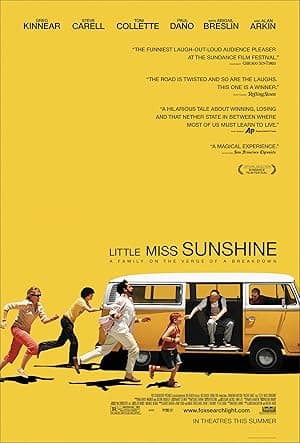
The picture’s basic promise is immediate and oddly cosy: the Hoover family pile into a bright-yellow Volkswagen bus and drive from Albuquerque to Redondo Beach so seven-year-old Olive can take part in a beauty pageant. It’s the sort of premise that sounds light until you notice how little money they have and how much else is already breaking around them.
That single road trip hands Jonathan Dayton and Valerie Faris a tidy storytelling machine. It forces the family into close quarters, which lets the film trade quiet, awkward moments and explosive rows without quite tipping into melodrama. Olive — played by Abigail Breslin — is the reason the journey has stakes you care about: she’s the small, steady goal everyone orbits, even as their private failures leak onto the dashboard.
Underneath the comedy and the road‑movie trappings are clearer themes: family dysfunction and attempts at repair, the pressures of ambition and the strange theatre of childhood performance. Dayton and Faris use a tight 101 minutes to keep things moving; the film never forgets why it started — a little girl’s place on a stage — and that focus is why it still feels watchable rather than indulgent.
THE SETUP
The idea that sets Little Miss Sunshine in motion
The plot hook is disarmingly mundane: Olive suddenly becomes eligible for the Little Miss Sunshine pageant because the original winner is disqualified. That small bureaucratic twist is what turns a handful of private problems into a shared, combustible trip across state lines.
Packing a family into a single vehicle is a classic device and here it does useful work. The film makes the journey itself a pressure cooker: there’s a broken clutch to worry about and not much spare cash, so every argument has the comforting drag of practical consequence beneath it.
Crucially, the trip is built around people with separate crises. Richard is juggling the collapse of a self-help career; Dwayne is nursing a vow of silence and a big plan; Frank has just gone through severe personal collapse. The road forces those individual tensions into the same small space.
That compressed setup is why the movie’s punch lands: it doesn’t need another plot twist because the family’s emotional complications are interesting enough to carry the ride.
THE CHARACTER
Why Olive Hoover matters
Olive Hoover is the orbiting point of the whole film. Abigail Breslin plays her, and the story is built so that Olive’s ambition — to go onstage and perform — makes everyone else’s brittle certainties wobble.
She’s not the one with the loudest problems, but she’s the one who gives the others something to aim at. Her grandfather’s coarse, enabling presence and his frantic pageant coaching are a big part of why Olive is even prepared to walk into that competition, and his role in her story is more than comic relief.
Sheryl, who does the unglamorous work of keeping the household afloat and managing the trip, is often the person who measures how the family is actually functioning. Olive’s presence exposes how each adult responds to failure, and that contrast is what makes her feel more than a plot prop.
Put simply: the journey is Olive’s, but the film’s real interest is watching the grown-ups spin around that small girl and show what they’re made of.
THE PERFORMANCE
Why Abigail Breslin's performance matters
One concrete piece of evidence matters here: Abigail Breslin’s portrayal of Olive earned her an Academy Award nomination. That’s not casual trivia — it’s a formal recognition that the role did something noteworthy in the film’s emotional economy.
The nomination gives the movie permission to centre a child without it feeling like a gimmick. It also helps explain why the film’s balance between affection and discomfort works: Olive is clearly the hinge on which many of the story’s smaller, sharper moments swing.
You don’t need the name on a plaque to see why the performance is important; the nomination simply confirms that the industry noticed what the script and the directors had already set up.
In short, Breslin’s casting and the attention it received are part of what lets the film ask big questions about how adults behave around children without losing the character who prompts those questions.
UNDER THE SURFACE
Little Miss Sunshine has more on its mind than the plot suggests
On the surface it’s a road movie about getting to a pageant. Under the bonnet it’s mostly about family dysfunction — the ways people talk past one another, fail to meet expectations and then try, awkwardly, to repair the damage.
Ambition and failure are threaded through the story. Richard’s self-help hustle and the family’s financial pinch are set against Olive’s simple, earnest desire to perform. That contrast makes the film funny and a little uncomfortable: success looks different to everyone in the bus.
Performance and childhood are another pair of ideas the film toys with. There’s the literal child-performance at the pageant, but also the ways adults perform for each other: Richard’s motivational routines, Grandpa’s ribald pep talks, the family’s public face versus private chaos.
Finally, communication and isolation, plus intergenerational conflict, keep cropping up. The trip throws different ages and disappointments together until they have to be acknowledged, or at least exposed. The movie doesn’t tidy everything up, but it does make the mess feel like the point.
THE FILMMAKING
How Little Miss Sunshine was put together
There are three practical credits that quietly shape the film’s feel: Tim Suhrstedt is listed on cinematography, Pamela Martin handled the editing and Kalina Ivanov is credited as production designer. Those names remind you this is a crafted indie picture rather than a throwaway comedy.
Directors Jonathan Dayton and Valerie Faris keep the film moving through compact scenes and a running momentum that suits a 101-minute runtime. The editing choices largely favour clarity over ornament — the road-trip beats and family confrontations arrive and leave cleanly.
Production design matters because it keeps the story believable: the bus, the motels and the cramped, stage‑ready world of the pageant all need to feel lived-in for the family’s trouble to land. The credits point to people responsible for that lived-in texture.
Taken together, the technical crew and the directors’ choices give the movie a level of polish that lets the script’s human oddities come through without the film ever feeling slack or undercooked.
PURE 00s
Little Miss Sunshine could not belong to any other decade
The movie is a product of a very particular mid‑2000s indie ecosystem: it premiered at Sundance in 2006 and was snapped up by Fox Searchlight soon after, in what was widely covered as a substantial festival acquisition. That festival-to-distributor route was something of a blueprint at the time.
Its release strategy — a platform rollout that began in late July 2006 before wider expansion — is also typical of how mid-00s specialty films found audiences: start small, build word-of-mouth, let people discover it organically.
Dayton and Faris were first‑time feature directors, which fed the film’s scrappy, character-forward energy. That sense of discovery — a new directing pair, a first-time screenwriter — is part of what made the movie feel like a find when it arrived.
In short, Little Miss Sunshine wears the 2006 indie model on its sleeve: festival premiere, high-profile pickup and a slow, steady release that let a modest, well-made film grow into something more than the sum of its parts.
WATCHING IT NOW
What has aged — and what hasn't
The film’s themes are sturdily portable because they rest on family dynamics, not passing trends. Family dysfunction — the messy negotiations, the resentments and the small reconciliations — remains recognisable and easy to feel now.
The central conceit, a family journey organised around Olive’s pageant entry, still works because it keeps the stakes small and human. Watching a child prepare to perform still has emotional pull, and the family’s competing ambitions remain a usable dramatic engine.
Where the film is less about datedness and more about temperament is in its mixture of tenderness and bluntness; that tonal mixing still reads as deliberate rather than a period affectation. The story’s interest in how adults behave in front of children is, if anything, timeless.
All told, Little Miss Sunshine’s strengths are the kinds of things that age into steady appreciation rather than nostalgia for a moment. The film asks straightforward questions about families and ambition that modern audiences can still answer along with it.
THE LEGACY
Why Little Miss Sunshine still matters
There are concrete markers that explain the film’s staying power. It earned four Academy Award nominations and came away with two wins — including Best Supporting Actor for Alan Arkin and Best Original Screenplay for Michael Arndt — which is not small potatoes for an indie comedy-drama.
Beyond the Oscars, the film won multiple independent-film prizes and created a clear commercial and critical breakthrough for its ensemble and for Arndt as a first-time screenwriter. Those outcomes helped move the movie from a festival curiosity to a broader cultural reference point.
The story’s afterlife includes a stage adaptation: it was turned into a musical with a book by James Lapine and music and lyrics by William Finn, which premiered in regional theatre before an Off-Broadway run. That kind of translation to another medium says something about the story’s theatrical qualities.
Put simply: awards, industry attention and a life beyond the screen are the tidy reasons why Little Miss Sunshine continues to be mentioned when people talk about memorable mid-00s indies.
THE VERDICT
Does Little Miss Sunshine still hold up?
Yes — it’s worth watching. The film gives you a clear, humane setup (a family driving a yellow van to a pageant) and then uses that simplicity to reveal characters who are oddly specific and sympathetically flawed.
The movie arranges its comic and dramatic moments around everyday mechanics — a bus with a broken clutch, a hurried eligibility twist that puts Olive onstage — so that the emotional beats feel earned rather than manufactured. The script’s attention to those small mechanics lets the interpersonal stuff hit harder.
It helps that the cast and the writing were recognised where it matters: Arndt’s screenplay won an Academy Award and Alan Arkin’s turn won him an Oscar; Abigail Breslin’s role was formally acknowledged with a nomination. Those honours underline that the film did something both popular and craft‑wise notable.
If you want something that’s funny, a little sharp and ultimately affectionate without slipping into schmaltz, Little Miss Sunshine is still a tidy watch. Olive’s trip remains the film’s compass — and if a movie still knows where it’s going after all these years, that’s a small miracle.
Share this movie
Keep watching
More movies from the 00s

2002
The Pianist
A quiet life unmade by war — and a pianist who refuses to stop listening.
Read the retrospective
→
2006
Blood Diamond
A mercenary, a fisherman and a pink diamond — and a film that still asks who pays for our jewellery.
Read the retrospective
→
2003
Kill Bill: Volume 1
A yellow jumpsuit, a long list of enemies and one woman who refuses to be finished.
Read the retrospective
→