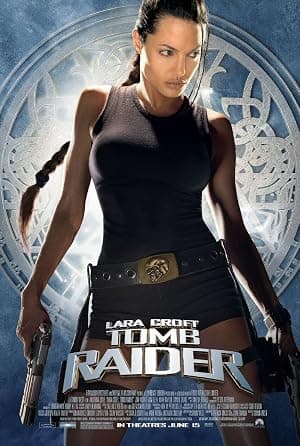
Lara Croft: Tomb Raider
An aristocratic adventurer, a stolen clock and a woman who makes a very old puzzle worth following.
Feature presentation
Lara Croft: Tomb Raider wears its ambitions on its sleeve: a globe-trotting treasure hunt, a secret cabal and a heroine with everything to prove. What keeps you watching — and what keeps the film alive now — is Lara herself: the quest is part world-saving, part family business, and Angelina Jolie is the engine that drives it all.
THE MOVIE
Lara Croft is still the reason this movie works
Say the name and you know roughly what’s coming: high-stakes puzzles, remote tombs and a woman who treats archaeology like a contact sport. The film sets that course straight away — Lara Croft is an aristocratic adventurer on a mission to stop the Triangle of Light, an artifact dangerous enough to threaten time itself.
The story ignites when commandos break into Croft Manor and make off with a clock that turns out to be the key to finding the Triangle’s two halves. That theft is the rope that drags Lara out of her home and across the map.
There’s a personal thread running through the action. Lara isn’t just chasing treasure for thrills: a letter and a clue left by her missing father turn this into a search about legacy and family as much as a race to save the world — and that mix is exactly why the outing keeps landing.
THE SETUP
The idea that sets Lara Croft: Tomb Raider in motion
At its most economical the film is a straight contest: Lara versus a modern-day Illuminati, with Manfred Powell standing in as the cabal’s face. Both sides want the Triangle of Light — and they’re willing to hunt for its pieces in very different places.
The pieces are hidden where adventure movies love to hide things: remote tombs and extreme locations. The plot alternates between tomb puzzles and modern action: a manor break-in, a Venice sequence, an Angkor tomb and an expedition that’s staged as a Siberia stand-in.
That contrast is the setup’s energy. Ancient traps and riddles sit next to chases and shootouts, so the film keeps swapping tone between mystery-solving and full-on action beats.
It’s also a personal quest. The uncovering of the Triangle ties back to Lara’s father and his work, which gives her reasons beyond abstract heroics for dragging herself — and the audience — into these set pieces.
THE CHARACTER
Why Lara Croft matters
Lara Croft isn’t a blank action avatar; she’s an inheritor. The quest is anchored to a missing father and a legacy of exploration, which makes her choices feel like family business as much as globe-trotting duty.
Angelina Jolie plays Lara Croft, and the casting matters because the story leans on Lara as its centre: the stakes are personal and the film keeps returning to her decisions and her inheritance of her father’s work.
Lara’s physicality is part of who she is in the movie. Production-level preparation mattered here — months of training and a stunt programme were used to get her into the action, and she performed a substantial portion of her own sequences.
That blend of motive and movement — a woman driven by family ties who can also operate in the sort of action set pieces usually reserved for men — is what makes the character stick in the head when the credits roll.
THE PERFORMANCE
Why Angelina Jolie's performance matters
Contemporary critics noticed what the rest of the movie leaned on: Jolie’s portrayal was called out as a strong element. Roger Ebert singled out her performance and awarded the film three out of four stars.
That single line of critical evidence matters because it signals how the film was read at the time — as a star vehicle where the lead’s presence could lift material that does not always stop to be subtle.
You can therefore watch the movie as much for Lara’s screen presence as for the set pieces. The way reviewers reacted kept attention on Jolie’s casting as a defining part of the package.
Read this way, the performance is less a separate thing to be audited and more the glue that helps the rest of the film hang together for many viewers.
UNDER THE SURFACE
Lara Croft: Tomb Raider has more on its mind than the plot suggests
Beneath its map-popping mechanics the film keeps returning to the idea of power as temptation. The Triangle’s time-altering ability is shown as something profoundly dangerous — an object that corrupts if it’s assembled rather than destroyed.
That danger ties into legacy. The search is not only about stopping a scheme; it’s about how Lara inherits her father’s wilder impulses and decides what to do with them. The family thread gives the adventure a moral question: inherit or end the line.
There’s also a negotiation going on about what a female action hero looks like onscreen. The movie stages the familiar sexualised iconography from the games alongside training, practical skills and action competence, so Lara is presented as capable rather than a passive figure.
And, because it’s an adventure, discovery remains central. The tombs, puzzles and remote locations are not just spectacle; they’re part of how the film frames Lara’s relationship to power, history and choice.
THE FILMMAKING
How Lara Croft: Tomb Raider was put together
The credits show the team responsible for how the film feels on screen: editors Glen Scantlebury and Dallas S. Puett and production designer Kirk M. Petruccelli. They’re the people who shape pace and space — the rhythm of chases and the architecture of tombs.
That editing work is the quiet machinery of an adventure: cutting between puzzle logic and action demands a particular sense of timing, and the production design gives the tombs the sense of being things you can move through.
Simon West’s direction sits on top of that crew, steering performance and staging to match the screenplay’s balance of modern beats and old riddles.
Credit where it’s due: when the movie feels propulsive, a lot of that comes down to how the editing and production design stitch together very different kinds of set pieces.
PRACTICAL EFFECTS
The effects work that gives Lara Croft: Tomb Raider its physical personality
The production deliberately mixed physical craft with computer work. Special effects supervisor Chris Corbould led the practical-effects unit while Steve Begg supervised the visual effects — a two-handed approach that keeps certain moments feeling tactile.
That tactile ambition extended to stunts and sets. The production emphasised practical stunt work and physical set construction, with the stunt team coordinating months of actor training and complex second-unit work.
Angelina Jolie’s own preparation fed into that approach: she spent months training and performed a significant portion of her action sequences, including a bungee sequence that the production described as primarily her work.
Put simply: the film was built to have hands-on action. When a scene involves ropes, jumps or trap-laden rooms, the practical mindset makes those beats read as physical challenges rather than pure CGI shorthand.
PURE 00s
Lara Croft: Tomb Raider could not belong to any other decade
Released in the summer of 2001, the film arrived when studios were backing star-driven tentpoles built from existing IP — the sort of project that hoped a well-known name and a familiar brand would fill multiplexes.
As part of that trend the movie sits among early-00s experiments in translating games into cinema. At the time it was one of the more prominent video-game adaptations and proved successful enough to spawn a theatrical sequel in 2003.
Its place in that moment explains a lot of the movie’s choices: big set pieces, a recognisable lead and the safe bet of an established franchise rather than a risky original idea.
Seen in that light, Lara Croft: Tomb Raider is a classic turn-of-the-century studio play — ambitious, slightly cautious and very much fashioned as a star vehicle for its lead.
WATCHING IT NOW
What has aged — and what hasn't
If you’re returning to the film now, you’ll find its strongest afterlife element is the lead. Retrospectives and rankings repeatedly point to Jolie’s embodiment of Lara as the thing that keeps conversation going, even where the screenplay and plotting draw criticism.
That emphasis means the movie’s longevity rests less on narrative tightness and more on having a central figure people want to watch. The family-and-legacy thread still gives emotional ballast: the father-daughter lineage is a simple, durable hook.
For viewers who like a star-led, hands-on adventure, the movie still delivers. For those who demand taut plotting and subtlety, the film’s rougher edges are more obvious today.
All told, it ages like a well-polished action toy: the main character still gleams; some of the seams show if you look close enough.
THE LEGACY
Why Lara Croft: Tomb Raider still matters
One obvious legacy is the sequel: the film’s production led directly to Lara Croft: Tomb Raider – The Cradle of Life in 2003, with Jolie back in the harness. That continuation kept the early-00s version of the character alive on screen.
Another part of its afterlife is how it functions in conversations about video-game adaptations. The 2001 movie is regularly referenced when people talk about how to bring game heroes to cinemas, and Jolie’s casting as the franchise’s first major-screen Lara Croft remains a touchpoint in public memory.
Put together, those two facts explain why the film keeps being brought up: it established a template — for better and worse — and it left a recognised face attached to the role.
Even where later takes would reboot or rethink the idea, this film is the one that first tried to turn a very specific game icon into a broadly theatrical heroine.
THE VERDICT
Does Lara Croft: Tomb Raider still hold up?
Yes — with a reservation. If you come for a star-led, early-00s adventure and for the idea of a woman who carries both family duty and gunplay, this will still give you what you expect. The plot is a clear, globe-trotting race: Lara must find and destroy both halves of the Triangle of Light before a secret cabal assembles it.
The movie gets going on a simple inciting incident — commandos at Croft Manor stealing a clock that unlocks the quest — and then alternates tomb puzzles and modern action across Angkor and a Siberia stand-in. If that mix appeals, the film delivers on promise.
What tips the balance in its favour today is the lead. Angelina Jolie plays Lara Croft, and contemporary reaction singled her out as a persuasive centre; that presence is the film’s main engine. Practical work — big constructed sets and committed stunt prep — helps the action feel tangible.
If you want a taut, modern reworking of adventure tropes, look elsewhere. But if you want a 100-minute, star-driven sprint where family legacy and the responsibility of dangerous power get mixed with bungee jumps and ancient traps, it’s still worth pressing play. Lara is still the reason to show up.
Share this movie
Keep watching
More movies from the 00s

2002
The Pianist
A quiet life unmade by war — and a pianist who refuses to stop listening.
Read the retrospective
→
2006
Blood Diamond
A mercenary, a fisherman and a pink diamond — and a film that still asks who pays for our jewellery.
Read the retrospective
→
2003
Kill Bill: Volume 1
A yellow jumpsuit, a long list of enemies and one woman who refuses to be finished.
Read the retrospective
→