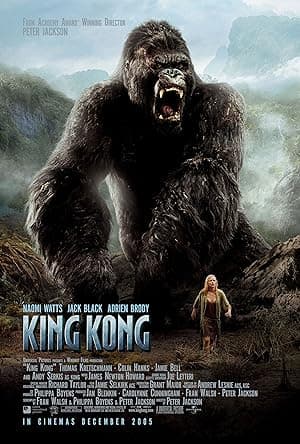
King Kong
A giant ape, a desperate actress and a director who refuses to let go — nostalgia wrapped in spectacle.
Feature presentation
Peter Jackson's King Kong is not a neat museum piece. It's a two-hour-plus, emotionally loud retelling that keeps returning to one stubborn idea: the film belongs to Ann Darrow. Revisit it for the beast, stay for the human story that gives the spectacle its teeth.
THE MOVIE
Ann Darrow is still the reason this movie works
If you remember one thing from King Kong it should be Ann Darrow boarding a shabby tramp steamer because she's out of options. The film opens in 1933, in Depression-era New York, where a struggling vaudeville performer gets roped into Carl Denham's grand idea of a movie expedition.
Peter Jackson takes that small, human corner of the story and lets it grow. Ann isn't just a MacGuffin for a monster — her resourcefulness and ability to connect with Kong steer the movie's emotional course, even as the crew sails toward Skull Island and the film ramps up into full-scale adventure.
That beauty-and-the-beast thread is deliberate. Jackson keeps the relationship between Ann and Kong front and centre, which is why, for as much as the movie is about spectacle, it never entirely forgets who it's about.
THE SETUP
The idea that sets King Kong in motion
The engine of the story is simple and sharp: a showman wants a spectacle. Denham assembles a cast and crew, charters the Venture and sails for a mysterious island to make a picture.
On Skull Island the expedition encounters prehistoric dangers and a colossal ape, Kong, who becomes obsessed with Ann. That encounter flips the film between wonder and menace — Kong is both threat and strangely expressive presence.
Denham's single-minded plan to ship Kong back to New York for public exhibition is the story's pivot. It's the practical decision that transforms an island adventure into a metropolitan catastrophe and drives the film's later set pieces.
Jackson's screenplay enlarges Cooper and Wallace's 1933 outline with more shipboard and New York material, adding character detail while keeping the original 'beauty and the beast' premise intact.
THE CHARACTER
Why Ann Darrow matters
Ann Darrow begins the film as a performer on the edge — the kind of character who will take a risky job because bills won't wait. That desperation is important, because it makes her agency believable: she survives by being clever, brave and available to care.
Her empathy is the story's human compass. Kong fixates on her, but the narrative is careful to treat that fixation as something other than a mere plot trick; it becomes the film's emotional focus, the place where spectacle collides with feeling.
Ann's relationship with Jack Driscoll gives the adventure a romantic throughline, but never swallows her. The human pair work as anchors during the movie's grander swings between island horror and New York chaos.
When the film asks us to care, it's usually asking us to care about Ann. That's why she resonates after the explosions are done.
THE PERFORMANCE
Why Naomi Watts's performance matters
There are plenty of ways to react to a movie of this size, but one reliable critical touchstone singled out Naomi Watts. Roger Ebert praised Watts's central turn and the film's capacity to make its emotional beats land.
That external nod matters here because the movie's success depends on the audience buying into Ann's choices. When the character feels real, Kong's reactions mean more — and the stakes of Denham's grand idea feel darker for it.
Watts's Ann is the human hinge between spectacle and pathos. The film throws everything at the audience, but it's that performance that often convinces you to keep watching rather than checking your watch.
UNDER THE SURFACE
King Kong has more on its mind than the plot suggests
On the surface it's an adventure about an island, a crew and a rampaging ape. But Jackson keeps nudging the story toward questions about empathy: how humans relate to what they don't understand, and what happens when curiosity hardens into control.
Exploitation versus spectacle runs through the film like a fault line. Denham's plan to parade Kong for paying crowds forces the movie to ask whether showing something to the world is the same as understanding it.
There's also a tidy humanity-versus-nature tension. Kong is framed as monstrous by the world he invades, but within the film's logic he's also a being capable of attachment — which complicates the easy 'monster' label.
Finally, the movie toys with the ethics of filmmaking and commerce: who profits, who pays, and what we sacrifice when art becomes an exhibit.
THE FILMMAKING
How King Kong was put together
Peter Jackson didn't make this in a vacuum. He brought together many collaborators from his Lord of the Rings work — including cinematographer Andrew Lesnie, production designer Grant Major and editor Jamie Selkirk — and shot principally in New Zealand.
That reuse of personnel and infrastructure gives the film a certain muscle: it feels engineered to handle large-scale sequences while still keeping an eye on detail.
The production's technical achievements were recognised at the Oscars, where the film took home awards for visual effects and technical sound categories, which is a useful marker of how the industry viewed its craft.
All of that matters because Jackson wanted both intimacy and spectacle. The team he assembled let him swing between those modes without losing the thread that binds the movie together.
PRACTICAL EFFECTS
The effects work that gives King Kong its physical personality
Kong isn't a suit. The creature was produced primarily through motion-capture and computer animation, with Andy Serkis supplying on-set reference as the ship's cook and later providing the motion and facial captures animators used.
Weta Digital pushed their pipeline on this project, developing fur-simulation and facial-performance tools to give Kong detailed hair and nuanced expressions.
Sound played a practical role too: the production captured Serkis' vocalisations and processed them through a system — used on set and in post — to shape the ape's calls into something suitably enormous.
Those choices make Kong feel present in scenes rather than pasted on afterwards; they also tie the character to human rhythm, which is vital for the film's empathy work.
PURE 00s
King Kong could not belong to any other decade
This was very much a mid-2000s project: it followed Peter Jackson's Lord of the Rings films and took advantage of the same New Zealand visual-effects infrastructure and talent pool.
It also fits the era's appetite for big‑budget remakes of classical properties — studio holiday-season fare that needed to satisfy both spectacle-hungry audiences and a marketplace concerned with fidelity to beloved originals.
Music and postproduction shifts also echo the period: James Newton Howard completed the score after Howard Shore's departure late in the process, a kind of last-minute reshuffle that was not unusual for blockbusters of the time.
Winning industry awards for effects and sound further marked King Kong as a 2000s statement about what the medium could do when resources and ambition aligned.
THE LEGACY
Why King Kong still matters
Part of the film's afterlife is technical: it took home Academy Awards for visual effects and sound, and it reinforced Weta Digital's standing in motion-capture character work after their Gollum breakthrough.
That technical reputation matters because the movie is often mentioned when people discuss successful attempts to build emotionally expressive CG creatures — not just monsters that roar, but figures that can register feeling.
King Kong also generated a major home-video release with extended material and documentary diaries, which kept debate about the film alive and fed ongoing conversations about how to handle classic studio properties.
So whether you're interested in craft, performance capture, or how remakes are handled, this film keeps cropping up in those discussions.
THE VERDICT
Does King Kong still hold up?
Yes — if you come for the mix of human drama and spectacle. The film begins in 1933 with Ann Darrow stepping into Denham's scheme, sails to Skull Island where Kong's fixation on her becomes the story's emotional hinge, and then moves into a bracing collision of commerce and consequence when Denham tries to ship the ape to New York for exhibition.
Jackson's expansion of the original material gives us more shipboard life, more of the city's fall into chaos, and richer detail around the characters who carry those beats. Ann is still the character who makes the audience care, and Roger Ebert's praise for the central performance is a useful shorthand for why that matters.
Technically, the film earned its industry plaudits — awards for effects and sound — and Weta's work on Kong remains a reference point for motion-capture character work. Those achievements keep the movie interesting even now.
If you want a blockbuster that remembers to be about people as well as set pieces, King Kong is worth watching. It asks an old question — what do we do when beauty meets the beast? — and doesn't let spectacle answer it alone.
Share this movie
Keep watching
More movies from the 00s
2002
The Pianist
A quiet life unmade by war — and a pianist who refuses to stop listening.
Read the retrospective
→
2006
Blood Diamond
A mercenary, a fisherman and a pink diamond — and a film that still asks who pays for our jewellery.
Read the retrospective
→
2003
Kill Bill: Volume 1
A yellow jumpsuit, a long list of enemies and one woman who refuses to be finished.
Read the retrospective
→