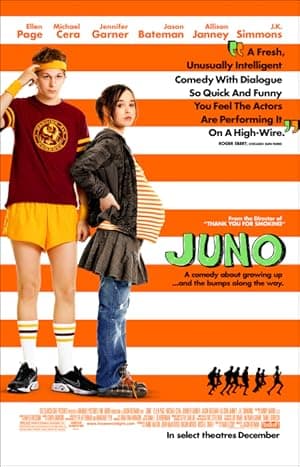
Juno
A sharp-voiced teenager, an awkward boyfriend and a decision that refuses to be simple.
Feature presentation
If you remember one thing about Juno, it’s not the plot so much as the voice: a flat, quick-witted sixteen-year-old narrating awkward choices like they’re punchlines. Jason Reitman’s 2007 coming-of-age dramedy makes that voice the engine—so much so that the movie often feels less like a story about teen pregnancy than a long, clever conversation you can’t stop listening to.
THE MOVIE
Juno MacGuff is still the reason this movie works
At its simplest, Juno begins when a sixteen-year-old called Juno MacGuff discovers she is pregnant after a one-off encounter and decides to pursue a private adoption rather than abortion. That setup could have been a straightforward drama; instead the film makes Juno’s perspective the thing you keep returning to.
Elliot Page plays Juno, and the screenplay leans hard on a mannered, sardonic teenage voice and the character’s idiosyncratic choices. It’s Juno’s decisions—her humour, her bargaining, the way she names the problem—that steer almost every scene.
Director Jason Reitman keeps the frame small and focused: ninety-six minutes of a coming-of-age story that is as much about adolescent self-definition as it is about a single life-changing event. The result is a film that still reads, and still irritates and delights, as a distinctly character-driven piece.
THE SETUP
The idea that sets Juno in motion
The engine of the film is tidy: Juno finds herself unexpectedly pregnant and, rather than choose abortion, decides to carry the baby and place it with adoptive parents.
She discovers Mark and Vanessa Loring through a classified ad and negotiates what is meant to be a closed adoption. Those practical arrangements—ads, meetings, paperwork—give the film its shape and move the plot forward in a believable, everyday way.
Complication arrives humanely. Mark develops feelings for Juno; Juno has to reckon with her own feelings for Paulie Bleeker, the quietly earnest boy who fathered the child. The emotional friction comes not from melodrama but from awkward, ordinary interactions.
That domestic, low-key conflict—an adoption plan becoming emotionally complicated—is what keeps the story grounded and watchable rather than sensational.
THE CHARACTER
Why Juno MacGuff matters
Juno MacGuff isn’t memorable because she’s extraordinary; she’s memorable because she has a distinct way of making ordinary things sound like performances. The screenplay gives her a rapid-fire, sardonic voice and a string of offbeat decisions that make the whole film orbit her perspective.
Paulie Bleeker sits opposite her as a quietly earnest sort of foil—long-term friends, mildly awkward, and not interested in drama. His steadiness helps define Juno by contrast: she’s loud, verbally nimble; he’s steady and reactive.
Juno’s home life matters too. Bren and Mac—her stepmother and father—are supportive and bemused in a way that supplies much of the film’s warmth without ever turning into a textbook family drama.
And Leah, Juno’s close friend, keeps the local, practical point of view in the frame. She’s the one who makes the pregnancy feel like something lived through among friends, not an abstract problem.
THE PERFORMANCE
Why Elliot Page's performance matters
Contemporary attention clustered on Elliot Page’s turn as Juno; Page received an Academy Award nomination for the role and reviews singled the central performance out as a reason the film held together.
That recognition matters because the film is, undeniably, anchored to that single point of view. The screenplay gives Juno a very particular voice; the acting brought that voice to the screen in a way that critics noticed, and awards attention underlined the film’s focus on its lead.
UNDER THE SURFACE
Juno has more on its mind than the plot suggests
On the surface it’s a teen pregnancy story. Below that it’s a coming-of-age film about how an adolescent tries to define herself when the future stops being imaginary and starts being immediate.
Adoption and responsibility thread through the film in a way that complicates any neat moral answer. The story asks practical questions—what does a ‘right’ choice look like?—and leaves room for messy human feeling around those choices.
Family dynamics are present without being preachy. The film treats home as a series of small, believable reactions: the polite confusion, the practical support, the awkward jokes that stand in for more serious conversation.
Ultimately, Juno is about identity and voice—how a teenager talks her way through decisions and slowly owns what those decisions mean.
THE FILMMAKING
How Juno was put together
Eric Steelberg shot Juno on location in and around Vancouver, which doubles for a small Minnesota town. That choice keeps the film feeling rooted in ordinary places rather than stylised sets.
The soundtrack and score also shape the film’s personality: Mateo Messina’s original music works alongside songs by Kimya Dawson and related artists to give the movie a consistent, intimate mood that sits under the dialogue rather than shouting over it.
PRACTICAL EFFECTS
The effects work that gives Juno its physical personality
The production needed to convey seasonal change across a short schedule, so practical set treatments and compositing were used to insert appropriate foliage and flora where required.
There was also a plan to import snow for winter scenes, but when the weather cooperated the crew captured real snowfall on location—one of those small, on-the-day wins that help a film feel lived-in rather than assembled.
PURE 00s
Juno could not belong to any other decade
Juno’s path—premiering on the 2007 festival circuit in Telluride and Toronto before widening into a mainstream release—captures a mid-00s pattern: indie films using festivals as springboards into broader commercial life.
Diablo Cody’s backstory as a blogger-turned-screenwriter is also a very 2000s story: it felt like a new route into the industry, one that reflected how the internet was beginning to reshape who could be noticed and how.
That combination—a festival pedigree plus an offbeat, internet-era writing voice—helped Fox Searchlight position the film as an indie with crossover potential, a model the studio leaned on throughout the late 2000s.
WATCHING IT NOW
What has aged — and what hasn't
As a teen film about pregnancy and family, Juno still speaks to subjects that haven’t gone away. The basic human business—awkward young people making consequential choices, families responding in their own imperfect ways—still plays.
Because the movie foregrounds relationships and decisions rather than cultural gags, many of its core scenes remain relatable to modern viewers who watch films for character rather than trend-chasing.
At the same time, Juno wears its 2000s indie personality openly: it’s a low-running, dialogue-forward film in the manner of other mid-decade dramedies. If you respond to that style, it still works; if you don’t, the movie’s voice can feel like a very particular kind of period flavour.
THE LEGACY
Why Juno still matters
Juno walked the unusual line of festival darling and mainstream awards contender: it picked up four Academy Award nominations, including Best Picture, Best Director, Best Actress and Best Original Screenplay, and won the Oscar for Best Original Screenplay.
Its soundtrack also became a notable commercial success and earned the film a Grammy for Best Compilation Soundtrack Album, which helped the movie’s personality travel beyond theatres.
Beyond trophies, Juno served as a commercial breakout for its creative team—most notably the screenwriter—and its crossover success helped demonstrate that offbeat, dialogue-driven indie comedies could find a sizeable audience in the late 2000s.
THE VERDICT
Does Juno still hold up?
Short answer: yes—if what you value is a character-led, dialogue-forward coming-of-age movie about a teenager making a consequential choice. Juno’s ninety-six minutes are economical; the film keeps its focus tight on a single voice and the domestic ripple effects of her decision to pursue a private adoption.
The central conflict—Juno arranging a closed adoption with the Lorings while Mark develops feelings for her, and Juno herself juggling what she feels for Paulie—remains a quietly effective engine because it’s driven by awkward, believable human moments rather than spectacle.
The production choices support that intimacy: the seasonal sequencing echoes the three trimesters of the pregnancy, the cinematography and soundtrack hold mood more than they demand attention, and a handcrafted title sequence reinforces the film’s slightly homespun personality.
So watch it for Juno MacGuff and the odd, precise world she occupies. It still works as a snapshot of a particular kind of 2000s indie voice—and as a film that understands how much can happen when a clever teenager speaks plainly about a life-altering choice.
Share this movie
Keep watching
More movies from the 00s
2002
The Pianist
A quiet life unmade by war — and a pianist who refuses to stop listening.
Read the retrospective
→
2006
Blood Diamond
A mercenary, a fisherman and a pink diamond — and a film that still asks who pays for our jewellery.
Read the retrospective
→
2003
Kill Bill: Volume 1
A yellow jumpsuit, a long list of enemies and one woman who refuses to be finished.
Read the retrospective
→