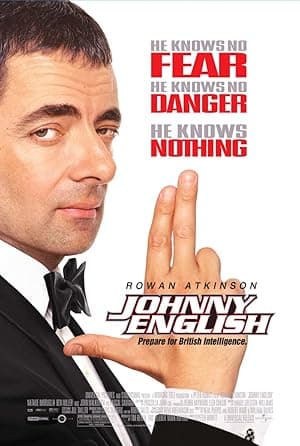
Johnny English
A coronation caper where national dignity is saved by a man who can’t stop tripping over it.
Feature presentation
Johnny English is the kind of comedy that makes a very particular promise: you won’t get a clever spy thriller, but you will get a very human kind of chaos. Put Rowan Atkinson into a Bond-shaped suit, hand him a coronation plot and watch institutional Britain wobble amusingly on its hinges.
THE MOVIE
Johnny English (Richard Latham / MI7 agent) is still the reason this movie works
There’s a simple engine behind Johnny English: a well-meaning but accident-prone MI7 agent becomes Britain’s only field operative after a single attack wipes out the agency’s top people. That premise is deliberately, gloriously daft — and it gives the film permission to be awkward on purpose.
The film trades on two recognisable loves: the gadget-and-glamor shorthand of Bond films and a very physical comic persona that audiences already know from Rowan Atkinson. It’s marketed and presented as a parody and homage, so it never pretends to be anything other than a riff on the spy movie playbook.
Peter Howitt directs an 87-minute sprint that keeps things brisk and obvious: a coronation plot, a French businessman antagonist, a mysterious woman tied into the theft, and a supporting cast (Bough, Pegasus) who help frame English’s mistakes as the plot’s forward momentum.
THE SETUP
The idea that sets Johnny English in motion
The film gives itself a tidy and very British ticking clock: during a public event the Crown Jewels are stolen, and with MI7’s elite suddenly gone, English and his partner Bough are the only pair left to sort it out. That’s all the plot needs to get moving.
What follows is less a careful investigation than a chain of accidental consequences. English’s incompetence — earnest, loud and unavoidable — both complicates the case and, oddly, propels it. The comedy arises from how mistakes double as discoveries.
The antagonist, Pascal Sauvage, frames the theft as part of a coronation-style scheme to displace the monarchy, which neatly raises the stakes from ‘find some bling’ to ‘save a national ritual’. It gives the film somewhere nobly silly to aim its jokes.
And there are useful, familiar pieces in place: Bough as the practical sidekick, Pegasus as the head of MI7 who dispatches English, and Lorna Campbell as the mysterious woman whose loyalties keep the plot uncomfortably uncertain.
THE CHARACTER
Why Johnny English (Richard Latham / MI7 agent) matters
Johnny English isn’t memorable because he’s competent. He’s memorable because he insists on doing the competent thing with spectacularly incompetent results. That earnest overconfidence is the character’s defining trait, and it’s what keeps the story moving.
The film deliberately recycles elements of a physical-comedy persona audiences already recognise from Rowan Atkinson’s earlier work. That familiarity lets the movie skip introductions and get straight to the business of tripping over protocol and national dignity.
English’s value to the story is structural: his mistakes are the plot’s propulsion. Each pratfall or ill-judged plan creates a new problem, a fresh misunderstanding, or an accidental lead. The character is both clown and plot device — and the film asks us to enjoy that overlap.
He doesn’t act alone on-screen. His relationships with supporting figures — Bough at his elbow, Pegasus watching from above, Lorna keeping her cards close — let the movie alternate between straight-man setup and physical pay-off without losing the spy-parody shape.
UNDER THE SURFACE
Johnny English has more on its mind than the plot suggests
On the surface it’s a spy parody: familiar Bond beats turned into set-pieces for pratfalls and misunderstandings. But that surface is exactly the point — the film invites us to laugh at the rituals and conventions of espionage precisely by copying them.
It’s also, quietly, a movie about confidence and appearance. The bumbling hero who insists he’s the real deal lets the story poke gentle fun at the idea that authority automatically equals competence.
There’s a streak of national comedy running through it too. The plot revolves around institutions — MI7, the coronation, the Crown Jewels — and the film gleefully exposes how easily pomp and procedure can be subverted by human error.
Finally, the movie squares its parody with physical comedy: the homage to Bond’s tropes sits next to Mr. Bean-style business, which keeps the film from becoming a cold satire and instead turns it into a succession of human, messy moments.
THE FILMMAKING
How Johnny English was put together
The film’s shape is very much in service of its jokes. Editing keeps sequences short and gag-driven, which suits a picture that relies on physical beats rather than long dramatic set-ups. It’s all about timing — quick setups, quick pay-offs.
Production design leans into slightly exaggerated institutional spaces: MI7 headquarters and ceremonial locations are recognisable but a touch theatrical, which helps the parody land without needing to rewrite the rules of a spy movie.
Those choices make the film feel like a neat, comic machine: design and pace are calibrated to let an awkward human centre — the agent — wobble against a tidy world of procedure and pageantry.
Put another way: the filmmaking keeps the audience’s attention on the jokes. When sequences are short and the rooms are a little larger-than-life, the comedy has room to breathe and to land.
PURE 00s
Johnny English could not belong to any other decade
Released in 2003, Johnny English arrived into a post‑Austin Powers era where spy spoofs and franchise-aware comedies were still finding their feet. That context matters: audiences were primed to accept broad genre pastiche and familiar comic riffing.
The film’s timing let it aim for an international audience comfortable with transatlantic comedy that referenced big cinematic icons rather than squeezing jokes into local in-jokes.
It also sits neatly in the early-2000s habit of building star-led, easily packaged comedies — a compact runtime and a recognisable central persona made the film an exportable product.
So yes: the movie is of its moment. The early-00s appetite for affectionate parody and star vehicles is baked into how Johnny English was made and sold.
WATCHING IT NOW
What has aged — and what hasn't
One concrete sign of the film’s staying power is that the character returned: a theatrical sequel followed in 2011, and another in 2018. That continuity suggests the central idea — the accident-prone spy — still had life in it after 2003.
The basic dynamics are simple and portable. Bough as the foil, Pegasus as the officious boss and Lorna as the ambiguous ally are economical pieces of comic machinery; they keep the relationship work readable for a modern viewer glancing in.
Because the film leans on character types and clear visual setups rather than topical jokes, much of it still functions: you don’t need to have lived through 2003 to get why a pratfall inside a ceremony is funny.
What hasn’t aged as neatly is the expectation that a single, broad comic tone will carry an entire feature without a deeper structural squeeze. But if you’re in the mood for uncomplicated, physical comedy, the movie still delivers what it promises.
THE LEGACY
Why Johnny English still matters
Its clearest legacy is practical: Johnny English became a named franchise with two theatrical sequels. That’s a straightforward industry fact — the film did well enough to justify more outings for the character.
Commercial success on initial release meant the title could be used as a brand: subsequent marketing leaned on the name and the recognisable comedic persona at its centre.
The character’s association with Rowan Atkinson’s post‑Mr. Bean screen persona is another part of the film’s afterlife. The title continues to be shorthand for that particular brand of broad, physical comedy.
So the film matters less as a cultural watershed and more as a durable entertainment concept that proved bankable and repeatable — a solid, if not subtle, piece of early‑00s movie-making.
THE VERDICT
Does Johnny English still hold up?
If you want a clever lampoon of espionage, this isn’t the one. But if you want a lean, 87-minute comedy built around a single comic idea — an earnest, accident-prone agent tackling a plot to steal the Crown Jewels and replace the monarchy — Johnny English knows exactly what it is.
The film’s central trick is simple and consistent: English’s incompetence generates accidental successes and misunderstandings that push the narrative forward. That mechanic is straightforward, and the film never pretends otherwise.
The supporting players (Bough, Pegasus, the ambiguous Lorna) do the necessary work of keeping the world coherent while the lead trips through it, and the antagonistic outline — a coronation-style scheme by Pascal Sauvage — supplies just enough gravity for the jokes to land.
So: should you watch it now? Yes, if you’re in the mood for a compact, undemanding spy parody that places a very specific kind of physical comedy at its centre. It remains an agreeable, if unambitious, piece of early-00s movie-making — charmingly immovable in its silliness.
Share this movie
Keep watching
More movies from the 00s

2002
The Pianist
A quiet life unmade by war — and a pianist who refuses to stop listening.
Read the retrospective
→
2006
Blood Diamond
A mercenary, a fisherman and a pink diamond — and a film that still asks who pays for our jewellery.
Read the retrospective
→
2003
Kill Bill: Volume 1
A yellow jumpsuit, a long list of enemies and one woman who refuses to be finished.
Read the retrospective
→