Feature presentation
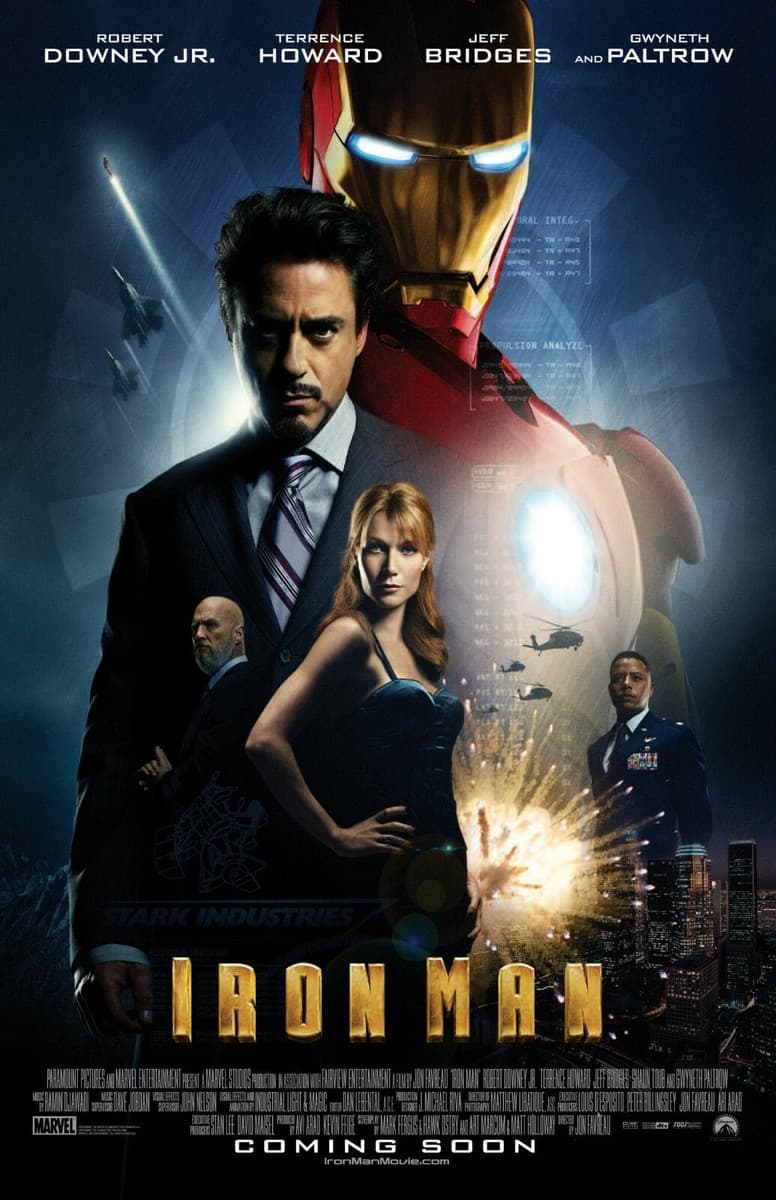
There’s a very particular pleasure in watching someone famous for making weapons decide, loudly and awkwardly, that maybe manufacturing weaponry wasn’t the best life choice. Iron Man gives us that turn in loud, confident colours: a capture, a crude armoured escape and a billionaire who has to learn what responsibility looks like. Jon Favreau keeps the film moving, but it’s the way the story lets the character change that still makes the movie worth revisiting.
THE MOVIE
Tony Stark / Iron Man is still the reason this movie works
If you remember one thing about Iron man, it’s probably Tony Stark doing something selfish and getting stopped by his own conscience. The film kicks into gear when a billionaire inventor, demonstrating weapons overseas, is kidnapped by the Ten Rings and forced to build a missile—only to build a crude armoured suit instead and escape.
That setup gives the movie a simple, satisfying engine: a man whose life is built on making destructive toys has to confront what those toys do. His capture and survival force a professional and moral reckoning that pushes the plot forward and gives the action an emotional knot to unt.
Jon Favreau directs, Robert Downey Jr. plays the central figure, and the picture makes room for bigger ideas — redemption, corporate responsibility, questions about identity and publicity and where technology sits in all this — without turning into a lecture. There’s also a wink to what comes next: a post-credits cameo that explicitly points toward an interconnected plan for future films.
THE SETUP
The idea that sets Iron Man in motion
The movie rests on an elegant, easily understood premise: a weapons manufacturer is taken captive while showing off his product and, instead of building the missile he’s been ordered to produce, constructs an escape suit. That single rebellious act — inventing a way out rather than more harm — is the plot’s hinge.
From there the film treats the suit as a storytelling device. Stark builds the Mark I in captivity with help from a fellow prisoner, then returns home and iterates: Mark II, Mark III. Each prototype isn’t just a cooler costume; it’s the mechanism by which the action escalates and the character changes.
What drives the tension beyond the gadgets is the choice Stark makes about Stark Industries. He stops the company’s weapons manufacturing, and that decision has consequences: it provokes hostility from within his own ranks, particularly from Obadiah Stane, who represents the pragmatic defence-of-weapons counterpoint.
So the setup works because the external problem — escape, enemies, suits — is always tied to an internal shift: the man who made a living selling weapons has to decide what kind of legacy he wants to leave.
THE CHARACTER
Why Tony Stark / Iron Man matters
Tony Stark is the pivot on which the film turns. He is presented as an inventor and figure of enormous private wealth whose choices have public consequences; the story is organised around what happens when that private life collides with real-world violence.
The character’s relationships do a lot of the heavy lifting. Pepper Potts provides a tether to normal life — an organised, professional counterpoint to Stark’s showmanship — and their developing connection keeps his civilian world believable rather than decorative.
Colonel James 'Rhodey' Rhodes functions as the film’s link to official power and consequence: a friend who represents how Stark’s actions echo beyond his workshop and into the military and government sphere.
And the film gives Stark moral pressure from multiple directions — personal, professional and political — so his transformation feels earned rather than engineered around set-pieces.
THE PERFORMANCE
Why Robert Downey Jr.'s performance matters
Contemporary critics pointed to Robert Downey Jr.'s portrayal as a central reason the movie landed. Reviews singled out his energy and the way his presence shaped the film’s tone, making the origin-story beats feel less like obligation and more like character.
That’s an important distinction. The script gives Stark a clear arc; what the contemporary coverage credited Downey with was turning that arc into something watchable on a moment-to-moment level, so the jokes, the arrogance and the quieter reckonings sit together cleanly.
The supporting cast — from Terrence Howard as Rhodes to Gwyneth Paltrow as Pepper and Shaun Toub in the captivity scenes — supplies the counterpoints the lead needs, but the contemporary consensus was that the film’s success hinged on its central performance.
Put simply: the reviews suggested the picture leans on Downey’s portrayal in a way that makes the whole project feel steadier than its components might be on their own.
UNDER THE SURFACE
Q192724 has more on its mind than the plot suggests
On the surface it’s a superhero origin story. Underneath, the film keeps returning to the same set of moral questions: what do you do when the thing that made you rich also harms people? Redemption, in that context, becomes an active choice rather than a tidy emotional payoff.
Corporate responsibility is threaded through the plot: Stark’s public decision to stop weapons manufacturing reframes the action as a reckoning with the consequences of commerce, and it sets up real conflict with those who profit from the status quo.
Identity and publicity also matter. The story treats Tony’s public persona — what he says, who he is in headlines — as part of his problem and his recovery. How a powerful technologist manages his image and choices turns into a theme that carries through the film.
Finally, technology and ethics are never just backdrop. The suits are glamorous and entertaining, but the movie keeps asking whether building more powerful machines is ethical if the people controlling them won’t change.
THE FILMMAKING
How Iron Man was put together
The film’s craft credentials were recognised by the industry: it earned Academy Award nominations for visual effects and sound editing. That’s a tidy way of saying the movie married spectacle to technical competence in a way the awards committees noticed.
Those nominations matter because the picture deliberately mixes physical and digital techniques to make the suits and action read as tangible. Recognition in these categories underlines that the film’s production values were more than window dressing.
Jon Favreau’s direction keeps the pace moving and the tone balanced between spectacle and character beats; the production choices around effects and sound were significant enough to earn formal attention.
In short, while the film aims to entertain on a blockbuster scale, the filmmaking side supplied the scaffolding that made the spectacle feel serviceable rather than slippery.
PRACTICAL EFFECTS
The effects work that gives Iron Man its physical personality
The movie didn’t rely on CGI alone. Stan Winston Studio built multiple practical armour iterations — from rubber pieces to metal 'hero' suits — that the production used on set to give physical presence to the costume work.
Those practical elements were then integrated with computer-generated work from vendors such as Industrial Light & Magic to show the suits moving and, crucially, flying. The blend of physical props and digital articulation helped sell both close-up moments and full-body sequences.
The captive sequences were also staged with physical control in mind: an extended Afghan cave environment was constructed on a soundstage to simulate the cold conditions of the imprisonment scenes, rather than relying entirely on on-location shooting.
Taken together, these choices give the film a tactile quality: you can see where the suit meets the actor, and where CGI fills the gaps necessary for the action.
PURE 00s
Iron Man could not belong to any other decade
Iron Man arrived in 2008 at a moment when Marvel was changing its own rules: it was the studio’s first self-financed feature and a deliberate move into producing its own tentpole films. That decision shapes how the movie feels — cautious in places, ambitious in others.
The film opened in May 2008 and effectively began a planned slate of interconnected pictures that would follow. The sense of a strategy — an emerging 'shared universe' mentality — is baked into what the movie does, even when it’s focused on a single man and his suit.
Principal photography ran across early 2007 with major production work staged in the Los Angeles/Playa Vista area and additional location days elsewhere, reflecting the production scale Marvel was willing to commit to.
So while the story is an origin tale you could tell in many eras, the film’s industry role and its place at the start of a deliberately connected Phase One give it a distinct late-00s identity.
THE LEGACY
Why Iron Man still matters
The film is widely recognised as the launch title for the Marvel Cinematic Universe; its success directly led to sequels and to the development of the Avengers crossover strategy. That planned serial approach is signalled inside the movie itself.
One clear marker of that intent is the post-credits cameo by a character who explicitly mentions an 'Avengers Initiative' — a deliberate connective tease that made the film feel like a first chapter rather than a standalone showpiece.
Beyond its franchise role, the production earned industry recognition: nominations for visual effects and sound editing at the Academy Awards underline the work put into the film’s craft elements.
Taken together, those factors explain why Iron Man is still referenced: it’s the beginning of an industrial idea as much as it’s an origin story for a single hero.
THE VERDICT
Does Iron man still hold up?
Yes — and the reason is straightforward. The central mechanics still work: a capture by the Ten Rings forces Tony Stark to build a prototype suit in captivity, then return home to iterate into better armours (Mark I to Mark III) while making the consequential decision to stop his company’s weapons manufacturing.
That moral turn — and the opposition it provokes from Obadiah Stane — gives the action weight. The presence of a sacrificial figure who helps Stark escape and the way Pepper grounds his everyday life mean the stakes are personal as well as spectacular.
Robert Downey Jr. is the connective tissue: contemporary coverage singled him out as a decisive element in the film’s reception, and the movie’s mid/late-film epilogue that introduces a shared-universe thread with a Nick Fury cameo keeps the picture feeling plugged into something larger.
If you enjoy origin stories that mix character change with blockbuster mechanics, Iron Man still delivers. It’s the kind of film that introduced a long-term plan without losing sight of the single man at its centre — and that balance is what helps it continue to repay a rewatch.
Share this movie
Keep watching
More movies from the 00s

2002
The Pianist
A quiet life unmade by war — and a pianist who refuses to stop listening.
Read the retrospective
→
2006
Blood Diamond
A mercenary, a fisherman and a pink diamond — and a film that still asks who pays for our jewellery.
Read the retrospective
→
2003
Kill Bill: Volume 1
A yellow jumpsuit, a long list of enemies and one woman who refuses to be finished.
Read the retrospective
→