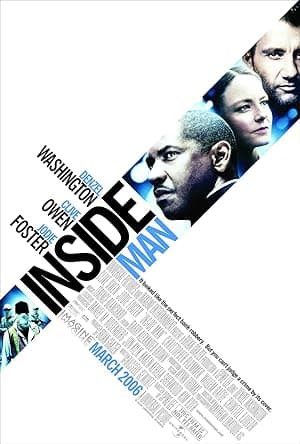
Inside Man
A polite robbery, a public spectacle and a detective who won't let the questions die.
Feature presentation
Inside Man opens with a daylight bank job that looks neat enough to be a demonstration — painters' coveralls, disabled cameras, everyone calm enough to be impressive. What sticks, though, isn't the blueprint of the heist but Detective Keith Frazier: the negotiator caught between procedure, headlines and private pressure. Spike Lee's film turns a tidy puzzle-thriller into something that keeps asking awkward questions about power, performance and who gets the last word.
THE MOVIE
Detective Keith Frazier is still the reason this movie works
The picture that opens Inside Man is crisp and almost casual: a daytime bank robbery at Manhattan Trust that unfolds like a lesson in efficiency. The robbers arrive in white painters' coveralls, cut the CCTV and take hostages without the melodrama you expect from a movie heist.
That neatness is the point. The film stages the robbery as a public event — something the city watches on loop — while a quieter set of players pull strings behind the curtains. It becomes less about the takings and more about how media, law enforcement and private power look when they meet on the same stage.
And at the centre of the fuss is Detective Keith Frazier, an NYPD hostage negotiator juggling procedure, public scrutiny and a fair number of private doubts. For all the clever plotting, it’s his steady questions that keep the story honest.
THE SETUP
The idea that sets Inside Man in motion
At face value it’s a cat-and-mouse: Detective Keith Frazier has to resolve a hostage standoff while the robber keeps his motives deliberately murky. That uncertainty — not just who took the money but why — gives the film its forward motion.
Running alongside the negotiation is a side-channel of influence: Madeleine White, a Manhattan fixer, is hired by bank founder Arthur Case to keep certain items in a safe-deposit box out of sight. It’s the off-the-record manoeuvring that complicates what looks like a conventional police operation.
Mechanically, the movie mixes on-site negotiation and police procedure with those behind-the-scenes interventions. The robbery itself is presented as meticulously staged, an event that’s at once a puzzle and a performance.
The setup works because those layers talk to each other. The standoff provides the tension; the off-site pressure gives it moral texture. You get a heist that’s also a debate about who gets to close a case — and on what terms.
THE CHARACTER
Why Detective Keith Frazier matters
Detective Keith Frazier is written and staged as the film’s human anchor. He’s the officer who has to talk his way through a standoff that every lens in the city is watching — and whose job it is to keep a messy situation from becoming worse.
Crucially, Frazier is not a paragon. He balances procedural duty with public scrutiny and private doubts. That mixture gives him texture: he’s someone solving a puzzle while also watching how the solution will look under a microscope.
Because the film keeps the robber’s motives ambiguous, Frazier becomes the audience’s guide. We learn about the siege through his questions, his small compromises and the decisions he’s forced to make in real time.
And he doesn’t stand alone. The movie pairs him with a capable ensemble — the robber, the fixer and the bank’s owner — so his choices are constantly tested from every angle. That is why he’s the character you remember when the credits roll.
THE PERFORMANCE
Why Denzel Washington's performance matters
Contemporary reviews were clear where one of the film’s strengths lay: the cast. Major outlets singled out the ensemble, naming Denzel Washington alongside Clive Owen and Jodie Foster.
That kind of attention is useful to note because casting isn’t neutral in a picture like this. The negotiator is the linchpin; having a heavyweight in the role signals that the story asks you to take those quieter procedural moments seriously.
Reviews therefore framed Washington’s presence as part of what made the movie feel substantial rather than merely clever. In practical terms, his role is the bridge between the police procedural and the film’s moral questions.
Put simply: reviewers treated the cast as more than star power — as a reason the film’s balancing act hangs together.
UNDER THE SURFACE
Inside Man has more on its mind than the plot suggests
At one level Inside Man is a heist puzzle; a neat, procedural game. Below that surface it’s preoccupied with public spectacle versus private power: what looks like public crisis management is often shaped by quiet phone calls and closed doors.
Ambiguity is baked into the storytelling. The robbers’ motives are kept deliberately obscure for much of the film, which forces characters — and viewers — to make moral judgements with incomplete information.
Those moral compromises matter. The film repeatedly asks whether a tidy legal resolution is the same as justice, or whether deals and secrecy trade something more costly.
And those questions sit beside considerations of race, class and urban authority. The standoff plays out in a city where who gets believed, who gets protection and who gets investigated are not neutral facts but social ones — and the movie stages that unease rather than ignoring it.
THE FILMMAKING
How Inside Man was put together
The production organised the movie around a small group of adjacent, practical settings: the bank exterior, the lobby and the basement. That spatial economy keeps the action focused and lets the standoff feel both contained and civic.
To cover those interiors efficiently, Spike Lee and his cinematographer discussed using a multi-camera approach for interior coverage. It’s a way of keeping the energy up without losing the detail of the negotiation beats.
Those choices are quietly disciplined. The result gives the film a feeling of a single, sustained event — which in turn helps the story’s theatrical conceit: a city watching a thing happen and people watching those people.
PRACTICAL EFFECTS
The effects work that gives Inside Man its physical personality
The production credits a named stunt team and multiple stunt performers, which points to practical stunt work being used for the film's action and police sequences. Those moments ground the procedural beats in something physical.
For the large-scale exterior set pieces, the crew used practical lighting trucks and exterior lighting units. When you’re staging a midday spectacle in a city, having that practical muscle matters — it keeps the sequences believable without resorting to obvious stage tricks.
Taken together, the practical choices give the film a texture that supports the drama rather than calling attention to itself.
PURE 00s
Inside Man could not belong to any other decade
Inside Man sits neatly in the mid-2000s as a studio-backed, commercial Spike Lee picture — produced by Brian Grazer and released by Universal during a time when star-driven thrillers were a reliable part of the studio slate.
It’s emblematic of the era’s mainstream heist films: a puzzle-thriller at its core that also makes room for character-focused negotiation drama. That blend — heady plot mechanics with human stakes — was very much the decade’s language for crossover crowd-pleasers.
The screenplay itself is a 00s story too: it was the first produced script by former lawyer Russell Gewirtz and moved through studio development before the director signed on. The project has that early-2000s scent of a single strong script finding its way into a commercial production.
Released in 2006, the film reflects that moment when studio money, a recognisable director and a bankable cast combined to turn a contained idea into a polished wide-release thriller.
THE LEGACY
Why Inside Man still matters
Part of the film’s afterlife is simply practical: it generated a later franchise entry with a 2019 direct-to-video/streaming sequel. That continuation underlines the original’s shape as a self-contained universe people were willing to return to, even without the same cast.
Critically, Inside Man earned year-end recognition on several lists for 2006. Contemporary critics noted how the film blended conventional heist mechanics with Spike Lee’s touches and social commentary, and those qualities kept it in the conversation at the time.
Taken together, the sequel and the critical mentions explain why the film didn’t disappear: it offered a neat genre puzzle while also giving reviewers and viewers something to argue about.
THE VERDICT
Does Inside Man still hold up?
Yes — and not for the obvious reasons. The daylight robbery and the meticulous staging make for a smart opener, but what keeps the film interesting is that its central conflict is a steady cat-and-mouse: a negotiator trying to resolve a siege while the robber’s motives remain deliberately opaque.
The movie earns that longevity by refusing to make every mystery tidy. It keeps key elements of the robber’s motive ambiguous for most of the running time, while showing the police work, the media spectacle and the off-the-record pressure that sit around the siege.
That mixture — on-site negotiation, police procedure and behind-the-scenes intervention — gives the film moral texture. A fixer protecting a safe-deposit box, a negotiator balancing duty and doubt, and a plot that emphasises contingency planning all make the conclusion feel earned rather than pyrotechnic.
So should you watch it now? If you like a heist that treats cleverness as a means to ask tougher questions about justice, power and compromise, then yes. Inside Man still plays like a polished mid-00s thriller that knows how to stage a heist and how to make the courtroom of public opinion the real battleground.
Share this movie
Keep watching
More movies from the 00s

2002
The Pianist
A quiet life unmade by war — and a pianist who refuses to stop listening.
Read the retrospective
→
2006
Blood Diamond
A mercenary, a fisherman and a pink diamond — and a film that still asks who pays for our jewellery.
Read the retrospective
→
2003
Kill Bill: Volume 1
A yellow jumpsuit, a long list of enemies and one woman who refuses to be finished.
Read the retrospective
→