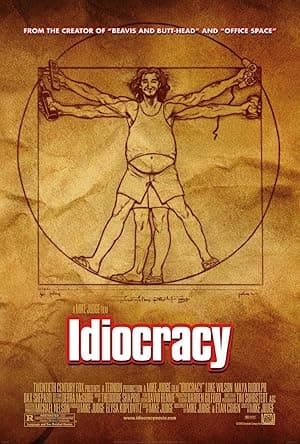
Idiocracy
A very average man wakes up to a very extreme future — and that's the joke, and the warning.
Feature presentation
Talk about a premise you can explain in a sentence and still get people to nod. Idiocracy sends an ordinary Army private, Joe Bauers, into the far future and lets the joke do the heavy lifting: in a country that has become comically anti-intellectual and thoroughly corporatised, his middling smarts suddenly look like genius. Mike Judge set up a neat comic engine — fish-out-of-water bewilderment as the map for satire — and it’s why the film keeps getting dragged back into conversation.
THE MOVIE
Joe Bauers is still the reason this movie works
Idiocracy trades big visuals for a simple, stubborn idea: what if the most 'average' person in America turned out to be the best shot at dealing with a future gone stupid? That average is Army private Joe Bauers, picked for a hibernation experiment precisely because he’s statistically unremarkable.
When Joe and Rita are forgotten in stasis and wake up roughly five hundred years later, the set-piece jokes follow: a society where civic knowledge has collapsed, corporations run the show, and branded logic replaces basic common sense. That sharpened premise — anti-intellectualism played as a dystopian comedy — is what lets the film land its nastier laughs without getting lost in melodrama.
Mike Judge directed and co-wrote the thing, keeps it tight at 84 minutes, and casts Joe with Luke Wilson opposite Maya Rudolph’s Rita and a roll-call of broadly drawn supporting players. It’s a compact movie with an obvious target: the cultural consequences of declining literacy and civic know-how. That focus is why people keep mentioning it when talking about how satire ages.
THE SETUP
The idea that sets Idiocracy in motion
The film’s engine is almost purely procedural. Joe Bauers and Rita are put into a government human-hibernation experiment and are, crucially, forgotten. They wake up centuries later into a nation that has slid into a very specific kind of decline.
That future isn’t just low on facts; it’s corporatised. Public life, the institutions you’d expect to rely on basic competence, now answer to brand logic. One of the clearest examples the movie cheats with is a branded sports drink being used where plain water should be — a small joke that scales up into a larger satirical point about misplaced priorities.
Because Joe was chosen for being average, his present-day normality becomes an advantage in a place where the educational baseline has fallen. His bewilderment — not heroics — is the tool the screenplay uses to explain the world: he asks questions the future simply doesn’t know how to answer.
That setup works because it keeps the focus tight. The comedy grows out of the gap between Joe and his surroundings rather than any complicated sci-fi mechanics, which makes the satire immediate and easy to follow.
THE CHARACTER
Why Joe Bauers matters
Joe Bauers is memorable because he’s deliberately unremarkable. The screenplay selects an ‘average’ soldier as its protagonist and then lets that averageness do the heavy lifting — in a dumbed-down future, normal equals useful.
That choice gives the audience a reliable point of view. Joe’s confusion becomes our map: when he reacts, we learn. The film trusts that bewilderment to reveal the world’s absurdities rather than spelling them out with exposition.
Joe isn’t a heroic archetype; he’s the kind of protagonist who stumbles through situations and, by asking obvious questions, highlights how far institutions have fallen. That structural role is why the character lodges in the memory: he’s less about grand transformation and more about single, clear perspective.
Casting Luke Wilson as Joe reads on the page as a neat shorthand: a face and a voice that don’t demand attention, which is exactly the point. The character is built to be serviceable as a lens, and everything the movie does funnels through his steady, bemused point of view.
THE PERFORMANCE
Why Luke Wilson's performance matters
One concrete note from contemporary commentary: critics pointed out that Luke Wilson’s restrained, deadpan delivery works as a stabiliser against the film’s widescreen freakshow of supporting characters.
That restraint isn’t decorative. Joe’s ordinary manner gives the loud set-pieces something to bounce off; when the rest of the world goes to eleven, Wilson keeps it at a sensible, watchable level.
So the performance matters because it preserves the film’s ability to translate bewilderment into comedy rather than chaos. The contrast is the joke’s engine: calm in a sea of absurdity.
Viewed that way, casting becomes a practical decision rather than star-mania — an actor whose approach keeps the satire legible.
UNDER THE SURFACE
Idiocracy has more on its mind than the plot suggests
On the surface the film is a string of absurd gags about a dumb future. Underneath, it’s a sketch about anti-intellectualism and the costs when civic literacy erodes. The comedy gets sharper because the stakes it hints at are recognisably social, not just personal.
Corporate capture is another clear target. The movie repeatedly shows public life rearranged to suit branding and market logic, which turns institutions that should serve citizens into billboard-adjacent ventures.
That consumerism and saturation by branding becomes a structural joke — everyday necessities and decisions are mediated by products and marketing. A branded sports drink standing in for water does more than get a laugh; it symbolises how commercial thinking can distort basic, practical judgement.
Taken together, these elements make Idiocracy a dystopian satire that uses exaggeration to underline a worry: when politics and public institutions start to think like corporations, common sense can become collateral damage.
THE FILMMAKING
How Idiocracy was put together
Idiocracy arrived as a modestly credited studio feature: Mike Judge directed and co-wrote, while Tim Suhrstedt is listed as cinematographer, David Rennie as editor and Darren Gilford as production designer. Theodore Shapiro supplied the music.
Those names don’t demand flash; they point to a production that was assembled efficiently and with clear craft roles in place. The result is a compact film that runs 84 minutes and keeps the idea moving briskly.
The production was shot in central Texas stages and locations and, importantly, the film was finished well before its release — a fact that sits oddly with the way it was distributed later on.
Mentioning the crew is not vanity; it anchors Idiocracy as a deliberately put-together comedy. Everything about the credits suggests a conventional, professional shoot rather than an improvisational oddity.
PURE 00s
Idiocracy could not belong to any other decade
Part of this movie’s life story is its release pattern: finished well before it hit cinemas, then given a limited theatrical rollout in 2006 with minimal marketing. That mid‑2000s distribution decision shaped how and when audiences actually encountered it.
A sparse theatrical run — opening in roughly 130 theatres rather than a conventional wide release — was not unusual for modest comedies of the period that studios weren’t sure how to sell. In that sense Idiocracy is very much a 00s creature: a studio film that found its real viewers after the theatrical window.
The follow-up home-video and cable cycle fits another 2000s pattern. Several comedies of that era built reputations after the fact through DVD and late-night TV plays — Idiocracy is part of that batch.
So the decade matters less for costumes or tech-trends and more for the mechanics of how a film could quietly migrate from near-obscurity to cult status once the long tail of home distribution took over.
THE LEGACY
Why Idiocracy still matters
After a quiet theatrical life, Idiocracy didn’t disappear so much as relocate: it developed a substantial cult following through DVD, cable and later streaming, a common afterlife for a number of 00s comedies.
That afterlife matters because it’s how the movie kept being seen and discussed — anniversary screenings and renewed commentary have sustained interest well beyond the modest box-office window.
Public discussion around the film frequently invokes it in political and cultural debates, which has kept the title in circulation whenever people want a shorthand for satire about dumbing down and corporate overreach.
So its legacy is not blockbuster folklore. It’s a film that found its audience slowly and then stuck in the culture as a reference point for certain arguments about civic literacy and branding.
THE VERDICT
Does Idiocracy still hold up?
Yes — but with a clear rider. Idiocracy’s comedy rests on a tight conceit: two time‑displaced people wake to a future in which anti-intellectualism and corporate logic have hollowed out basic competence. That premise is still sharp; the fish-out-of-water device means the jokes land quickly and the satire stays visible.
Joe Bauers remains the movie’s practical asset. As an ‘average’ soldier who becomes, by default, the smartest person alive, his bewilderment is how the audience understands the world. Maya Rudolph’s Rita shares that displacement and functions as the pragmatic companion who helps him navigate the mess, which keeps the pair grounded amid the spectacle.
There are limits. The film’s humour depends on broad caricature and a handful of satirical set pieces — notably the branded replacement for water — so if you prefer nuance over barnstorming satire, Idiocracy will feel blunt. But the bluntness is deliberate; it’s a simple machine that trades subtlety for clarity.
Ultimately, Idiocracy is worth watching today if you’re interested in a tidy, pointed satire about anti-intellectualism, corporate capture and consumerism. It does what it set out to do, and Joe’s ordinary perspective still gives the whole thing a sensible spine.
Share this movie
Keep watching
More movies from the 00s

2002
The Pianist
A quiet life unmade by war — and a pianist who refuses to stop listening.
Read the retrospective
→
2006
Blood Diamond
A mercenary, a fisherman and a pink diamond — and a film that still asks who pays for our jewellery.
Read the retrospective
→
2003
Kill Bill: Volume 1
A yellow jumpsuit, a long list of enemies and one woman who refuses to be finished.
Read the retrospective
→