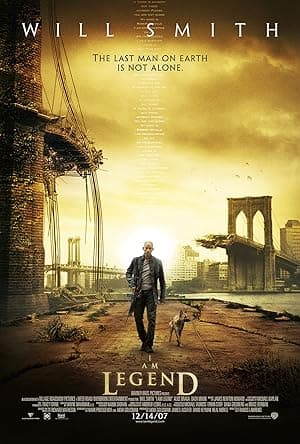
I Am Legend
One man, a dog and a city emptied by a virus — Robert Neville keeps the film honest.
Feature presentation
I Am Legend is the sort of blockbuster that keeps returning to one stubbornly simple image: a single survivor moving through silent streets, trying to keep science and grief from swallowing him whole. Directed by Francis Lawrence and released in 2007, the film trades spectacle for a surprisingly intimate centre — and that centre is Robert Neville.
THE MOVIE
Robert Neville is still the reason this movie works
People still talk about I Am Legend because, amid deserted skyscrapers and predator-thin nights, the film insists on keeping its focus stubbornly human. At the centre of the spectacle is Robert Neville, a virologist who may be the last uninfected person in New York after a genetically altered virus runs rampant.
That virus has a name in the movie — the Krippin Virus — and it matters because the film doesn’t present the outbreak as a mystery macguffin. It’s the result of a well-intentioned medical intervention gone catastrophically wrong, which gives the whole story a nervy, moral thrum beneath the action.
What holds the film together isn’t just the empty-city postcards or the late-night scares. It’s Neville’s daily rituals: experiments, radios, routines driven by scientific duty and the grief of losing his family. Francis Lawrence stages all of that within a compact, 100-minute frame, letting Will Smith’s central presence carry the quieter, lonelier moments.
THE SETUP
The idea that sets I Am Legend in motion
At its simplest the film sets a clear operating rule: daylight is travelable, night is deadly. That day/night swing turns New York into a place of practical problem‑solving — how to gather supplies, how to keep experiments going, how to sleep with the city outside your doors.
The other simple, crucial premise is the science angle. Robert Neville is not just surviving; he’s running tests and searching for a cure, which gives his work a procedural urgency that sits beside the film’s scares.
That combination — survival logistics by day, containment and science by habit — is what lets I Am Legend balance action set pieces with quieter scenes of process and waiting.
The film also shifts its stakes later by introducing other survivors, which changes the logic from solitary survival into a question about escape, cure and community.
THE CHARACTER
Why Robert Neville matters
Robert Neville isn’t just the last man standing for drama’s sake. He’s a scientist with a mission: to turn catastrophe into a cure. That gives the film its engine — Neville’s routines, his notes, his experiments — every one of them is an attempt to make the world return to reason.
There’s also a private layer. Neville’s motivation is entangled with grief: he lost his family to the outbreak, which is why his days have a ritualised intensity. Those personal stakes stop the movie becoming a mere survival checklist and keep it tethered to why any of it matters.
Put bluntly: the film’s structure depends on Neville caring. His scientific duty and his mourning are what make decisions dramatic rather than procedural.
And because he’s the viewpoint the story never really leaves, the audience’s experience of the empty city, the infected nights and the eventual arrivals of other people all register through his particular combination of practicality and heartbreak.
THE PERFORMANCE
Why Will Smith's performance matters
Contemporary reviewers repeatedly pointed to Will Smith’s central turn as the thing that keeps the film emotionally anchored. When the camera lingers on Neville alone in a ruined world, it needs someone who can carry silence without collapsing the scene — and that was where most critics located the film’s seriousness.
That critical focus matters because the movie asks an actor to do two different jobs: sell burnout and keep the audience invested in a scientist’s procedural obsession. Doing both prevents the film from sliding into pure spectacle.
So while I Am Legend trades in big set-pieces, a lot of its emotional currency comes from moments that require steadiness rather than flash — and contemporary commentary singled out Smith as providing that steadiness.
In short: the film’s quieter beats work only because the central performance gives them something to hang on to.
UNDER THE SURFACE
I Am Legend has more on its mind than the plot suggests
On the surface it’s a post-apocalyptic action-horror: empty streets, dangerous nights, a man trying to survive. Underneath, the film keeps returning to loneliness as a lived, ordinary thing. The quiet rituals — tests, radios, the way Neville organizes his day — are how he counteracts isolation.
Grief colours everything. Neville’s work and his routines are as much a coping mechanism as a scientific mission. That blend of duty and mourning is what prevents the film from treating the catastrophe as merely atmospheric.
There’s also a running idea about science creating consequences it didn’t intend. The Krippin Virus is presented as a medical intervention that mutated; that fact gives the story a note of moral unease, where the line between healer and harm-doer is disturbingly thin.
Finally, the movie probes what it means to be human when monstrosity is on the loose. The infected are the physical threat, but many of the film’s dramatic questions are about whether the survivors — and Neville in particular — can keep their humanity intact.
THE FILMMAKING
How I Am Legend was put together
A lot of the film’s identity comes from practical choices about where and how to shoot. The production actually used New York locations and staged closures and night shoots to create those trademark empty-city images, which makes the film feel lived-in rather than entirely composited.
Andrew Lesnie is credited as the cinematographer and Naomi Shohan as production designer; those names anchor the film in a specific craft sensibility — the look and the way the world is laid out are deliberate decisions, not afterthoughts.
There’s also a tidy economy to the film’s construction: at roughly 100 minutes, it moves briskly between survival beats and set-pieces without lingering on filler.
Taken together, these choices give the film a recognisable texture: a big-studio canvas but one shaded by intentional, location-driven production work.
PRACTICAL EFFECTS
The effects work that gives I Am Legend its physical personality
Some of the film’s most affecting moments are stubbornly tactile. Neville’s companion Sam is played by two German Shepherds, credited as Abbey and Kona, and that real animal presence gives several quiet scenes legitimate emotional weight.
On the sound side, creature vocalisations are an important part of the film’s personality. Singer Mike Patton and others supplied the infected screams and noises, so the menacing chorus isn’t only visual — it’s a crafted layer of sound design and vocal performance.
Between the working dog and bespoke creature voices, the movie relies on physical, human-led techniques as much as it does on spectacle.
Those choices make a difference: a real dog in a scene and a recognisable, unsettling vocal mix are harder to shrug off than abstract CGI noise.
PURE 00s
I Am Legend could not belong to any other decade
The 2007 I Am Legend sits at a particular moment in studio filmmaking: a big-budget reimagining of a mid-century novel that aims to be both a thrilling popcorn picture and a serious adaptation. It’s the third major feature version of Richard Matheson’s story, following films from 1964 and 1971, and its production presented itself as a modern re-telling.
Warner Bros. released the film in December 2007 and the opening weekend performance — a record at the time for the month — shows how the studio positioned it as a year-end tentpole.
That 00s logic — big-name star, sprawling urban spectacle, and an attempt to strip a classic down to a contemporary human story — is typical of the era’s mainstream approach to genre.
The home-video market of the time also mattered: releases in 2008 included an alternate ending that shifted the film’s tonal allegiance closer to the original novella, which is a reminder that the decade still treated different cuts as part of a film’s life-cycle.
WATCHING IT NOW
What has aged — and what hasn't
If you revisit I Am Legend today the strongest elements remain story and structure: the premise of a lone scientist in a ruined city, the daylight/nighttime rule and the way grief and duty prop Neville forward still read clearly.
Conversely, the film’s legacy gets complicated by the existence of multiple cuts. Home-video releases included an alternate ending that aligns more closely with the novel, and those differing resolutions legitimately shift how you interpret the whole tale.
Runtime variations between theatrical and home-entertainment versions mean viewers can have noticeably different experiences depending which cut they see — a reminder that the movie’s tone is partly a product of editing and release choices.
Put simply: the core setup and themes have held up, but the film’s final note depends on which version you watch.
THE LEGACY
Why I Am Legend still matters
The film’s commercial success — it grossed several hundred million dollars worldwide — guaranteed it a long shelf-life in public conversation about 2000s genre cinema.
More importantly, its release renewed attention on Matheson’s original novella and the earlier films, provoking debates that have lasted among fans about what the story should mean.
Those debates often revolve around the ending: the theatrical cut and the alternate home-video ending push the film in different directions, which has kept critical and fan conversations alive.
So its legacy is twofold: a mainstream blockbuster that performed strongly, and a version of a classic tale that reopened questions rather than settling them.
THE VERDICT
Does I Am Legend still hold up?
Yes — with a couple of important footnotes. The film’s premise is emphatic and clean: a virologist survives in an emptied New York after the Krippin Virus, a genetically altered therapy, mutates and spreads. That clarity keeps the film taut even as it moves between action and quieter scenes of testing and waiting.
Where the picture earns its keep today is in the way it centres Robert Neville. Will Smith’s presence is what contemporary reviews singled out as carrying much of the film’s emotional weight, and Neville’s daily rituals — scavenging, testing animal tissue, radioing for survivors — give the movie an honest rhythm.
If you’re watching for thrills, the day/night mechanic still delivers: daylight equals mobility and work; night equals containment and danger. When the film brings Anna and the boy Ethan into the story it shifts from solitary survival to questions about cure and escape, and that pivot still lands.
Finally, be conscious of which version you watch. The theatrical cut and the alternate ending on home video lead to different readings of the film’s moral note. But whether you favour the darker, more novel-faithful ending or the theatrical one, the film’s heart remains Robert Neville — a scientist doing everything he can to make sense of the ruin around him.
Share this movie
Keep watching
More movies from the 00s

2002
The Pianist
A quiet life unmade by war — and a pianist who refuses to stop listening.
Read the retrospective
→
2006
Blood Diamond
A mercenary, a fisherman and a pink diamond — and a film that still asks who pays for our jewellery.
Read the retrospective
→
2003
Kill Bill: Volume 1
A yellow jumpsuit, a long list of enemies and one woman who refuses to be finished.
Read the retrospective
→