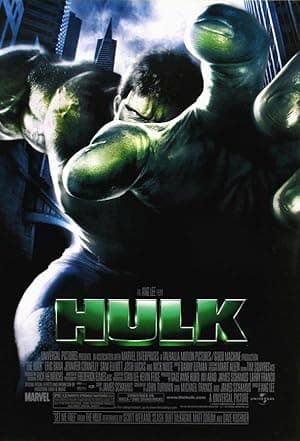
Hulk
A childhood wound made monstrous — Ang Lee’s Hulk still asks what happens when science, fathers and suppressed anger meet.
Feature presentation
Hulk is the sort of superhero film that refuses to be merely a spectacle. Ang Lee takes the green giant and makes him a symptom: a scientist’s life laced with childhood injury, a personality split in two, and a studio picture that keeps stopping to examine the scars. It’s an odd, thoughtful comic-book film — and that’s exactly why it’s worth revisiting.
THE MOVIE
Bruce Banner / The Hulk is still the reason this movie works
Hulk centres on a very particular idea: Bruce Banner is a scientist who physically becomes a giant green humanoid whenever his emotions cross a line. That simple transformation rule keeps the film honest — the monster is never random, it’s a reaction.
What gives the story its bite is how Banner’s present is threaded through the past. A childhood trauma — his mother’s death and his father’s incarceration — isn’t decorative backstory but a repeating engine that pushes Banner toward both discovery and disaster.
Ang Lee treats all of this with unusual seriousness for a big-studio comic adaptation. He layers drama, genre and formal flourishes so the Hulk feels like a Jekyll-and-Hyde tragedy as much as an action picture — and Eric Bana is the face the film keeps returning to.
THE SETUP
The idea that sets Hulk in motion
At its most basic, Hulk is an origin story: Banner’s experimental work and a brush with gamma exposure turn him into the Hulk whenever his anger spikes. The film makes that rule the spine of everything that follows.
Rather than sprinting from one set piece to the next, the narrative keeps returning to family history. Present-day pursuit sequences sit alongside memory fragments and explanations of how Banner became this man — and this monster.
That structure gives the military chase more meaning. General Thaddeus Ross and the U.S. military aren’t just action-plot obstacles; they bracket Banner’s life, placing the personal crisis of father–son damage against institutional force.
It’s worth noting that the film’s path didn’t continue in the same form: sequel plans after this version were later reorganised, and a different live-action Hulk would appear in 2008.
UNDER THE SURFACE
Hulk has more on its mind than the plot suggests
The easiest reading of Hulk is a monster movie. The less easy, and more interesting, reading is that it treats the monster as a symptom of inherited damage — how a father’s obsessions can warp a child.
There’s a straight Jekyll-and-Hyde thread here: Banner’s scientific rationality and the Hulk’s eruptive irrationality are two halves of one life. The film keeps asking which half is the real person.
Scientific hubris is threaded into that inheritance. The experiments of one generation drop consequences into the next, and the film uses lab accidents and regenerative research as plausible narrative bridges from intellect to disaster.
Finally, the movie frames the Hulk as tragedy rather than triumph. He’s not only a force to be used or contained; he’s the visible version of Banner’s unresolved pain.
THE FILMMAKING
How Hulk was put together
Ang Lee didn’t make a straightforward comic-book film. He borrowed the grammar of comics on purpose, using split-screen and multi-panel editing to echo the experience of reading panels on a page.
Those formal choices do two jobs: they keep the film visually distinct from other superhero fare, and they allow Lee to juggle time — memory, trauma and present action — without cutting the story into unrelatable fragments.
The movie also had a seasoned crew behind the scenes: a director of photography and an editor brought technical experience to support Lee’s experiments, while an established production designer shaped the world the film inhabits.
The result is a studio picture that regularly makes you aware of its structure; it’s an auteur trying to have a conversation with a genre picture, not simply to fit inside one.
PRACTICAL EFFECTS
The effects work that gives Hulk its physical personality
The movie’s Hulk was a digital construction assembled by Industrial Light & Magic rather than a single trick. ILM built multiple CG models at different scales to match what the story required.
They didn’t rely on one technique: motion-capture reference and live-action plates informed the character’s moves, and keyframe animation filled in moments where something more stylised or exaggerated was needed.
ILM also used high-resolution texture maps and careful compositing to sit the CG creature into shot footage, adapting advances they’d been developing on other detailed digital characters.
That blend aimed to make the Hulk feel like a tangible occupant of the same space as the human characters, even when the film was pushing its more formal experiments.
PURE 00s
Hulk could not belong to any other decade
Hulk landed in 2003, at a moment when Hollywood was still working out what a comic-book film could be. The early 2000s let directors experiment with tone in a way that would soon narrow as the blockbuster model consolidated.
That in-betweenness is central to Hulk’s personality: it’s a studio picture with auteur impulses, an attempt to translate comic grammar to cinema while keeping a director’s fingerprints obvious.
Shooting in 2002 and releasing in 2003, the film sits between the first wave of mainstream superhero hits and the later era of franchise engineering. It feels like a product of a time when adaptations tried different roads rather than offering a single map.
And, tellingly, the film’s path changed afterwards: plans for sequels were reshaped and the property was rebooted in a different form a few years later — a reminder that the early-00s marketplace was still sorting itself out.
THE LEGACY
Why Hulk still matters
A key part of Hulk’s afterlife is practical: there were sequel conversations, but studio decisions and rights arrangements redirected the property and led to a 2008 reboot instead of a direct continuation.
Beyond paperwork, Ang Lee’s version keeps turning up in conversations about what a superhero film can be. Critics and scholars often point to it as an atypical, auteur-driven approach — a studio film that openly experiments with form and tone.
That reputation matters because it widens the map of what these movies could try. Even if it didn’t spawn a direct franchise, Hulk’s ambitions are still discussed when people debate how far a director can push a comic adaptation.
In short: the film matters not just for its story but for its willingness to be different inside a mainstream space.
THE VERDICT
Does Hulk still hold up?
Yes — if you come expecting a thoughtful, sometimes slow-burn origin tale that treats the Hulk as a symptom of personal and scientific damage. The film’s inciting laboratory accident and the rule that Banner becomes the Hulk when emotionally provoked give it a moral logic that keeps the action meaningful.
Its fixation on inherited trauma — the way a father’s experiments and behaviour ricochet through a child’s life — still gives the film emotional teeth. The memory sequences and repeated returns to family history keep the spectacle anchored.
That said, this isn’t everyone’s idea of a superhero night out. It’s long, it’s formal, and it frequently prioritises questioning over easy thrills. But if you want a version of the green man that asks why the monster exists rather than only how many things he can flatten, this is the one to watch.
So watch it for Banner and Betty and the way the film insists their personal stakes matter. It may not have become the template for the genre, but it remains a brave, strange attempt to make a comic-book tragedy with a director at the wheel.
Share this movie
Keep watching
More movies from the 00s
2002
The Pianist
A quiet life unmade by war — and a pianist who refuses to stop listening.
Read the retrospective
→
2006
Blood Diamond
A mercenary, a fisherman and a pink diamond — and a film that still asks who pays for our jewellery.
Read the retrospective
→
2003
Kill Bill: Volume 1
A yellow jumpsuit, a long list of enemies and one woman who refuses to be finished.
Read the retrospective
→