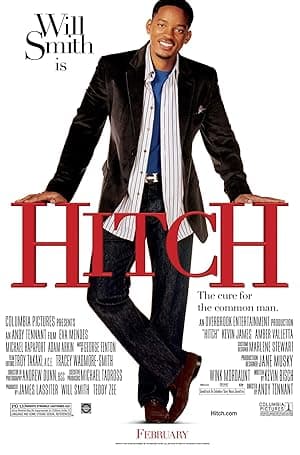
Hitch
A rom‑com about coaching people to be themselves — and what happens when the coach needs lessons too.
Feature presentation
Hitch arrives with a neat premise: a professional 'date doctor' who quietly turns nervous blokes into someone worth pursuing. The movie keeps its promise with a pair of linked cases — a shy client after an heiress, and the coach falling for a sharp gossip columnist — which gives the whole thing room to be funny, warm and a little sly about how we perform ourselves in public.
THE MOVIE
Alex "Hitch" Hitchens is still the reason this movie works
At its centre is a neat, addictive idea: Alex "Hitch" Hitchens is a successful, anonymous New York date doctor who coaches men on how to win the women they want. That setup gives the film a crisp dramatic engine — it’s about someone who engineers confidence for other people and keeps himself deliberately offstage.
Hitch’s cases are deliberately paired. One involves some very public social awkwardness — the shy Albert Brennaman trying to get close to heiress Allegra Cole — and the other is painfully personal: Hitch himself finds himself falling for Sara Melas, a gossip columnist whose curiosity threatens to blow his cover. The two stories talk to each other, which is why the film feels tidy rather than scattershot.
Underneath the rom‑com glue there’s a running question about authenticity versus performance. Hitch presents as urbane and in control — his job is to give clients the nerve to act — but the film nudges him towards emotional risk when his techniques meet a woman who calls his bluff. Andy Tennant directs the whole thing, and Will Smith plays the title role, carrying the movie’s balance between polish and vulnerability.
THE SETUP
The idea that sets Hitch in motion
The movie keeps its mechanics simple. Hitch teaches techniques — coached approaches to starting conversations, making an entrance, or turning a small moment into something memorable — and those set pieces are where the laughs and pratfalls live.
Alongside the coaching is a gentler point: the film suggests that confidence and honest self‑presentation, rather than perpetual trickery, are what make a relationship last. That contrast is the story’s steady hum — are you performing someone likeable, or are you learning how to be yourself when it matters?
Comedy comes from a string of public situations and dates — speed‑dating scenes, a few Manhattan set pieces and an escape to Ellis Island among them — that ratchet up awkwardness and misunderstanding without needing a separate subplot to complicate matters.
Trouble arrives when Sara discovers Hitch’s true line of work and a published exposé damages his standing. That breach pulls the rug out from under the coaching model and forces the characters to confront what they’ve been hiding.
THE CHARACTER
Why Alex "Hitch" Hitchens matters
Hitch matters because the movie trusts its premise enough to make the fixer the emotional fulcrum. He’s not a sidekick or a collection of gags; he’s the professional who designs other people’s romances while keeping his own life deliberately private.
That anonymity is part of the character’s charm: he’s an urbane problem‑solver whose business is to give clients the confidence to act. The narrative is structured so that those coaching tools read as both practical tips and a form of performance.
The gentle irony is that the methods which work for everyone else start to fail when the woman he loves turns a journalist’s light on him. The arc asks whether someone who designs other people’s emotional honesty can actually deliver it himself.
It’s worth noting that Will Smith was not only the actor in the role but also credited among the film’s producers, which helps explain why the movie leans into the character as its beating centre rather than a supporting conceit.
UNDER THE SURFACE
Hitch has more on its mind than the plot suggests
At face value it's a studio romantic comedy about making people meet. Dig a little and the film becomes a conversation about how confidence can be taught — and what coaching actually changes. Is confidence a mask or a muscle?
That tension — authenticity versus performance — is threaded through the central relationships. The film wants us to enjoy the clever manoeuvres but also to notice that long‑term connection depends on dropping the tricks and being recognisable to the person you love.
Closely tied to that is the movie’s interest in self‑presentation. Hitch’s whole business model treats charm as a set of behaviours you can practise, which opens up both the comedy and the moral question: what happens when your public self and private self don’t match?
There’s also a subplot about exposure: a career that depends on secrecy collides with the press. Media attention and the loss of privacy turn out to be the most dangerous hazards for someone whose power comes from staying invisible.
THE FILMMAKING
How Hitch was put together
Andy Tennant directs Hitch, and the picture’s look is credited to cinematographer Andrew Dunn. Those names place the movie squarely in the mainstream rom‑com lane — competent, classically staged and focused on serviceable clarity rather than flashy experiments.
Editors Troy Takaki and Tracey Wadmore‑Smith are credited on the feature, and the film’s editing gives it a brisk, commercially paced rhythm. That mid‑2000s studio timing keeps jokes moving, dates from dragging and the emotional beats neatly cued.
What that means for viewers is straightforward: the filmmaking aims to make the story readable and watchable. Scenes are designed to land laughs and then fold back into the plot without fuss; it’s storytelling built for an audience who wants warmth and polish.
You can hear the filmmaking choices in the way set pieces are structured to escalate misunderstandings quickly — the picture rarely lingers where it doesn’t have to, and that tempo is part of its personality.
PURE 00s
Hitch could not belong to any other decade
Hitch dropped in February 2005 at a time when studios routinely used star‑led romantic comedies as reliable mid‑winter fare. That slot says a lot: the film is meant to be crowd‑friendly, generous and comforting rather than cutting or experimental.
The decision to anchor the movie in New York City — principal photography ran March to June 2004 and includes recognisable Manhattan set pieces — reinforces a familiar 00s rom‑com habit of making urban backdrops feel like safe, shared territory for romantic misadventure.
The picture’s soundtrack was released around the same time as the film, which was still a common way of packaging a rom‑com as a full entertainment experience in the mid‑2000s: film, music and a cosy night out.
Even the afterlife gestures feel of the decade: the story’s broad, exportable premise later turned up in a Hindi remake, which is itself a reminder that this era’s studio rom‑coms were treated as portable concepts as much as local comedies.
THE LEGACY
Why Hitch still matters
Hitch arrived as a commercial hit and is often mentioned alongside Will Smith’s more successful mainstream comedies of the 2000s. That box‑office performance matters because it kept the film in living rooms and on rental shelves long after the theatrical run.
Part of the movie’s staying power is structural: the premise is tidy and musical — a coach, a client, a love interest who threatens the operation — which makes it easy to remember and re‑watch without needing to relearn beats.
The international afterlife also matters. The story’s transfer into an Indian remake and the legal drama that followed underline how the film’s basic idea travelled and how studios treated those stories as exportable commodities.
Put simply: Hitch still turns up in conversations because it does what it sets out to do cleanly and commercially, and because its premise proved useful beyond its original market.
THE VERDICT
Does Hitch still hold up?
Yes — but with a small caveat. Hitch asks an uncomplicated question and then answers it amiably: coached techniques can open doors, but what keeps a relationship working is not a trick, it’s someone learning to be themselves. That central contrast is still tidy and satisfying.
The movie’s two linked stories — the shy Albert Brennaman’s pursuit of Allegra Cole and Hitch’s own courtship of Sara Melas — give us both a comic demonstration of the coaching model and an emotional test of it. Albert’s success is deliberately framed as coming from being himself, which neatly undercuts the idea that performance alone will do the job.
The film moves at a pace that keeps its set‑piece dates and public mishaps entertaining without turning into a farce; and the drama that comes when Sara discovers Hitch’s work and a published exposé damages his reputation gives the plot a believable source of conflict that forces change rather than just gagging for laughs.
If you want a rom‑com that’s tidy, warm and rooted in a simple idea about confidence and authenticity, Hitch still delivers. Watch it when you want the comfort of a well‑constructed crowd pleaser that remembers being humane under the glossier bits.
Share this movie
Keep watching
More movies from the 00s
2002
The Pianist
A quiet life unmade by war — and a pianist who refuses to stop listening.
Read the retrospective
→
2006
Blood Diamond
A mercenary, a fisherman and a pink diamond — and a film that still asks who pays for our jewellery.
Read the retrospective
→
2003
Kill Bill: Volume 1
A yellow jumpsuit, a long list of enemies and one woman who refuses to be finished.
Read the retrospective
→