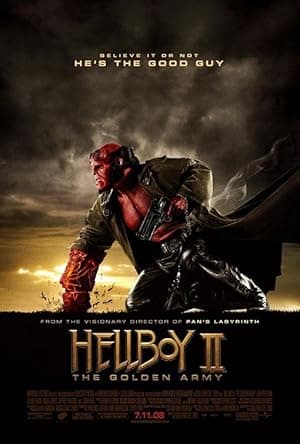
Hellboy II: The Golden Army
A monster who wants belonging, a prince who wants a world back — and a director who still prefers real creatures to a green screen handshake.
Feature presentation
Hellboy II: The Golden Army is the sort of sequel that doubles down on what made the original weirdly lovable: a grumpy, horned hero, a crew who count as family, and a fairy-tale war between two very different ideas of home. Guillermo del Toro loads the set with practical creatures, a ticking clockwork threat and relationship strangeness, then lets Ron Perlman’s Hellboy hold the centre.
THE MOVIE
Hellboy is still the reason this movie works
Put simply: Hellboy II is a movie that asks one big question and refuses to answer it in a neat paragraph — what happens when the old bargains between the human world and the magical one collapse? That premise pushes everything forward: an exiled prince, a search for crown fragments and the threat of a reawakened Golden Army make the stakes clear, and they never feel purely ornamental.
What keeps the movie from becoming just another fantasy set-piece is personality. Hellboy sits at the centre as a pragmatic, world-weary agent of the B.P.R.D., the kind of monstrous hero who grumbles and still knows how to pick a side. Around him del Toro builds a found family whose loyalties and tensions — especially the awkward intimacy with Liz Sherman — give the fighting a human weight.
And yes, it’s a Guillermo del Toro picture through and through: a director fascinated by the coexistence of fairy-tale beings and modern life, who stages that friction with dense production design, lots of creature work and a visual appetite that refuses tidy genre labels.
THE SETUP
The idea that sets Hellboy II: The Golden Army in motion
At its most basic the film pairs a straightforward quest — collect the fragments of a magical crown — with a much older grievance: Prince Nuada wants the magical races to reclaim what they once had. That clash — reclaiming versus defending — provides the engine for the action without collapsing the movie into a single-idea stunt film.
Del Toro punctuates the crown hunt with curious set pieces: hidden markets and sanctuaries where mythic creatures live among, and sometimes under, human eyes. These places aren’t just spectacle; they act as plot hooks and mood pieces that show the world isn’t uniformly hostile or welcoming.
Alongside the central campaign are quieter threads that keep the stakes personal. Hellboy’s relationship with Liz introduces domestic tension amid the chaos, while Abe Sapien’s unexpected romance with Princess Nuala gives his choices a heartfelt logic that isn’t only there for laughs.
Because it’s a direct sequel, the film can afford to tilt into its characters rather than reset them, so the hunt for the crown never feels abstract — it’s always pulling on loyalties the audience has already met.
THE CHARACTER
Why Hellboy matters
Hellboy is the film’s anchor because he’s useful and complicated in equal measure. He is presented as a world-weary but moral agent of the B.P.R.D., a walking blunt instrument who nevertheless carries responsibilities and doubts about where he belongs.
That outsider status — demon on the outside, human enough on the inside — is what makes his choices interesting. He’s not a bright, clean-cut saviour; he’s a creature who has to choose allegiance, and those choices are the kind that carry domestic consequences as well as global ones.
The movie surrounds Hellboy with figures who shape him: Professor Trevor Bruttenholm acts as his paternal mentor and moral touchstone, and new additions like Johann Krauss underline the contrast between Hellboy’s directness and a more bureaucratic, non-corporeal temperament.
Because Ron Perlman reprises the role from the earlier film, Hellboy arrives already established — which lets the movie dig into loyalty, found family and the messy business of making a home when you don’t quite fit.
THE PERFORMANCE
Why Ron Perlman's performance matters
This section asks what Perlman brings, but the reliable, supplied performance evidence for the film actually highlights a different performance milestone: Doug Jones’s expanded contribution. In this sequel Jones not only performs Abe Sapien physically but also provides the character’s voice — a change from the previous film.
That shift matters because it tightens Abe’s throughline and makes interactions around Hellboy feel more immediate; a character who previously had a separate voice identity is now unified in body and speech, which subtly changes how Hellboy’s circle reads on screen.
So while we can’t use unsupported claims about Perlman’s acting here, the available record shows performance choices around the cast that influence the film’s tone and dynamic.
In short: the performance story the evidence gives us is about consolidation — actors and production choices bringing characters into closer alignment, which in turn helps Hellboy’s role as the team’s blunt centre feel sturdier.
UNDER THE SURFACE
Hellboy II: The Golden Army has more on its mind than the plot suggests
On the surface you can watch Hellboy II as a hunt for magical relics and a fight against a clockwork army. Underneath, del Toro is sketching the uneasy geography of coexistence: what happens when myths lose their places and demand restitution? The film frames conflict as the consequence of historical displacement, not just bad blood.
Identity and belonging thread through the film. Hellboy’s outsider status is the obvious example, but Abe Sapien’s cross-world attachments and the way characters choose loyalty make the movie a study in who gets to belong and why.
Loyalty, too, is complicated. ‘Chosen family’ isn’t just feel-good shorthand here — it’s the reason characters make dangerous personal choices, and it’s what makes fights matter beyond spectacle.
Finally, there’s a friction between technology and myth: the Golden Army is a clockwork solution to a mythic problem, which sets up an argument about whether mechanical force can replace organic, old ways — and whether the two can ever truly reconcile.
THE FILMMAKING
How Hellboy II: The Golden Army was put together
Del Toro’s visual recipe here is dense and deliberate: shot design and an ornate production approach that leans heavily on practical creature work, then augments that with digital effects. The result is a layered texture — set pieces feel occupied, not just composited.
Danny Elfman provides the original score, while Guillermo Navarro handled cinematography and Bernat Vilaplana edited the film — a technical team that keeps the film moving through its two-hour runtime without losing the small, odd moments that make del Toro’s world persuasive.
Production and press focused on that hybrid approach: the film doesn’t choose digital over tangible; it stages both, and that decision shapes how the movie presents its monsters and environments.
That combination of rococo production design and mixed-effects thinking gives the film its particular identity: tactile, slightly cluttered and unapologetically material in how it stages fantasy.
PRACTICAL EFFECTS
The effects work that gives Hellboy II: The Golden Army its physical personality
The film leans hard on practical creature fabrication and prosthetic makeup — Spectral Motion and local vendors are credited as major contributors. That’s not a decorative choice; the creatures are built to be touched, to occupy the frame physically.
Production built full-size replicas and physical props for the Golden Army and constructed extensive creature suits and animatronics for market and battle sequences. Those objects anchor the movie’s larger, clockwork conceit in something you can register as ‘real’ on screen.
Multiple performers worked inside those suits and armatures — a crowded, human-intensive approach to creature work that gives even small background figures a sense of presence.
All of this practical craft is the movie’s pulse. When the camera meets a creature it feels like meeting a person in a costume, not a placeholder for CGI; that texture changes how you experience the film’s fairy-tale world.
PURE 00s
Hellboy II: The Golden Army could not belong to any other decade
There’s something distinctly mid‑late‑00s about a movie that marries heavy-duty practical effects with the growing muscle of digital VFX, and Hellboy II sits squarely in that moment. It’s one of those studio films that used both tools rather than pledging allegiance to one.
The production’s move to Eastern Europe — principal photography around Budapest and work at the newly built Korda Studios — is also very of the period. Many U.S. genre projects were doing the same then: shooting overseas to access new facilities while keeping large-scale production values.
Released in 2008, the film wears that decade’s production strategies rather than any particular fashion; it’s a practical+digital hybrid that feels like a transitional textbook for big genre pictures of the time.
And because Ron Perlman returned to the role from the 2004 Hellboy, the sequel had permission to get stranger and more intimate. That continuity is another signpost of 00s franchise thinking: keep your lead, push your world.
WATCHING IT NOW
What has aged — and what hasn't
The human, emotional material tends to hold up better than spectacle. Themes of identity, belonging and chosen family still land because they’re played as interpersonal commitments rather than just slogans.
Abe Sapien’s tighter characterisation — helped by Doug Jones providing both physical performance and voice in this film — makes the emotional beats clearer, which in turn strengthens how the ensemble reads together.
As for the film’s fantasy-versus-technology argument, that debate still feels interesting: a clockwork army versus organic myth isn’t an anachronism, it’s a mood — the same uneasy question about progress and loss we still like to argue over.
So a modern viewer is likely to be pulled in by the relationships and the moral friction more than by how flashily the movie renders battles; the core human and mythic tensions remain convincing.
THE LEGACY
Why Hellboy II: The Golden Army still matters
The film earned industry recognition — a Best Makeup nomination at the 81st Academy Awards — which is a concrete nod to the craft work that grounds its odd world.
Beyond awards, Hellboy II expanded the live-action Hellboy cinematic universe and remained a frequently mentioned del Toro franchise entry in conversations about 2000s practical-creature effects. It’s often brought up when people talk about that era’s hybrid effects approach.
The production’s use of the new Korda Studios outside Budapest was also notable in trade coverage, marking it as an early major American shoot at that facility and signalling the era’s international production strategies.
Taken together, these facts explain why the movie gets referenced: it’s a technical and stylistic example of a certain kind of genre filmmaking, anchored by characters people already knew and found worth returning to.
THE VERDICT
Does Hellboy II: The Golden Army still hold up?
Yes — if you watch it for the reasons it was made. The film’s quest structure (Nuada’s campaign to reclaim a world for the magical races and the hunt for crown fragments that can awaken the Golden Army) gives it a clear purpose, and del Toro fills that purpose with relationships that make the battles matter.
Ron Perlman’s Hellboy remains the emotional pivot: a creature who chooses his people. Contemporary coverage singled out Perlman’s return as anchoring the film’s tone, and that steadiness matters in a movie that mixes clockwork soldiers with fairy markets and family arguments.
If you’re curious about the craft, the makeup nomination, the practical-creature work and the hybrid effects approach are all part of the film’s continuing appeal. Meanwhile, the subplots — Hellboy’s tensions with Liz and Abe Sapien’s romance with Princess Nuala — keep the film from being all spectacle and no heart.
Bottom line: Hellboy II still works because it’s built around loyalties (chosen and complicated), a clear, angry premise about displacement, and a director who trusted tangible monsters to carry real emotions. It’s not flawless, but it’s still the sort of strange, affectionate blockbuster that rewards a rewatch.
Share this movie
Keep watching
More movies from the 00s
2002
The Pianist
A quiet life unmade by war — and a pianist who refuses to stop listening.
Read the retrospective
→
2006
Blood Diamond
A mercenary, a fisherman and a pink diamond — and a film that still asks who pays for our jewellery.
Read the retrospective
→
2003
Kill Bill: Volume 1
A yellow jumpsuit, a long list of enemies and one woman who refuses to be finished.
Read the retrospective
→