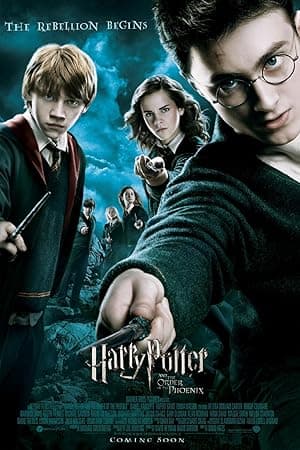
Harry Potter and the Order of the Phoenix
Teenage fury, a sticky-fingered bureaucrat and a boy everyone keeps refusing to believe.
Feature presentation
Harry Potter and the Order of the Phoenix is the point in the series where the playground arguments become national politics. David Yates’s 2007 instalment turns Hogwarts into a battleground of institutions and adolescents — and keeps Harry at the furious, lonely centre.
THE MOVIE
Harry Potter is still the reason this movie works
There’s a stubborn core to Order of the Phoenix: it’s about a boy who keeps telling the truth and being treated as mad. That complaint — Voldemort is back, but nobody will admit it — propels the film and gives every fight a political edge.
David Yates, directing the franchise’s fifth screen outing, leans into the squeeze between authority and a young protagonist. The Ministry’s decision to install Dolores Umbridge at Hogwarts constrains how the school teaches defence, and it’s that very constraint that pushes the students into secret lessons of their own.
On top of the politics sits personal damage: Harry is an adolescent who is isolated by vision-driven trauma and the disbelief of adults and peers. It’s a heavy, recognisable mix, and it’s precisely why this particular Potter film still invites conversation.
THE SETUP
The idea that sets Harry Potter and the Order of the Phoenix in motion
At base the film is simple: it follows Harry in his fifth year at Hogwarts as he deals with the fallout from Voldemort’s return and the refusal of official channels to acknowledge it. That refusal turns what could be private trauma into a public, political problem.
The screenplay keeps some of the book’s formal beats — classroom politics, the pressure of O.W.L. exams and the sense that education itself has become contested ground — and uses them to sharpen the tension between pupils and power.
Crucially, the film allows the younger characters to respond proactively: when taught nothing useful about defence, they organise clandestine lessons to learn practical magic for themselves.
All of this sits inside the ongoing series narrative: Order of the Phoenix picks up where the previous film left off, continuing the larger story arc and the established cast of characters.
THE CHARACTER
Why Harry Potter matters
Daniel Radcliffe plays the film’s anchor: Harry is the character the story keeps returning to because his experiences make the politics feel urgent. He isn’t just a chosen one on paper — he’s a teenager whose life is being shaped by forces that refuse to listen.
That isolation is both plot and personality. Harry’s visions and the reactions they trigger leave him cut off from the adults who should be protecting him and from peers who sometimes doubt him.
Because of that cut-off, the adults who do help him — members of the Order — matter as secret sources of knowledge and protection. They remind us that some grown-ups are on Harry’s side even when institutions are not.
And the younger characters are important because they don’t wait around. Their decision to learn practical defences themselves is one of the film’s clearest statements about agency: this is a generation that won’t be taught how to protect itself, so it takes action.
THE PERFORMANCE
Why Imelda Staunton's performance matters
Imelda Staunton’s turn as Dolores Umbridge was singled out by contemporary critics as one of the clearest standouts in the film. Reviews at the time noticed that she drew attention wherever she appeared.
That critical notice matters because Umbridge is the physical embodiment of institutional denial: she’s the Ministry’s polite face inside Hogwarts, and Staunton’s casting makes that choice feel tangible to viewers.
The result is that the film’s political argument — that power can hide behind pleasant manners — becomes easier to understand. Critics’ focus on Staunton at release reflects how the performance crystallises that theme.
Put simply: when reviewers described Umbridge as scene-stealing, they were pointing at how one performance can make an abstract idea, like bureaucratic abuse, register as immediate and uncomfortable on screen.
UNDER THE SURFACE
Harry Potter and the Order of the Phoenix has more on its mind than the plot suggests
On its surface the plot is adventure and fantasy; under the surface it’s interested in what happens when institutions refuse inconvenient truths. The Ministry’s campaign against Dumbledore and Harry doesn’t just provide antagonists — it structures the movie’s political tension.
That tension is personal as much as it is political. Harry’s recurring visions and emotional responses are central to the film; they explain why he behaves as he does and why other characters either fear him or fail to believe him.
The film also makes a sustained case for teenage rebellion and agency. When the official curriculum is weaponised against students, the youngsters refuse to be passive — they take their education into their own hands.
And threaded through all of this is a question about truth versus official denial: who gets to decide what is real, and what lengths will a bureaucracy go to avoid admitting a threat?
PRACTICAL EFFECTS
The effects work that gives Harry Potter and the Order of the Phoenix its physical personality
The production mixed large-scale physical set work with contemporary digital visual effects teams. That combination lets the film feel materially grounded even when the story goes fantastical.
Credit listings make that hybrid clear: John Richardson is named as the special-effects supervisor and Tim Burke as the visual-effects supervisor, signalling a split between practical and digital responsibilities.
One obvious example is the Ministry of Magic atrium and other interiors, which were built as substantial physical sets at Leavesden Studios. Having those spaces as real, walkable environments affects how actors and scenes relate to the locations.
In short, Order of the Phoenix leans on big constructed sets to give the fantasy a tactile backbone, then layers visual effects where required to complete the picture.
PURE 00s
Harry Potter and the Order of the Phoenix could not belong to any other decade
Released in the summer of 2007, Order of the Phoenix sits exactly where big studio franchises of the 2000s start to grow up. By its fifth film the series was turning towards darker, more adolescent-focused stories rather than the lighter family tone of its beginnings.
That tonal shift is also visible in the people the franchise chose to work with: David Yates arrived as director for this chapter and a new composer, Nicholas Hooper, signalled a willingness to steer the series in a different creative direction.
So the film feels of its time not because of gimmicks but because it’s part of a larger, industry-wide maturing of franchise storytelling in the late 2000s.
Viewed that way, Order of the Phoenix reads as a franchise midlife moment — a point where the series decided it would take its characters' adolescence seriously and follow the consequences.
WATCHING IT NOW
What has aged — and what hasn't
One thing that still reads clearly is the film’s faith in teenage agency. The idea that young people will organise to protect themselves when adults won't is durable and still feels sharp today.
The darker, character-focused approach David Yates introduced has also aged in a useful way: shifting the emphasis from spectacle to the characters’ interior states gives the film a seriousness that modern viewers expect from franchise instalments.
Because the film is part of a consecutive stretch of adaptations, its choices make sense as a bridge between earlier, lighter entries and the more somber later chapters — that throughline helps it feel coherent on repeat viewings.
Overall, the parts of the movie that emphasise character and adolescent response age better than anything that leans purely on spectacle or novelty.
THE LEGACY
Why Harry Potter and the Order of the Phoenix still matters
Practically speaking, Order of the Phoenix established David Yates as the filmmaker the franchise trusted to steer its darker chapters — a decision that shaped the remaining films’ tone.
It’s also the first film scored by Nicholas Hooper, who returned for the next instalment, signalling a significant change in the series’ creative team that lasted beyond a single release.
Those two facts together explain much of the film’s afterlife: it’s remembered as the bookend where the series decided it would treat adolescence and consequence with more weight.
So while it’s not the only important Potter film, its role in the franchise’s tonal shift explains why it continues to be referenced and revisited.
THE VERDICT
Does Harry Potter and the Order of the Phoenix still hold up?
Yes — with caveats. If you care about character, politics and the messy business of adolescence, Order of the Phoenix still delivers. The film’s central conflict — a Ministry that refuses to accept Voldemort’s return and installs Dolores Umbridge as an expression of that denial — gives the story an edge that feels urgent even now.
More than spectacle, the film is powered by Harry’s private experiences: recurrent visions tied to Voldemort shape his behaviour and make his isolation believable as a dramatic engine. That keeps the stakes emotional as much as plot-driven.
The way younger characters respond — organising clandestine lessons in the face of official obstruction — still reads as a satisfying declaration of agency. And having adult allies in the Order gives the film some necessary counterweights to institutional failure.
Finally, the contemporary notice given to Imelda Staunton’s Umbridge underlines how the movie makes its political argument tangible: a single performance can turn abstract abuse of power into something viscerally unpleasant. So watch it for the politics, for the teenage revolt and, yes, for the scene-stealing presence that makes the danger feel real.
Share this movie
Keep watching
More movies from the 00s
2002
The Pianist
A quiet life unmade by war — and a pianist who refuses to stop listening.
Read the retrospective
→
2006
Blood Diamond
A mercenary, a fisherman and a pink diamond — and a film that still asks who pays for our jewellery.
Read the retrospective
→
2003
Kill Bill: Volume 1
A yellow jumpsuit, a long list of enemies and one woman who refuses to be finished.
Read the retrospective
→