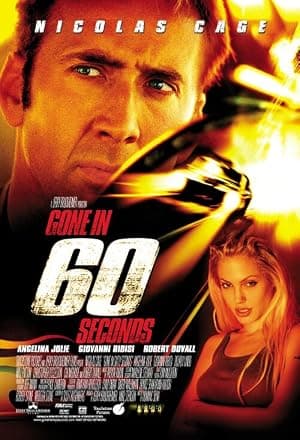
Gone in 60 Seconds
Brotherhood, burnout and one obsessive Mustang — the film that turned a car into a character.
Feature presentation
Gone in 60 Seconds is noisy, shameless and oddly loyal to one idea: family matters more than clean exits. Dominic Sena’s big, brash heist movie straps itself to that one engine and doesn’t let go.
THE MOVIE
Randall "Memphis" Raines is still the reason this movie works
There’s a particular kind of movie energy that says: all right, put the music up and forget subtlety. Gone in 60 Seconds does that and then gives you an actual human reason for the racket — Randall “Memphis” Raines, a legendary boost who has walked away from the life only to be dragged back because family comes first.
The hook is simple and stubborn: Memphis must steal an absurdly large list of high-value cars to save his younger brother after the kid botches a job and ends up owing a very dangerous man. The film turns that single promise — a one-night, everything-or-nothing assignment anchored by a last car called Eleanor — into nearly two hours of sprinting stakes and cultivated obsession.
Dominic Sena directs, Jerry Bruckheimer produces, and the cast is a marquee mix built to carry noise and spectacle. Yes, it’s loud. Yes, it’s 118 minutes of engines, emotion and occasionally thin plotting. But it’s Memphis — and the idea of a man willing to burn his clean life to save his brother — that gives the whole thing a pulse worth revisiting.
THE SETUP
The idea that sets Gone in 60 Seconds in motion
At its core the movie is one tidy transaction: a retired master thief is forced back into the trade to rescue his brother. That neat spine keeps the action legible when the pace threatens to scatter.
Kip Raines’ failed job creates the ticking clock — the plot frames the demand as fifty cars that must be produced under threat of lethal consequences — and suddenly Memphis is running through long odds because he won’t abandon family.
The heist itself is organised like a listicle: high-value vehicles, each with a code name, and a clear playbook of who on Memphis’ old crew can do what. It’s efficient storytelling for a film designed to be kinetic rather than introspective.
And then there’s the deliberate decision to save one car for last: the 1967 Shelby Mustang GT500, nicknamed Eleanor. By arranging the job around that prize, the screenplay gives the thieves a finish line that’s about more than money — it’s about fixation and unfinished business.
THE CHARACTER
Why Randall "Memphis" Raines matters
Memphis isn’t just the guy who can nick any car; he’s the set piece that keeps the movie honest. The plot asks him to make a bad-sounding choice for a very good reason: protect his kid brother. That weight — elder sibling responsibility — is what turns otherwise disposable action into something you can care about, however grudgingly.
He’s presented as a reformed legend: a boost who quit the life to look after family. That history gives him credibility inside the world — people listen when he speaks because he’s done the work and walked away once. And the fact that he still carries an obsession with the one car he never stole, Eleanor, makes him human in a movie that enjoys mechanical spectacle.
The crew around him and a romantic anchor in Sara “Sway” Wayland give Memphis a personal network rather than a solo-movie halo. Sway is both a mechanic and a history: she’s the professional muscle and a reminder of the life he left, which in turn strengthens the choices he’s forced to make.
So Memphis matters because he’s the moral and logistical fulcrum: family loyalty drives him, past reputation opens doors, and that obsession with unfinished business — Eleanor — gives his return to crime a shape you can follow.
THE PERFORMANCE
Why Nicolas Cage's performance matters
Contemporary critics were clear that acting choices often felt overwhelmed by the movie’s production methods and spectacle. That context matters when thinking about Cage here: his Memphis is operating inside a machine that prizes scale.
Put another way, Cage is part of a film that sometimes folds performances into propulsive set pieces. The result is that individual turns can feel secondary to the overall velocity.
That doesn’t mean the role is irrelevant. Cage’s casting signals the film’s intent: Memphis needs to be a figure whose past reputation and present stubbornness can carry the plot, and the performance is built to serve that functional requirement.
So consider the performance as part of the engine rather than the engine itself — useful, visible, but occasionally asked to subsume nuance for momentum.
UNDER THE SURFACE
Gone in 60 Seconds has more on its mind than the plot suggests
On the surface it’s a list of thefts; underneath it’s a film about why people return to bad habits and who they won’t abandon when things go wrong. Family and loyalty are threaded through every decision Memphis makes.
Redemption and relapse run side by side. Memphis has walked away, but the story keeps asking whether stepping back into the life will reclaim something lost or simply pull him under again.
There’s also a clear, almost anthropological obsession with the object — Eleanor is treated like a holy relic, a thing that represents unfinished business and desire. That fixation changes what the heist is about; it’s not just profit but closure.
Finally, criminal camaraderie and an old code keep the film from feeling purely transactional. The crew’s specialised skills and the way they slot into the operation give the movie an uneasy warmth: this is a crime family that believes in its own rules.
THE FILMMAKING
How Gone in 60 Seconds was put together
The film’s credits point to a conventional big-studio action assembly: Paul Cameron is named for cinematography and a small team of editors are credited, which reflects the kind of hands-on production a movie like this requires.
You can feel the production choices in the rhythm — it’s built to sustain sequences that demand clarity over ambiguity. That editorial strategy is sensible for a picture whose pleasures are often kinetic rather than contemplative.
Notably, critics at the time found the screenplay and direction the weaker elements while conceding that the scale of the stunt and driving work carried the day. That split explains much of the film’s personality: spectacle papering over thin spots.
So the filmmaking identity here is pragmatic: a studio director, credited cinematography and multi-editor cutting aimed at keeping a complicated heist legible and, above all, loud.
PRACTICAL EFFECTS
The effects work that gives Gone in 60 Seconds its physical personality
The movie’s physicality is a deliberate construction. The production built multiple custom 'Eleanor' Mustangs and a variety of modified picture cars so sequences could be repeated safely and reliably.
That picture-car department didn’t just swap paint jobs: they reinforced suspensions, fitted heavy-duty rear ends and installed high-performance crate motors to allow repeated stunt driving without melting the mechanics after the first take.
Stunt coordinator Chuck Picerni Jr. worked with the director and visual-effects supervision to stage practical driving stunts, including at least one climactic jump described in production material — the film leans on bodily stunts rather than purely digital trickery.
Those choices give the movie a tactile hum. When cars land, bump or scrape in this film you sense machinery and engineering behind the chaos, and that effort is a big part of why people still mention specific sequences.
PURE 00s
Gone in 60 Seconds could not belong to any other decade
This is very much a product of its moment: a studio-backed, glossy action-heist picture built to sit in the summer market. The film is an authorised remake of a 1974 independent original, but it’s been refitted for late‑’90s/2000 mainstream cinema where scale and shine mattered.
Being distributed by a major studio under the Touchstone/Buena Vista umbrella positioned the film among other large-scale theatrical offerings — it’s designed to be the sort of summer event where spectacle trumps subtlety.
Jerry Bruckheimer’s name on the project signals the production intent: big set pieces, emphatic beats and a commercial clarity that aims for wide appeal rather than art-house ambiguity.
Released in 2000, it sits at the precise turn-of-millennium moment when studio action pictures were comfortable spending on stunts, star power and a polished sheen to sell the idea that cinema should feel like motion itself.
WATCHING IT NOW
What has aged — and what hasn't
If you watch it now, the things that survive best are the things that were built to last: the scale of stunt work and the sheer physicality of the driving sequences. Those were the areas critics then and since have been willing to praise.
What hasn’t aged as comfortably is the screenplay and the thinner character development. The moral engine — family and loyalty — still lands, but some characters exist largely to support the operation rather than feel fully formed.
Memphis’ basic situation — returning to the life to save his brother — still provides a straightforward emotional throughline. That clarity helps the movie remain watchable even when other elements feel of their moment.
So as a modern watch it’s best approached with expectations set: come for the carwork and the familial promise that keeps the plot honest; don’t expect deep surprises from the script.
THE LEGACY
Why Gone in 60 Seconds still matters
Part of the film’s afterlife is literal: Eleanor, the 1967 Shelby Mustang GT500, became a recognisable image. After release the car prompted replica builds and genuine collector interest — people remember the thing as much as the movie.
The remake’s status is also part of its story: it’s explicitly tied to the 1974 original through licensing and production involvement, which keeps conversation about the film connected to debates over adaptation and reverence for stunt cinema.
Beyond that, Memphis, Sway and Kip function as easily recalled archetypes — the reformed legend, the trusted mechanic/ex and the impulsive kid brother — which help the movie remain a go-to example when people talk about turn‑up-the-volume heist pictures.
In short: it’s not revered as deep cinema, but it’s stuck around because of its central car image, its familial premise and the way it packages old-school stunt appetite into a glossy new-studio wrapper.
THE VERDICT
Does Gone in 60 Seconds still hold up?
Yes — with conditions. If you want tight plotting and deep character work, this isn’t your film. If you want a high‑octane premise carried by a single moral promise — an elder brother willing to burn his clean life for his sibling — it still delivers.
The screenplay asks Memphis to pull off a ludicrously compressed, one-night operation: fifty cars, code names, specialists slotting into jobs and a deliberate saving of Eleanor for last. That structure makes the film easy to follow and gives each sequence a specific job to do.
Police pressure from Detective Roland Castlebeck and other pursuers keeps the tension two-sided, while Sway’s role as mechanic and former lover anchors the crew with a professional and personal stake. Those elements combine into a watchable, if occasionally shallow, genre ride.
So watch it for the family angle, the focused one-night deadline and the car-work. Treat the script and character depth as supporting players to the spectacle rather than the reason you put it on. In other words: bring earplugs for the noise, but don’t be surprised if you find yourself oddly invested in that Mustang at the end.
Share this movie
Keep watching
More movies from the 00s

2002
The Pianist
A quiet life unmade by war — and a pianist who refuses to stop listening.
Read the retrospective
→
2006
Blood Diamond
A mercenary, a fisherman and a pink diamond — and a film that still asks who pays for our jewellery.
Read the retrospective
→
2003
Kill Bill: Volume 1
A yellow jumpsuit, a long list of enemies and one woman who refuses to be finished.
Read the retrospective
→