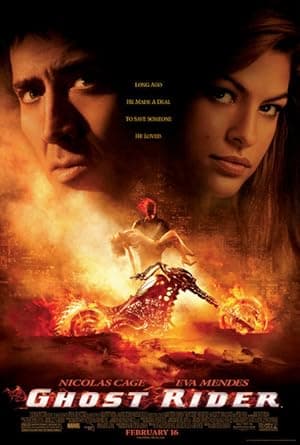
Feature presentation
Ghost Rider is the kind of 2000s comic-book movie that arrives with a howl: a stuntman who sells everything to save a parent, then wakes up carrying a supernatural job description he didn’t ask for. It’s loud, slightly daft and, stubbornly, still interesting because of the man at its centre — Johnny Blaze and the monstrous dichotomy he carries between daylight and whatever comes after dark.
THE MOVIE
Johnny Blaze / Ghost Rider is still the reason this movie works
People keep circling back to Ghost Rider not because the effects are tasteful or the plot is subtle, but because its engine is a clear, strange promise: a stunt motorcyclist trades everything to save his father and ends up bound to a Spirit of Vengeance. That bargain — made with a demon — sets up a story where duty and damnation are on a permanent collision course.
Mark Steven Johnson steers all of this; he wrote and directed the film and keeps the central paradox in play — Johnny Blaze by day, a supernatural hunter by night. It’s a straightforward set of choices, and the movie spends its 110 minutes riffing on that tug-of-war.
And yes, there’s a roster of recognisable faces around him — Eva Mendes, Wes Bentley, Sam Elliott and Peter Fonda — but it’s Blaze’s split life that gives the film its personality. That’s what makes it worth revisiting rather than simply dismissing as another mid‑2000s genre outing.
THE SETUP
The idea that sets Ghost Rider in motion
At heart there’s a single, decisive idea: Johnny Blaze saves his dying father by making a Faustian bargain and is then bound to a Spirit of Vengeance. That’s the motor beneath the action sequences and the CGI flourishes.
From there the film keeps a simple through-line — Blaze trying to keep hold of who he is while being forced to hunt down escaped demons led by Blackheart. The personal cost of the deal is the movie’s propulsion; the supernatural chases are just the scenery.
The Contract of San Venganza (the movie’s MacGuffin) is a neat piece of storytelling shorthand: it’s the physical proof that the bargain exists and the object the antagonist wants to control. It turns metaphysical stakes into a concrete prize, which is handy for an action film.
And rather than telling everything in a single sweep, the film mixes present‑day action with flashbacks that show Blaze’s youth and his connection to Roxanne, so the audience always has a sense of why the choices matter to him personally.
THE CHARACTER
Why Johnny Blaze / Ghost Rider matters
Johnny Blaze matters because the movie keeps flipping him like a coin. By day he’s the daredevil stuntman with a public life; by night he’s fused to a Spirit of Vengeance with its own agenda. That contrast gives everything a constant internal friction.
The bargain he made isn’t abstract: it’s a history that haunts him. The film is less interested in inventing fresh mythology than in watching what that history does to a man who still wants to be ordinary.
Casting Nicolas Cage in the role ties those two halves together on screen — he is the figure who carries the contract, the guilt and the possibility of fighting back. The movie depends on that central, combustible identity to keep the audience engaged.
Because the story keeps returning to that split, Johnny Blaze is never just a symbol or a case study. He’s the pivot around which vengeance and redemption repeatedly turn.
THE PERFORMANCE
Why Nicolas Cage's performance matters
Contemporary reviewers couldn’t stop talking about Cage. His presence became the obvious thing to comment on — for better or worse — and that attention shaped how people experienced the film.
That matters because when a performance becomes a focal point of discussion, it changes how the movie is received. With Cage as Johnny Blaze, the role is never background colour; it’s a live wire that the rest of the film has to react to.
So whether viewers find his choices baffling or riveting, Cage functions as the movie’s centre of gravity: the character’s contradictions are inseparable from the actor in the role.
UNDER THE SURFACE
Ghost Rider has more on its mind than the plot suggests
Take away the motorcycles and the flames and the film still carries a compact moral argument: what do you owe the people you love, and how far will you go to save them? That’s the Faustian bargain at the movie’s centre.
From that deal springs a cluster of related ideas — vengeance versus mercy, the chance to atone and the difficulty of changing your own story. Johnny is constantly balancing justice and retribution in ways that make the action feel like moral theatre.
The movie also enjoys messing with identity: Blaze isn’t simply punished, he’s split. The Rider enforces a code the man might not agree with, so questions of free will and predestination keep nudging the narrative.
None of this is subtle in the art‑house sense; it’s more like genre filmcraft using big beats — bargains, curses, a needy demon — to ask older questions about responsibility and redemption.
THE FILMMAKING
How Ghost Rider was put together
On the technical side, the film credits Russell Boyd as cinematographer and Richard Francis-Bruce as editor. Those names anchor the movie in a professional studio craft that aims to keep the larger‑than‑life materials legible.
One specific design choice says a lot about the production’s priorities: the Hell Cycle was given solid tyres covered in flames rather than the comics’ idea of purely flaming wheels. That decision was made to convey weight and a sense that the bike actually exists in the physical world of the movie.
It’s a small, practical bit of adaptation thinking — change an element so it reads on camera — and it speaks to how the filmmakers translated comic‑book imagery into something the audience could believe for the length of a shot.
PRACTICAL EFFECTS
The effects work that gives Ghost Rider its physical personality
The Hell Cycle’s design tweak — solid tyres wrapped in flames — is one of the film’s clearest practical decisions, made so the vehicle reads as heavy and believable on camera.
Production combined real stunt riding with digital augmentation. The film used live stunt work on Buell motorcycles and a custom hardtail chopper, and then layered computer-generated flame and creature elements for the Rider sequences.
That blend of live action and digital enhancement is very much a 2000s approach: practical pieces to anchor the audience, with VFX doing the supernatural heavy lifting.
PURE 00s
Ghost Rider could not belong to any other decade
This is a mid‑2000s tentpole in the sense that it arrived amid a scatter of studio comic‑book adaptations across multiple companies — a pre‑MCU era when different studios could mount their own Marvel projects with a lot of creative variation.
Produced and released in 2007, Ghost Rider has the production scale and VFX approach typical of big genre films of that year: substantial effects work, international shoots and a clear studio impulse to turn a niche comic into a mainstream spectacle.
The film’s path to the screen was also very 00s: development that stretched through the late 1990s and early 2000s, various writers and attachments, then a concentrated production period in the mid‑2000s before Columbia pushed it out.
Put simply: it’s a film shaped by an era when studios experimented with darker, more supernatural comic adaptations without the single unified tone that would later define franchise cinema.
THE LEGACY
Why Ghost Rider still matters
One practical reason the film hasn’t vanished is that its story continued: a direct sequel arrived in 2012 with Nicolas Cage returning as Johnny Blaze. Sequels are tidy reminders that a character’s screen life extends beyond a single movie.
A second reason is legal and industrial: the film’s rights eventually reverted back to Marvel Studios in 2013, which changed who could make future films with the character and therefore shaped the property’s later cinematic options.
So its legacy is partly narrative — the Rider returned — and partly administrative: the property’s ownership history affected how the character would be handled on screen afterwards.
THE VERDICT
Does Ghost Rider still hold up?
If you want tight subtlety, Ghost Rider is the wrong place to look. It’s a loud, moral pulp piece built on a single, terrible promise: Johnny Blaze sold his soul to save his father and must live with the consequences. The film is faithful to that central trade-off and keeps returning to its consequences rather than turning the bargain into a throwaway gimmick.
That focus — a man trying to keep hold of his humanity while being forced to hunt demons — is the movie’s strength. The Contract of San Venganza gives the antagonist something tangible to fight over, and Roxanne’s presence reminds the story that this is about people, not just spectacle.
Technically and narratively it’s very much of its moment: a studio superhero film with a mid‑2000s production approach, directed and written by Mark Steven Johnson, and clocking in at a brisk 110 minutes. If you enjoy genre movies that are content to be emphatic rather than subtle, there’s a lot to get from it.
So should you watch it now? Yes — if you’re curious about a comic‑book adaptation that leans into its darker, pulpy impulses and is carried by a central conceit about debt and atonement. It won’t surprise you, but it does what it intends: it puts a man and his bargain at the centre of a noisy, combustible ride.
Share this movie
Keep watching
More movies from the 00s
2002
The Pianist
A quiet life unmade by war — and a pianist who refuses to stop listening.
Read the retrospective
→
2006
Blood Diamond
A mercenary, a fisherman and a pink diamond — and a film that still asks who pays for our jewellery.
Read the retrospective
→
2003
Kill Bill: Volume 1
A yellow jumpsuit, a long list of enemies and one woman who refuses to be finished.
Read the retrospective
→