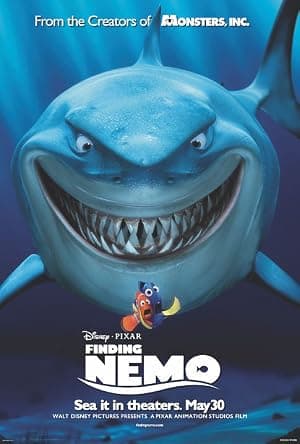
Finding Nemo
A film about a terrified dad learning to trust the ocean — and his son — without ever losing its laugh.
Feature presentation
There’s a simple, stubborn truth at the heart of Finding Nemo: Marlin — a nervous, grief-haunted clownfish — is the emotional engine that keeps the whole thing moving. Andrew Stanton’s 2003 adventure pairs that anxiety with one of animation’s most beguiling odd couples and a plot that trades spectacle for stubborn, human-scale feelings.
THE MOVIE
Marlin is still the reason this movie works
If you only take one thing away from a return to Finding Nemo, make it this: it’s Marlin’s panic that makes the whole adventure believable. The film’s premise is almost ruthlessly simple — Marlin must cross the ocean to find his son Nemo after the boy is taken from the reef by a scuba diver — and that urgency never loses shape because Marlin’s fear gives it stakes.
That fear isn’t abstract. Marlin’s overprotectiveness is rooted in a traumatic barracuda attack that killed his mate and the rest of their eggs, which explains why he watches Nemo like a hawk and why the search becomes so personal. When the story puts that broken, furious tenderness on screen, you understand why every small choice — and every wrist-slap of luck — matters.
Andrew Stanton directed the film and the run-time (100 minutes) keeps the promise of being an adventure that’s brisk, warm and focused. Put another way: Finding Nemo could have been a parade of ocean tricks. Instead it’s an anxious dad’s road trip, and that narrowing of vision is what makes it worth revisiting.
THE SETUP
The idea that sets Finding Nemo in motion
The movie’s engine is straightforward: a parent’s desperate search for a child. Marlin’s journey begins when Nemo is taken from the reef, and it’s that singular objective — find Nemo — that keeps the narrative tight without turning it into a checklist of incidents.
That tightness is helped by a structural trick: the film alternates between Marlin’s perilous open-ocean journey (with Dory) and the captive 'tank gang' subplot inside a dentist’s aquarium. Those two tracks give the film a pleasing bounce — the ocean feels huge and dangerous while the tank scenes are cramped, conspiratorial and often very funny.
Dory’s short-term memory loss is handled as both a narrative obstacle and a source of comedy; her forgetfulness generates setbacks that force Marlin to adapt instead of bulldozing ahead. At the same time, repeated anchors like the dentist’s address — the famously referenced 'P. Sherman, 42 Wallaby Way, Sydney' — keep the rescue simple to follow and emotionally clear.
All of these elements — the search, the split-story structure, the comic-but-fraught obstacle in Dory — are what let the movie stay adventurous without losing sight of the people, or fish, at the centre.
THE CHARACTER
Why Marlin matters
Marlin is the movie’s compass. Albert Brooks provides the voice for a character whose instincts are not whimsical but survivalist: the trauma from a barracuda attack is the reason he watches Nemo so closely and why this rescue is more than paternal fuss — it’s a mission to correct a breaking of the world he once knew.
That history makes him memorable because it complicates every decision. He’s cautious to the point of obsession, which sets up a constant clash between holding on and letting go — the familiar parental theme the film keeps returning to. You can see the whole movie as a lesson in how grief reshapes responsibility.
Marlin’s rigidness also gives the rest of the cast something to play off. In a family film, that kind of focused, flawed parent is rarer than you’d expect: he’s not simply a joke, nor is he a perfect guide. The push-and-pull between his fear and the unpredictable world around him is what gives the story its emotional weight.
Finally, Marlin’s need to accept help — to trust other creatures and the ocean itself — is what turns a simple missing-child tale into a story about learning to share risk and love, which is why Marlin’s arc still feels urgent when you watch it again.
THE PERFORMANCE
Why Albert Brooks's performance matters
Contemporary reviews singled out Albert Brooks’s voice work as a notable element of the film’s emotional and comic centre.
That’s a useful fact because Marlin is primarily a voice-driven character: in animation, the voice is the shorthand for interior life, and Brooks’s contribution was the thing critics flagged when they described the film’s feelings as convincing rather than cartoon shorthand.
Saying the voice work was singled out doesn’t map out every nuance, but it does explain why Marlin registers: critics heard something in that vocal performance that made his panic and tenderness feel like real stakes.
Put simply: when a film asks you to worry about a fish, the voice has to carry the worry. Contemporary responses suggested Brooks did the necessary work to make that worry land.
UNDER THE SURFACE
Finding Nemo has more on its mind than the plot suggests
At first glance the film is a straightforward rescue tale. But under the surface it’s threading several human-size ideas: parenthood and the hard business of letting go; trust and the courage it demands; memory and what it does to identity; and the value of friendship when family fails or is absent.
Dory’s amnesia — a narrative device that interrupts the journey and the memory of who anyone is — shifts several scenes from comic to quietly existential. Her forgetfulness shapes relationships and asks questions about belonging that the movie never turns into a lecture.
The parenthood thread is obvious in Marlin’s arc: the film keeps circling his fear that the world will take his son unless he can control every risk. That tension between protection and permission is what gives the adventure emotional heft; it isn’t just about getting from A to B, it’s about whether Marlin can relinquish a little control.
And then there is the film’s insistence on found family. The characters who help Marlin or aid the tank gang aren’t related by blood, but they form a dependable, sometimes absurd, support network — which is how the story balances danger with warmth.
THE FILMMAKING
How Finding Nemo was put together
Finding Nemo was Andrew Stanton’s solo feature directing debut, and production records also credit Lee Unkrich as a co-director. That combination matters because the film announces a confident new voice working within Pixar’s collaborative workshop.
A director’s first full-length feature can reveal a lot about priorities: here, the choice to keep the story compact and emotionally centred suggests a steady editorial hand rather than an interest in piling on set-pieces for their own sake.
The film’s construction — tight structure, matched comic and tender beats, and carefully written character moments — reads like the work of a director who trusted a script that favoured feeling and clarity.
In short: the film’s filmmaking identity is rooted in its clear storytelling choices, and those choices show up in how the movie balances anxiety, humour and a straightforward rescue plot.
PURE 00s
Finding Nemo could not belong to any other decade
Finding Nemo arrived in May 2003 during a period when Pixar was turning its short-run success into a string of major summer releases. Its timing placed it squarely in the studio’s early-feature era, where each new film helped cement animated movies as headline summer entertainment.
The production itself reflects early-2000s advances in CGI and a studio-scale R&D appetite: Pixar was investing in ways to simulate natural phenomena — water, light and particulates — so the ocean felt alive without losing the story beneath it.
There’s also a commercial 00s detail: the movie’s home-video release later that year set single-day sales records for its distributor at the time, which tells you something about how family films were consumed in the decade — blockbuster theatrical runs followed by big, immediate home demand.
So while Finding Nemo is timeless in its feelings, it’s also very much a product of the early 2000s: a studio willing to make bold technical investments and to treat an animated family picture as a high-profile summer release.
WATCHING IT NOW
What has aged — and what hasn't
If you’re wondering how Finding Nemo sits next to modern family fare, the simplest answer is that its emotional story beats and character-based humour remain the reason people watch it. Retrospectives note those elements as central to the film’s staying power, and that still rings true: the plot is a vehicle for relationships rather than spectacle alone.
Technically, the film has been revisited in later reissues — for example a 3D re-release used to reframe its underwater imagery — which shows the studio’s confidence in the material and a willingness to polish the visual presentation for new audiences.
Small production touches also still stand up: the sound design and the use of unconventional real-world sources for effects — a tiny detail such as tapping a hot-water bottle to get a particular bounce — keep scenes feeling tactile in a way that’s pleasant to rediscover.
And narratively the film’s focus on friendship and found-family remains comfortably modern. That mix of tenderness and a willingness to let characters help each other keeps the movie feeling generous rather than dated.
THE LEGACY
Why Finding Nemo still matters
Finding Nemo won the Academy Award for Best Animated Feature and earned nominations for Original Screenplay and Original Score. Those honours matter because they recognise the film’s combination of storytelling and music rather than only its technical bravura.
Pixar and Disney developed the property into a franchise that includes a direct sequel and various theme-park and merchandising extensions, which is a practical measure of how the characters continued to have commercial life beyond the film itself.
The film became one of Pixar’s most commercially and culturally prominent releases in the 2000s and remained a frequently cited family film in retrospective coverage — in other words, it travelled through the decade as more than a one-off hit.
All of which is to say: Nemo’s not just a pleasant memory. The awards, the follow-ups and the continued references in later coverage make a plausible case that the film has lasted because it balances cleverness with genuine feeling.
THE VERDICT
Does Finding Nemo still hold up?
Yes. If you watch Finding Nemo now you’re watching a film whose engine is clear and whose stakes are emotional rather than merely spectacular: an overprotective father (Marlin) crossing the ocean to find his son, a rescue sparked when Nemo is captured and placed in a dentist’s aquarium, and a plot that alternates between that open-ocean quest and the tank-gang subplot.
The central conflict — Marlin’s need to control clashing with the necessity of trusting others and the ocean’s unpredictability — still reads as honest and affecting. Dory’s short-term memory loss continues to function as both comic relief and a narrative friction that forces change rather than providing easy answers.
Contemporary responses singled out Albert Brooks’s voice work as a notable element of the film’s emotional and comic centre, and reviewers also praised Ellen DeGeneres’s performance as Dory and the chemistry between the two leads. That combination of well-timed laughs and recognisably human feeling is why the film still pulls an audience in at 100 minutes.
So should you watch it? Absolutely. It’s a family adventure with the kind of emotional clarity and character writing that rewards both first-time viewers and those returning for the comfort of an intelligently told, heartfelt story.
Share this movie
Keep watching
More movies from the 00s

2002
The Pianist
A quiet life unmade by war — and a pianist who refuses to stop listening.
Read the retrospective
→
2006
Blood Diamond
A mercenary, a fisherman and a pink diamond — and a film that still asks who pays for our jewellery.
Read the retrospective
→
2003
Kill Bill: Volume 1
A yellow jumpsuit, a long list of enemies and one woman who refuses to be finished.
Read the retrospective
→