Feature presentation
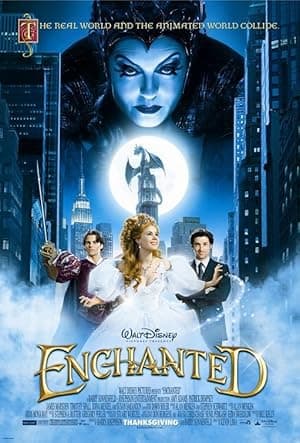
There’s a strange little pleasure in watching Enchanted now: it’s a film that winks at its own fairy-tale machinery while still asking you to feel. Put simply, the movie works because it trusts its central brightness—Giselle—and lets that brightness collide with the messy reality of New York and modern love.
THE MOVIE
Giselle is still the reason this movie works
Enchanted opens where you expect a story like this to begin: a hand-drawn kingdom of impossibly cheerful odds and ends, where a princess believes wholeheartedly in songs and sudden proposals. That Andalasia-to-New-York leap—one second a cartoon, the next a live person stumbling onto Manhattan—sets up a collision the film keeps teasing for a full 107 minutes.
The collision is personal. Giselle lands in the real world and is taken in by a divorce lawyer and his small daughter, which turns a fairy-tale fish-out-of-water joke into a test: can old-fashioned romantic talk survive a household used to pragmatic bedtime routines and custody schedules?
It helps that Kevin Lima and company didn’t try to neutralise the contrast. Enchanted is openly playing both sides—loving the gestures of animated musicals while pointing out how odd they look off the screen—and at the centre of it all is the person you can’t help rooting for: Giselle, played by Amy Adams.
THE SETUP
The idea that sets Enchanted in motion
At its simplest, Enchanted trades on a very satisfying mismatch: a textbook Disney princess is physically transported from the tidy, consequence-light world of Andalasia into the middle of modern New York. That single fish-out-of-water gambit provides most of the film’s comic and emotional energy.
The movie keeps switching modes—hand-drawn animation for Andalasia, live-action for New York—and that medium-hop is more than a visual trick. It’s a shorthand for two ways of solving problems: one where song and an instantaneous promise fix everything, and another where humans negotiate feelings, obligations and messy timelines.
Instead of treating the switch as a novelty, the screenplay uses it to set stakes. Giselle’s fairy-tale instincts rub against a city that expects people to behave like adults: to balance work, family and messy break-ups without a chorus line to clear the air.
That premise is flexible enough to swing between slapstick, musical set-pieces and genuine tenderness without losing its centre, which is why the film’s fish-out-of-water engine keeps turning.
THE CHARACTER
Why Giselle matters
Giselle isn’t just the plot device that causes mayhem; she’s the film’s barometer. Her way of seeing the world—open, generous, ready for a song—forces everyone around her to reckon with how small their lives have become when cynicism rules the room.
The story smartly frames her through the most believable gateway: Robert’s daughter. The child’s readiness to accept magic persuades a pragmatic adult to shelter someone he would otherwise dismiss, and that triangular dynamic keeps the stakes felt rather than schematic.
Because this is a family film, Giselle’s innocence is allowed to be robust rather than fragile. The movie asks whether that kind of unashamed hope can coexist with real choice and responsibility—whether happily-ever-after is something granted, or something people build.
And, crucially for the whole enterprise, the film leans on the performer inhabiting that optimism. Without that note of belief, Giselle would become a caricature; instead she remains oddly persuasive at the movie’s centre.
THE PERFORMANCE
Why Amy Adams's performance matters
Contemporary reviews kept landing on the same point: whatever else Enchanted is, it lives and dies by its central performance. Critics singled out Adams’s singing and the way she occupies comedic beats as essential to the film’s charm.
That matters because the script asks the audience to accept a very specific type of heroine—someone who’s both a running joke about fairy-tale naivety and a sincere emotional counterweight to the rest of the cast. Adams’s presence gives that blend credibility.
Put another way: when the movie winks at Disney conventions, it needs a player who can carry a wink and keep the heart intact. The contemporary responses suggest Adams provided exactly that balance.
So, whether you watch Enchanted for the jokes or for the romance, the performance at the centre is the thing that makes the whole approach hang together.
UNDER THE SURFACE
Enchanted has more on its mind than the plot suggests
On paper Enchanted is a spoof with musical numbers. In practice it’s a conversation between two sets of romantic grammar. One insists on destiny, song and immediate certainties; the other insists on compromise, adult responsibilities and tested affection.
The film’s humour frequently plays off Disney conventions—there’s a self-aware parodying of grand gestures and stock characters—yet it never lets the joke completely swallow the emotional stakes. It’s teasing and affectionate at once.
Crucially, the film also turns the question of agency into something audience-friendly: not merely who gets the girl, but who chooses what kind of life they want. That makes the romantic beats feel like more than plot beats; they become decisions.
So the undercurrent isn’t hostility to fairy tales. It’s curiosity about whether their solutions still make sense when you can’t tidy problems away by the next verse.
PRACTICAL EFFECTS
The effects work that gives Enchanted its physical personality
A fair amount of the film’s charm comes from how the animated and the real were stitched together. Tippett Studio provided hundreds of CGI shots—most notably the digital creature work—so the movie could convincingly place animated animals and a dragon into live-action scenes.
But the crew didn’t rely on pixels alone. On set, actors had physical stand-ins—stuffed animals, rod markers and puppeteered props—so they had something tangible to react to. That’s the kind of small, practical detail that makes comic exchanges land.
For sequences that needed real animal behaviour as reference—like the tidy-but-gross cleaning number—the production filmed actual rats and pigeons to guide the animation; some of the tiniest critters remained digital.
There are also sequences that mix stunt-like capture with effects, for example using a specialized greenscreen rig and a robotic arm to map an actor’s face for a dragon-carried moment. It’s an effects recipe that leans on both craft and clever on-set problem-solving.
PURE 00s
Enchanted could not belong to any other decade
Released in 2007, Enchanted sits in an awkwardly exciting moment for Disney: the studio was rethinking what princess stories could look like and briefly flirted again with hand-drawn animation inside a mainstream release.
That decision—literally cutting back to 2D for the Andalasia prologue—reads as a late-00s act of nostalgia, but the film pairs that wistfulness with the era’s taste for pastiche. It’s not simply reverent; it’s playful and self-aware in a way that matched other postmodern takes of the decade.
In short, Enchanted wears its reference points proudly while also updating them. The result feels of its moment: part tribute, part gentle critique, and tucked into the mainstream studio system of the late 2000s.
WATCHING IT NOW
What has aged — and what hasn't
Watching Enchanted now, its tone is the main thing that survives. The mixture of affectionate satire and genuine sweetness means the film still plays comfortably as a family title; it doesn’t rely solely on throwaway references that would date badly.
Part of that is the centre figure: retrospectives and interviews with the director have emphasised that the blend of earnestness and parody helped the film maintain its appeal, particularly because Amy Adams’s turn continues to be the performance people point to.
The movie’s interest in how innocence and choice intersect—asking whether romantic idealism can coexist with real agency—also feels less like a period curiosity and more like a tidy premise that still speaks to modern viewers.
THE LEGACY
Why Enchanted still matters
There are concrete reminders that Enchanted resonated beyond its opening run: awards-season attention, including three Academy Award nominations for its original songs, kept the film in conversation for reasons beyond nostalgia.
Its hybrid approach—working hand-drawn sequences back into a major release and openly mixing animation with live action—shows up in later discussions about how and when 2D techniques can still be useful within big studio storytelling.
Finally, the fact that the studio returned to Giselle’s world for a direct sequel speaks to the movie’s continuing practical life as a property that could be revisited on its own terms.
THE VERDICT
Does Enchanted still hold up?
Yes—on its own promises. Enchanted asks the audience to buy two linked ideas: that a cartoon princess can tumble into a modern life, and that someone with an unashamedly rosy view of love can make real people change. If you accept that premise, the film mostly delivers.
It helps that the fish-out-of-water device is more than a gag; Giselle’s arrival really does alter the domestic life she stumbles into, and the movie keeps returning to the consequences of that intrusion rather than treating it as a one-off joke.
Technically the film balances theatrical spectacle—big musical numbers and a dragon-laden peril—with quieter emotional anchor points: a father-daughter relationship, a question of choice in romance, and a sidekick who loses his speaking voice and must adapt. Those beats keep the stakes felt, not just performed.
If you’re deciding whether to rewatch or introduce it to someone new, pick it for the central performance and the pleasant oddness of a studio movie that remembers how to be both affectionate and slightly cheeky about its own lineage. It still feels like a warm, knowing fairy tale that wants you to sing along.
Share this movie
Keep watching
More movies from the 00s
2002
The Pianist
A quiet life unmade by war — and a pianist who refuses to stop listening.
Read the retrospective
→
2006
Blood Diamond
A mercenary, a fisherman and a pink diamond — and a film that still asks who pays for our jewellery.
Read the retrospective
→
2003
Kill Bill: Volume 1
A yellow jumpsuit, a long list of enemies and one woman who refuses to be finished.
Read the retrospective
→