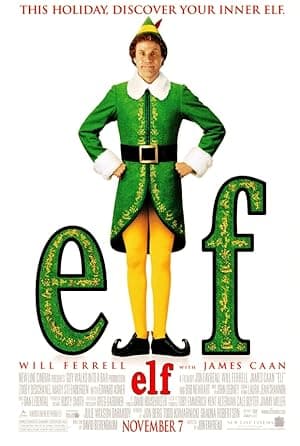
Elf
A grown man raised by elves, a New York that refuses to be magical, and one stubborn belief in family that still lands.
Feature presentation
Buddy is delightfully simple: an adult who behaves like an elf and refuses to stop believing that people can be better. Jon Favreau’s 2003 Christmas comedy turns that single idea into a string of hilarious collisions and surprisingly earnest family scenes. Rewatching Elf today, it’s the character — not the premise — that keeps you watching.
THE MOVIE
Buddy is still the reason this movie works
Right from the start the film sells you a single, irresistible story engine: a baby crawls into Santa’s sack and ends up raised at the North Pole as one of the elves. That origin sequence is brief, vivid and it gives Buddy a worldview so specific you can predict the comedy — and the trouble — that will follow.
When Buddy learns he’s actually human he heads for New York to find his father, a man who has no idea Buddy exists. That journey — an earnest believer stepping into a sceptical city — is the classic fish‑out‑of‑water set‑up, and it’s what keeps the jokes from being mere gags: they’re collisions of two different moral grammars.
Will Ferrell plays the part, and Jon Favreau directs the whole thing with a tidy 97‑minute runtime. The result is a family holiday film that leans on one central personality and refuses to apologise for it.
THE SETUP
The idea that sets Elf in motion
The central engine of the film is pure opposition: Buddy’s wide‑eyed, literal elf behaviour versus Walter Hobbs’s work‑first, sceptical life. That contrast makes every scene a small culture clash.
Because Buddy follows the elf rulebook — literally — his honesty turns into comedy. Department store scenes and his Midtown walk are jokes with stakes: they’re amusing, but they also pressure the family relationships at the film’s heart.
The story is economical. Buddy’s trip to New York is simple on paper — find the father who never knew you existed — but it’s the character collisions along the way that give the movie forward motion.
What works is how each comic set‑piece doubles as a test. The humour comes first; the emotional consequences come immediately after.
THE CHARACTER
Why Buddy matters
Buddy isn’t memorable because he’s clever; he’s memorable because his rules are consistent. His whole behaviour is shaped by being raised at the North Pole, and that literalism gives him a kind of moral clarity the film keeps testing.
At its core Buddy wants family and belonging. That simple need makes him more than a one‑note joke; it makes him a catalyst. His insistence on honesty forces others to answer questions they’ve been avoiding.
That’s why Walter Hobbs exists in the story: he’s a successful, emotionally distant man whose priorities create the principal obstacle to what Buddy wants. The film stages situations where Buddy’s sincerity bumps up against Walter’s cynicism.
There are small supporting wheels that turn the plot — Jovie, who becomes a romantic foil, Papa Elf, who sets Buddy on his path, and the brief antagonism of Miles Finch, which raises the stakes — but Buddy is the motor.
THE PERFORMANCE
Why Will Ferrell's performance matters
Contemporary reviewers singled out Will Ferrell as the movie’s central comic and emotional engine. That critical attention isn’t just about laughs: it’s about how the role holds the film together.
Ferrell’s Buddy is the character the screenplay needs to function; the movie relies on his ability to sustain a single, exaggerated moral position without collapsing into parody.
Because reviewers highlighted his contribution, it’s fair to say the film’s success hangs on that central presence. When Buddy’s behaviour lands, scenes feel alive; when it doesn’t, the balance shifts.
Ultimately the performance gives the film a reliable rhythm: big, physical comedy beats followed by quieter moments that let the family story breathe.
UNDER THE SURFACE
Elf has more on its mind than the plot suggests
On the surface it’s a fish‑out‑of‑water comedy: an adult raised as an elf goes looking for his origins. Underneath that, the film keeps returning to the business of identity — who you are when your upbringing and your biology don’t match.
The bigger engine is family and reconciliation. The movie is organised around repairing an absent father–son relationship, and most scenes are designed to nudge Walter and Buddy toward an awkward, necessary conversation.
There’s also a throughline about innocence versus cynicism. Buddy’s unguarded optimism acts as a foil to New York scepticism, asking whether cheerful goodness is merely naïve or actually corrosive to hardened adults.
Finally, Christmas belief functions both literally and metaphorically: holiday ritual fuels plot mechanics and stands in for human generosity that the film wants you to value.
THE FILMMAKING
How Elf was put together
One of the film’s most tangible signatures is the production design. Rusty Smith’s work gives the North Pole and the title sequences a deliberately stylised look that the movie carries through its set pieces.
That visual language matters because it sets expectations: the world Buddy comes from feels like a coherent place, which makes his arrival in New York sharper by contrast.
The film’s crew credits also point to a straightforward commercial approach: Greg Gardiner is listed as director of photography and Dan Lebental as editor, a team that sticks to clear storytelling rather than flashy technique.
All of that adds up to a movie that prioritises readable environments and comedic clarity — useful choices for a family comedy that needs to land broad humour and quieter emotional beats alike.
PRACTICAL EFFECTS
The effects work that gives Elf its physical personality
Elf leans on tangible craft in a few memorable moments. Short sequences — the opening/title pieces and the Leon the Snowman scene — were realised with stop‑motion puppetry and physical models rather than pure CGI.
The production credited specialist teams for that work, including the Chiodo Brothers, whose involvement anchors those moments in traditional puppet craft.
Technically, the team used motion‑control photography alongside classic stop‑motion techniques to integrate the puppetry with live action, a choice that keeps those sequences tactile and oddly old‑fashioned.
Those practical touches give the movie a physical personality: small, handmade moments that sit comfortably alongside broader, modern comedy filmmaking.
PURE 00s
Elf could not belong to any other decade
Released in November 2003, Elf arrived when family comedies were comfortably mixing broad physical gags with sentimental family themes. It sits neatly in that era’s mainstream.
The film’s tone — big, accessible jokes that quickly pivot to family feeling — is very much of the early‑2000s approach to holiday pictures.
Its commercial positioning also matters: Elf joined a crop of dependable seasonal releases that helped reassert Christmas family comedies as reliable box‑office players.
That timing gave the film momentum: it fitted the marketplace’s appetite for cheerfully engineered, family‑friendly entertainment in the holiday window.
WATCHING IT NOW
What has aged — and what hasn't
As a family film, Elf’s instinct is clarity over complexity. That design decision means its central story — about a son trying to reconnect with his father — remains easy to follow and emotionally immediate.
The reconciliation at the centre still reads as the narrative’s beating heart. Because the film keeps the father–son repair work personal, that element survives repeated viewings.
The presence of Mary Steenburgen as Emily Hobbs is one of the steadying influences in those family scenes; she anchors the domestic side of the story even when the comedy gets loud.
In short: the family material still functions. The clearer the emotional architecture, the less likely it is to fray with time.
THE LEGACY
Why Elf still matters
Elf returned to screens in later years and became a recurring seasonal title, turning up again and again in holiday broadcast and streaming lineups.
That recurring presence helped reshape how people think about modern Christmas films: it’s often grouped in coverage as a contemporary seasonal favourite and credited with raising Jon Favreau’s profile in mainstream comedy directing.
Its afterlife is practical as much as critical — if a film keeps coming back every December, it becomes part of how audiences structure the season.
So when you hear the film mentioned with a smile, it’s usually because it’s still being watched, not just talked about.
THE VERDICT
Does Elf still hold up?
Yes — as long as you accept what the film sets out to do. It’s built from a simple origin — a child raised at the North Pole who later discovers he’s human — and from there it stages a series of escalating social confrontations that are meant to be funny and, crucially, to change people.
The central engine is Buddy’s literal elf behaviour crashing into Walter Hobbs’s work‑obsessed cynicism. That clash produces both the film’s comic set pieces and its emotional pressure; it’s a neat two‑handed dynamic that the screenplay keeps returning to.
Will Ferrell’s presence as Buddy is the glue. The story depends on a clear, sustained point of view: an adult who behaves as if kindness and belief matter. When that perspective hits the marks the film becomes both funny and oddly affecting.
If you want a tight, 97‑minute family comedy with clear ideas about belonging, forgiveness and festive belief, Elf still does the job. It’s not trying to be anything other than a cheerful, narrowly focused holiday movie — and for that purpose it still lands.
Share this movie
Keep watching
More movies from the 00s

2002
The Pianist
A quiet life unmade by war — and a pianist who refuses to stop listening.
Read the retrospective
→
2006
Blood Diamond
A mercenary, a fisherman and a pink diamond — and a film that still asks who pays for our jewellery.
Read the retrospective
→
2003
Kill Bill: Volume 1
A yellow jumpsuit, a long list of enemies and one woman who refuses to be finished.
Read the retrospective
→