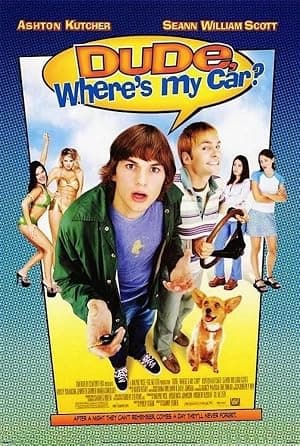
Dude, Where's My Car?
A missing car, two obliging doofuses and a Rubik’s-cube alien — juvenile, daft and oddly loyal.
Feature presentation
Dude, Where's My Car? is the sort of film people quote when they want to evoke a particular kind of early‑00s comedy: low stakes, high absurdity and a friendship you can believe in because the guys actually care about each other. It’s short, silly and entirely committed to its own nonsense — and that commitment is why it still gets watched.
THE MOVIE
Jesse Montgomery III is still the reason this movie works
The film kicks off with a classic “we have no idea what happened last night” hook: Jesse and Chester wake up, Jesse’s car is gone, and inside that car are the anniversary presents their girlfriends deserve. Simple, urgent and immediately silly — exactly the engine the whole movie runs on.
What follows is a very particular kind of comic geography: retracing steps becomes a string of escalating daft encounters — a transsexual stripper, a deliberately daft Chinese drive‑thru loop, a UFO‑worshipping cult and, yes, two sets of aliens. The missing car gives the movie permission to be happily ridiculous.
Underneath the pratfalls is an honest organising principle: the two leads are motivated by loyalty — to their partners and to each other. That buddy‑ship, played as affectionate incompetence, is the reason the film’s small stakes feel genuinely important.
THE SETUP
The idea that sets Dude, Where's My Car? in motion
The plot is tidy by design: two housemates with fuzzy memories discover a tangible problem — a missing car containing anniversary gifts — and set off to fix it. That straightfaced premise keeps the film focused, even when everything else goes joyfully sideways.
The movie’s gag engine is a retrace‑your‑steps structure. As Jesse and Chester try to piece the previous night together they tumble from one dafter-than-the-last scenario to another, which keeps the pace brisk and the jokes unpredictable.
At the centre of the silliness is an affair of sci‑fi whimsy: a toy that transforms into an otherworldly device when you solve it like a puzzle. That plot device turns the lads’ personal problem into something that attracts attention from a few very strange parties.
Running beside the alien business is a smaller, human track: the Dudes trying to mend fences with their twin girlfriends after forgetting an anniversary and wrecking their home. It gives the search a genuine deadline and some emotional teeth.
THE CHARACTER
Why Jesse Montgomery III matters
Jesse is the obvious anchor: he’s the guy who’s lost the car and, by extension, the one whose mistakes need fixing. That straight‑ahead set‑up makes him more than a punchline — he’s the axis the plot spins around.
What makes him memorable in the film’s terms is not complexity but function: Jesse’s problems create stakes. The search for the car isn’t abstract; it’s about mending a relationship and keeping promises, which keeps the comedy tethered to something concrete.
And crucially, Jesse exists inside a duo. The movie’s heart is the pair — the kind of friendship written as loyal, daft and stubbornly supportive. Jesse matters because he’s the emotional fulcrum of that partnership.
THE PERFORMANCE
Why Ashton Kutcher's performance matters
Contemporary responses made a clear point: the film rides or falls on its leads. Reviews at the time singled out the pairing of Ashton Kutcher and Seann William Scott as the movie’s chief asset, noting that the whole thing depends on their on‑screen rapport.
That observation matters because the movie doesn’t hide behind plot complexity — it’s built around two people playing the same game. If their back‑and‑forth clicks, the film gets away with a lot of daftness; if it doesn’t, the jokes feel hollow.
So when we talk about Kutcher in this film it’s less about star turns and more about fit: he’s one half of the friendship engine the whole movie depends on.
UNDER THE SURFACE
Dude, Where's My Car? has more on its mind than the plot suggests
It’s tempting to call this a stoner movie, and that’s fair: the slacker/stoner energy informs the tone — loose, indulgent and allergic to over‑explanation.
But under the haze there’s a friendship movie. The jokes land because the two leads inhabit a genuine buddy dynamic: affectionate incompetence held together by loyalty.
There’s also a flavoursome stretch of absurdism. The film treats improbable bits — cults, aliens, a puzzle‑activated device — as if they were everyday obstacles, and the contrast is where much of the humour comes from.
Finally, it’s still anchored by small, recognisable stakes: teenage anniversaries and the fear of letting the people you care about down. That makes the film’s silliness surprisingly portable.
THE FILMMAKING
How Dude, Where's My Car? was put together
Danny Leiner steered the film towards a heightened, comic‑book sort of energy rather than a straight road‑trip comedy. That choice lets ordinary moments feel larger and funnier than they might otherwise be.
Behind the scenes the crew kept things compact: the cinematography, editing and music credit list shows a small, efficient team supporting that comic tone. Everything is set up to serve the jokes and the duo at its centre.
The result is a film that looks and moves like a deliberately breezy, fast‑paced comedy — which is exactly the point.
PRACTICAL EFFECTS
The effects work that gives Dude, Where's My Car? its physical personality
The film leans on tangible, playful props to sell its sillier ideas. The device central to the plot is presented as a cube‑style toy that reconfigures into something extraterrestrial — a prop altered with electronic touches so it looks both familiar and a bit weird.
There’s also a moment that required genuine animals on set: at least one sequence involved live ostriches, which gives the film a slightly anarchic physicality that CGI wouldn’t convey in the same way.
Those grounded choices — a toy turned sci‑fi McGuffin and real birds causing trouble — help the comedy feel lived‑in rather than just imagined.
PURE 00s
Dude, Where's My Car? could not belong to any other decade
Released at the tail end of 2000, the movie sits squarely in an early‑00s groove: it’s part of a wave of teen and party comedies that followed the late‑90s revival of youth‑centred box‑office fare.
It shares audience DNA with other post‑American Pie comedies — the same appetite for lowbrow setups married to surprisingly earnest friendship beats.
The timing matters: the film arrived when studios were willing to bankroll short, sharp comedies aimed at a young audience, which explains its brisk 88‑minute runtime and concentrated comic ambition.
That particular moment in film finance and audience taste is why the movie feels like a product of its year rather than an attempt to be timeless.
WATCHING IT NOW
What has aged — and what hasn't
If you watch it today as a teen comedy, it still reads like one: the setup, the stakes and the tone are all recognisably in that register.
The friendship at the centre — two mates muddling through and trying not to hurt the people they care about — remains the film’s firmest currency. That loyalty is evergreen, even if the jokes feel dated to some viewers.
The teenage anniversary plot keeps the stakes small and human, which helps the film survive repeated viewings better than it would if it relied only on throwaway gags.
But the film is very much a product of its early‑00s audience and comic instincts: if those particular sensibilities don’t appeal, the movie’s charm will feel narrow rather than broad.
THE LEGACY
Why Dude, Where's My Car? still matters
It mattered to its studio: on a modest budget the film did healthy business, which is one reason it stuck around in pop culture conversation longer than many similar comedies.
Beyond the numbers, it picked up a modest cult profile. Small, specific bits of the film — the cult hand‑signal from the Zoltan group being one vivid example — have had their own afterlife in the oddest of places.
And for years there was talk of turning the joke into a sequel; a proposed follow‑up circulated in development even though it never reached production. The chatter says something about the film’s persistent, if selective, footprint.
THE VERDICT
Does Dude, Where's My Car? still hold up?
Yes — if you come looking for a very particular film. It’s a compact, 88‑minute comedy about two guys chasing a missing car, and that narrow premise lets it commit to daftness without losing focus.
The movie asks you to accept a lot of nonsense — cults, aliens and a puzzle‑activated device — but it always ties that nonsense back to a simple problem: the lads need to get their car back and fix what they broke. Memory loss acts as a neat running device, revealing the night in fragments and keeping the jokes moving.
Crucially, contemporary viewers recognised where the movie’s value lay: the pairing of its two leads was flagged early on as the central asset. If you respond to that chemistry and to buddy‑ship played as affectionate incompetence, the film’s absurd setup pays off.
If you don’t, it will feel like a string of sketches with an overblown sci‑fi punchline. For the right audience — people who enjoy short, silly comedies with low stakes and loud loyalty — it still works. For everyone else, it’s an amusing curio from 2000.
Share this movie
Keep watching
More movies from the 00s

2002
The Pianist
A quiet life unmade by war — and a pianist who refuses to stop listening.
Read the retrospective
→
2006
Blood Diamond
A mercenary, a fisherman and a pink diamond — and a film that still asks who pays for our jewellery.
Read the retrospective
→
2003
Kill Bill: Volume 1
A yellow jumpsuit, a long list of enemies and one woman who refuses to be finished.
Read the retrospective
→