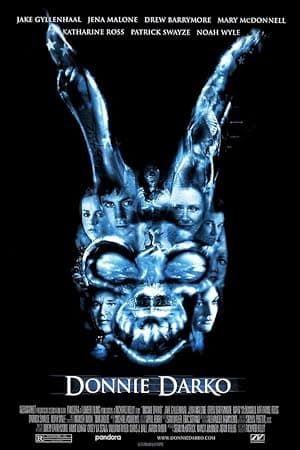
Feature presentation
Remember that moment when Donnie sleepwalks into the night and, for reasons nobody can explain, comes back to find a jet engine in his bedroom? That improbable hook — part nightmare, part puzzle — is where Richard Kelly's first feature convinces you to stay. Donnie Darko mixes teenage crushes and school corridors with a 28-day countdown to something catastrophic, and, awkwardly but effectively, it still holds your attention.
THE MOVIE
Donnie Darko is still the reason this movie works
Let’s lead with the strange bit everyone remembers: the film is set in October 1988 and opens with Donnie sleepwalking out of his house, only to return later and discover a jet engine has crashed through his bedroom ceiling. It’s the sort of image that lives in your head — absurd, alarming and impossible to ignore.
That impossible image is given a voice by a mysterious figure in a rabbit suit, Frank, who summons Donnie outside at night and then sends him back into a situation he cannot yet understand. From that moment the film folds teenage life into a metaphysical puzzle: therapy sessions, school corridors and a new relationship sit beside a 28-day countdown and questions about fate versus free will.
Richard Kelly’s debut isn’t content to be mere mood or mystery. It centres on an intelligent but troubled 16-year-old whose sleepwalking, visions and mounting actions propel the story, and it gives us Jake Gyllenhaal as that boy at the very start of a career. That mix — adolescent interior life and uncanny science fiction — is why people still find reasons to talk about Donnie Darko.
THE SETUP
The idea that sets Donnie Darko in motion
Donnie Darko starts with a neat, high-concept click: sleepwalking leads to an absurd accident. That jet engine in the bedroom is the image that turns ordinary suburban drama into something stranger.
From there the film builds its central conflict around Donnie’s visions and the increasingly deliberate acts of vandalism and sabotage he carries out. Those actions feel driven by more than teenage petulance; they are bound up with a metaphysical mystery — an impending apocalypse sketched against a 28-day countdown.
Kelly layers in time-travel mechanics and the idea of a 'tangent' or parallel reality to make sense of events that would otherwise read as random or symbolic. Those devices let the story wobble between everyday detail and science-fiction weirdness without ever fully committing to one register or the other.
All of this sits alongside Donnie’s ordinary life: a new romance with Gretchen Ross and the banalities of high school. That domestic thread keeps the film emotionally anchored even as the plot asks you to accept increasingly unusual rules.
THE CHARACTER
Why Donnie Darko matters
Donnie is the film’s fulcrum: an intelligent but troubled 16-year-old whose sleepwalking, therapy sessions and visions give the plot its momentum. He’s not a cipher for adolescence; he is adolescence, noisy and awkward and prone to catastrophic impulses.
His family and school life — Rose and Eddie Darko at home, a sympathetic teacher in Karen Pomeroy at school — provide the normalising background that makes his behaviour feel urgent rather than ornamental. The point is that those ordinary relationships ground the stranger material; without them the metaphysics would float.
A romance with Gretchen Ross gives Donnie something human to lose. The relationship doesn’t cancel the high-concept plot; it humanises it, so that the stakes feel less like an abstract puzzle and more like a risk to a young person trying to be understood.
All the while, this film was Richard Kelly’s first feature and uses Donnie’s point of view to fuse personal confusion with a larger, more baffling cosmic argument. In other words: the character is the film’s reason for being strange and the reason you care when it is.
THE PERFORMANCE
Why Jake Gyllenhaal's performance matters
Contemporary critics and later commentators frequently singled out Jake Gyllenhaal’s turn as central to the film’s impact, and it was widely identified as a star-making role. That consensus is part of why Donnie Darko sits in so many conversations about early-2000s cinema.
Put simply: the film’s strange tone depends on somebody able to carry both teenage banality and the weight of the film’s metaphysical questions. The record shows Gyllenhaal’s performance is the performance people point to when they explain why the film worked for them.
That isn’t the same as saying the film lives or dies on a single player. But the contemporary reaction makes clear his role was the pivot that helped the picture land with audiences and critics at the time.
So, when you rewatch it now, keep an ear out for why early commentators treated this as a breakout moment: it became part of the film’s atmosphere and its afterlife.
UNDER THE SURFACE
Donnie Darko has more on its mind than the plot suggests
At a glance the film is a weird thriller with time-travel flourishes. Underneath, it’s concerned with adolescence and alienation in suburban America — strained family relationships, school as a pressure cooker and a youngster who feels fundamentally out of step.
That personal discomfort feeds the film’s bigger questions about fate versus free will. The ticking 28-day clock pushes Donnie into choices that feel, narratively, like tests: is he following a script or rewriting it?
Time travel and alternate realities are the tools the story uses to let those questions play out. The mechanics — tangents and parallel timelines — give a framework that makes what could be melodrama feel like an experiment.
Finally, the film quietly takes aim at suburban moral posturing. When ordinary citizens proclaim certainties, the film often shows how brittle those certainties are in the face of genuine confusion.
THE FILMMAKING
How Donnie Darko was put together
One practical fact helps explain the film’s textured, slightly scrappy feel: principal photography was executed on a compressed schedule documented as 28 days. That short shoot is the sort of constraint that forces choices — quick setups, a lean crew and a focus on essentials.
Constraints like that don’t automatically produce charm, of course, but they do shape the film’s personality. The result feels like a carefully stitched independent picture rather than a studio-manufactured concept piece.
It’s worth noticing how the filmmaking serves the story: the economy of production lets character moments breathe, which matters when the plot leans into metaphysical puzzles.
So Donnie Darko reads like an ambitious, small-scale film — the sort of debut that’s too confident to apologise for being strange.
PRACTICAL EFFECTS
The effects work that gives Donnie Darko its physical personality
The jet-engine-through-the-bedroom image was created with a physical set and prop, and the production’s making-of materials document how that sequence was staged and shot. That concreteness helps the film: when something surreal happens, it feels physically anchored.
Production materials also note the combination of practical on-set effects with additional visual work to produce the film’s skies and its time-related phenomena. In practice, the film blends tangible props with supplementary techniques to sell its odd moments.
That hybrid approach is sensible for a film on an independent scale: use what you can physically build, then add measured effects where necessary to suggest the impossible.
The bottom line is straightforward — the movie’s weirdness has a physical backbone. When the narrative asks you to believe the strange, it gives you something you can see and touch to hold onto.
PURE 00s
Donnie Darko could not belong to any other decade
Although the story is set in 1988, Donnie Darko was made and released in the early 2000s, and contemporary coverage framed it as an 1980s-set metaphysical suburban drama with nods to John Hughes-style teen films and 1980s pop culture. That temporal layering gives the film a particular early-2000s flavour: nostalgia looking back while insisting on something darker.
Its life story is also typical of the DVD-era indie picture: a low-budget independent production that found a wider audience after release, growing into a substantial cult following through word-of-mouth and home-video circulation.
The film’s soundtrack also travelled in unexpected ways: Michael Andrews and Gary Jules’s pared-down cover of 'Mad World' became a UK Christmas number-one single in December 2003, which helped keep the film in public view a couple of years after its release.
All of this — period setting, indie production and a soundtrack that turned into a separate cultural moment — ties Donnie Darko to the specific conditions of the early 2000s without making it a mere period exercise.
WATCHING IT NOW
What has aged — and what hasn't
Rewatching Donnie Darko today, two practical realities shape the experience: the existence of a 2009 sequel produced without Richard Kelly’s involvement, and the fact that the film’s production extras document how its key sequences — especially the jet-engine-through-the-bedroom scene — were staged.
The sequel’s existence is a reminder that the story continued in other hands, which can complicate how audiences think about the original but doesn’t erase its pleasures. The production material, meanwhile, is useful: seeing the on-set staging for the jet-engine sequence clarifies how much was achieved with concrete craft rather than pure digital trickery.
That knowledge doesn’t settle the film’s interpretive arguments for you; it simply changes the textures you notice on a rewatch. The oddness remains. The practical details make the oddness feel earned rather than accidental.
If you come to the film now, you’ll view it with more context — and possibly more sympathy for the decisions required by a tight shoot and an ambitious script.
THE LEGACY
Why Donnie Darko still matters
Donnie Darko developed a substantial cult following after its initial release, and it’s widely credited with significantly raising Jake Gyllenhaal’s profile. That afterlife is part taste, part timing: an unusual film that found an audience willing to argue about it.
The soundtrack also fed the film’s second life. The Michael Andrews and Gary Jules cover of 'Mad World' became a UK Christmas number-one single in December 2003 — an odd crossover moment that kept the film in public conversation and introduced it to people who might not have seen it on first release.
Richard Kelly later issued a Director’s Cut with extra footage and alternate music cues. That choice invited reappraisal and kept the film available for new takes and fresh debates in home-video extras and critical reexamination.
Finally, the fact the characters were used in a later sequel — made without Kelly — is evidence of the film’s narrative currency. It didn’t turn everything it touched into gold, but it did leave a trace worth returning to.
THE VERDICT
Does Donnie Darko still hold up?
Yes — with caveats. The film’s opening gambit (Donnie summoned by a rabbit-suited Frank and returning to find a jet engine in his bedroom) still works as a striking invitation: it tells you immediately that this will not be a straightforward suburban drama.
What follows is a blend of teenage life — family rows, a teacher who tries to listen, a new romance with Gretchen Ross — and a metaphysical puzzle built from a 28-day countdown and time-travel notions about tangent realities. If you enjoy stories that let big questions sit alongside small human details, this will still reward you.
Be prepared, though: the film asks you to accept unusual rules and to live with some ambiguity. It isn’t tidy. It refuses to hand you a single interpretation about fate versus free will, and that open-endedness is both its strength and the source of frustration for some viewers.
Still, for anyone curious about a movie that braids adolescent alienation to speculative mechanics — and for those who want to see the performance that helped launch Jake Gyllenhaal — Donnie Darko remains worth watching. It’s a film that keeps the argument going; it doesn’t let you walk away comfortable.
Share this movie
Keep watching
More movies from the 00s
2002
The Pianist
A quiet life unmade by war — and a pianist who refuses to stop listening.
Read the retrospective
→
2006
Blood Diamond
A mercenary, a fisherman and a pink diamond — and a film that still asks who pays for our jewellery.
Read the retrospective
→
2003
Kill Bill: Volume 1
A yellow jumpsuit, a long list of enemies and one woman who refuses to be finished.
Read the retrospective
→