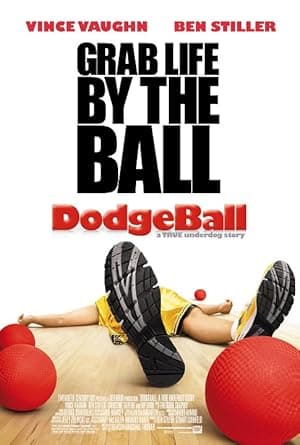
DodgeBall: A True Underdog Story
A ragged bunch, a laid‑back owner and one smug gym billionaire — still funny, still oddly affectionate about losers.
Feature presentation
DodgeBall: A True Underdog Story is exactly the sort of daft, grubby little comedy that knows which buttons it wants to press — and presses them with relish. At its centre is Peter LaFleur, the easygoing owner of Average Joe’s whose refusal to panic is the movie’s secret engine; everyone else exists either to rally around him or to be loudly humiliated by White Goodman. Rewatching it now is less about nostalgia and more about watching a crowd of comic characters hold a weird, earnest belief in team spirit.
THE MOVIE
Peter LaFleur is still the reason this movie works
There are comedies that hit with a riff and those that live or die by a centre. DodgeBall: A True Underdog Story sits squarely in the second camp because it trusts Peter LaFleur to hold everything together. He’s the unflappable owner of Average Joe’s whose gym is suddenly staring down the barrel of foreclosure — and his calm is not passive so much as quietly contagious.
That setup — Average Joe’s must raise $50,000 in thirty days and the team enters a Las Vegas dodgeball tournament for the prize — gives the film an obvious, pleasingly simple spine. It’s an underdog story in the classic sense: small group, big threat, ridiculous stakes and one sport that becomes the battleground for community pride.
Rawson Marshall Thurber’s debut directs that chaos into a compact 92‑minute comedy, and what keeps it from feeling mean-spirited is the movie’s friendliness toward its losers. Which, crucially, starts with Peter.
THE SETUP
The idea that sets DodgeBall: A True Underdog Story in motion
Keep the premise simple and the jokes come faster. Average Joe’s is under threat because a rival has bought the deed; the immediate problem is money and the immediate solution is absurdly obvious: enter the tournament with a $50,000 prize and win.
That mechanics-first energy — a regional-to‑Las Vegas tournament carrying the story forward — means the film rarely lingers on melodrama. It’s a string of matches and pratfalls tied together by a clear objective, which is exactly what a crowd-pleasing sports comedy needs.
The tournament structure also gives Thurber a reason to introduce a parade of characters and little comedic set pieces without losing the plot. Each match escalates stakes, personalities and, yes, how loudly the antagonist can preen.
All of which keeps the story brisk: it’s a short, focused movie that knows how to use the rules of its own game.
THE CHARACTER
Why Peter LaFleur matters
Peter LaFleur isn’t the loudest figure in the film, which is precisely why he registers. Vince Vaughn’s character runs Average Joe’s with a kind of pleasant, avoidant calm — he’s not a slacker in the usual pejorative sense so much as someone who refuses to make panic the default reaction.
That temperament does a lot of heavy lifting. It turns the story’s stakes into something communal rather than melodramatic: when Peter won’t escalate, the team has to. His passivity becomes a nudge toward solidarity rather than an excuse for apathy.
Peter’s role is also structural. By being the antithesis of the film’s villain, he defines the cake-and-frosting of the comedy: one side is showy narcissism, the other is everyday stubbornness and loyalty.
When the film needs to remind you who the crowd is rooting for, it doesn’t cue a speech—it just lets Peter be inconveniently ordinary. And that ordinariness is its own kind of leadership.
THE PERFORMANCE
Why Vince Vaughn's performance matters
A tricky line to walk: this section isn’t here to crown performances, only to say what we can safely observe. One reliable piece of evidence is that contemporary reviews singled out the comic chemistry between Vince Vaughn and Christine Taylor.
That matters because much of the movie’s heart comes from relationships, not one‑liners. Where the script could have made Peter a flat ‘nice guy’ cork, his scenes with Kate give him context — he’s not just mellow, he’s anchored.
So even if you’re not watching for virtuoso acting, the rapport on screen is functional: it makes Peter’s temperament believable within the film’s tone and keeps the emotional stakes from being hollow.
Ultimately, the performance’s role is practical: it lets the plot’s absurdities sit beside genuine, visible connections, which is what the movie needs to work.
UNDER THE SURFACE
DodgeBall: A True Underdog Story has more on its mind than the plot suggests
On the face of it, the movie is a gag machine about a silly sport. Underneath, it’s quietly invested in team solidarity: the underdogs band together not just to win money, but to defend a place that is social as much as commercial.
That community-versus-corporation dynamic gives the comedy a moral axis. The villain isn’t just strong, he’s the sort of corporate-showman who treats people as props — which pushes the team’s scruffiness into something admirable.
There’s a second, related idea about performative masculinity. White Goodman’s whole persona is a satire of loud, performative virility; his swagger is meant to be exposed and deflated, which the film does cheerfully.
Finally, the movie has an eye on spectacle itself. The dodgeball tournament turns athleticism into entertainment, and the film teases the ridiculousness of sports as commodified spectacle while still enjoying the theatricality.
THE FILMMAKING
How DodgeBall: A True Underdog Story was put together
This is Rawson Marshall Thurber’s first feature, and he assembled a team that favours clarity over fuss. The film credits Jerzy Zieliński as cinematographer and lists Alan Baumgarten and Peter Teschner among the principal editors.
That combination signals a straightforward, no‑frills approach: the camera and cut exist to serve the jokes and the pace rather than to show off technique. The film’s rhythms are engineered for comedic timing and tournament momentum.
Production-wise, this is a studio comedy that leans on ensemble casting and set pieces; the filmmaking choices keep the tone even so the audience can shift from a throwaway gag to scenes that need a touch of sincerity.
Put simply: the filmmaking is functional and purpose-driven — designed to make the premise run like a well-oiled, ridiculous machine.
PURE 00s
DodgeBall: A True Underdog Story could not belong to any other decade
This is very much an early‑2000s mainstream comedy: debut director, studio backing, and a cast made up of comic character players who turn up to get the laugh. That era loved big, broad premises and ensemble playgrounds, and DodgeBall fits neatly into that habit.
The film’s marketing and afterlife also wear the decade. Its home‑video ‘Extreme Edition’ extras are a marker of the DVD boom, a time when comedies earned second lives on special features and behind-the-scenes banter.
The short runtime, the tournament-as-structure and the crowd-friendly jokes all reflect the period’s appetite for accessible, rewatchable comedies that favour immediate payoffs over slow-burn nuance.
In other words, it’s a product of its era in the best possible way: unapologetically engineered to entertain a mass audience in 2004.
WATCHING IT NOW
What has aged — and what hasn't
Ben Stiller’s White Goodman is explicitly modelled on an earlier over-the-top fitness instructor persona, which makes him feel like a deliberate throwback: a cartoonish antagonist built to be mocked. That choice still lands because the movie treats his bluster as a target to be deflated rather than celebrated.
A late-scene same-sex kiss involving Kate Veatch remains a notable moment in the film’s coverage. It’s a late, visible nod toward LGBTQ representation within a mainstream comedy of the era — small in length but significant in presence.
Stylistically and tonally, much of the humour reads as early‑2000s broad comedy: loud, fast and occasionally gleefully mean. That will either charm or grate depending on your tolerance for that particular comic volume.
Overall, the film’s basic bones — a believable ragged team resisting a corporate shiny antagonist — still play. The edges might feel dated; the core purposefully doesn’t.
THE LEGACY
Why DodgeBall: A True Underdog Story still matters
The film’s music earned a concrete nod: Theodore Shapiro received a BMI film music award for his work, which is a tidy reminder that even broad comedies carry craft choices people notice.
On the popular-awards circuit the movie did fairly well: Ben Stiller picked up an MTV Award for Best Villain and the film attracted nominations that underlined its mainstream appeal.
There’s also a curious cultural afterlife: the fictional ESPN8, 'The Ocho', was later acknowledged by ESPN in 2017 with a themed programming block, which is a neat example of a joke travelling back into real life.
Finally, talk of a sequel kept returning to public discussion across the 2010s and into the 2020s, with reported development activity at multiple points — not proof of global dominance, but evidence the movie stuck around in people’s minds.
THE VERDICT
Does DodgeBall: A True Underdog Story still hold up?
Yes — so long as you accept what it tries to be. It’s a compact, 92‑minute studio comedy that bets on a single premise: Average Joe’s needs $50,000 to avoid foreclosure, so the team enters a tournament and the film builds from there. If that sounds daft, great; it’s meant to be.
What keeps the film working is its central contrast: Peter LaFleur’s deliberately easygoing leadership versus White Goodman’s performative machismo. That opposition turns each match into more than slapstick; it becomes a small moral quarrel about what it means to lead and to belong.
The movie also leans on reliable comic scaffolding — a found 1950s‑style training film about Patches O’Houlihan, celebrity cameos and a tournament structure that keeps the pace brisk. Contemporary viewers noticed the chemistry between Vince Vaughn and Christine Taylor, and that relationship still helps the film land its quieter beats.
So if you want a satire of hyper‑masculinity wrapped in a messy, affectionate underdog story, DodgeBall still delivers. It’s not subtle, but it’s clever about who it laughs at — and that makes it worth revisiting.
Share this movie
Keep watching
More movies from the 00s
2002
The Pianist
A quiet life unmade by war — and a pianist who refuses to stop listening.
Read the retrospective
→
2006
Blood Diamond
A mercenary, a fisherman and a pink diamond — and a film that still asks who pays for our jewellery.
Read the retrospective
→
2003
Kill Bill: Volume 1
A yellow jumpsuit, a long list of enemies and one woman who refuses to be finished.
Read the retrospective
→