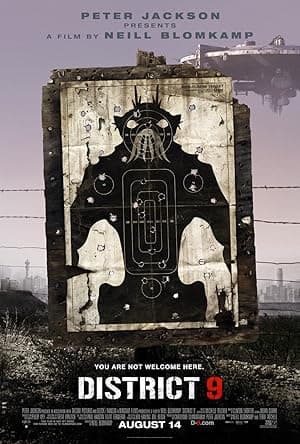
District 9
An awkward bureaucrat, an alien slum and an idea that refuses to be polite.
Feature presentation
There’s a specific, uncomfortable thrill to District 9: an alien ship over Johannesburg, a slum called District 9 and a meek MNU bureaucrat shoved into a situation he neither understands nor controls. Neill Blomkamp’s 2009 film dresses hard political ideas in mockumentary grit and an escalating bodily horror — which is exactly why it still nudges you long after the credits roll.
THE MOVIE
Wikus van de Merwe is still the reason this movie works
District 9 throws a very ordinary man into an absurdly inhuman situation and then watches the small, ugly decisions multiply. An alien spaceship hangs over Johannesburg; the stranded extraterrestrials are corralled into a filthy district and treated like a problem to be managed.
That ordinary man is Wikus van de Merwe, an awkward MNU field bureaucrat whose pragmatic obedience is the film’s opening status quo. He’s sent to oversee a forced relocation and, in the process, becomes infected by alien fluid — a physical change that pushes his life in directions he never intended.
Neill Blomkamp dresses all of this in mockumentary skin: interviews, news footage and surveillance-style inserts that keep the camera slightly off-balance. The result is a movie that behaves like a social report one moment and a thriller the next — and Wikus, played by Sharlto Copley, is the hinge between those tones.
THE SETUP
The idea that sets District 9 in motion
At its simplest, the film’s engine is bureaucratic cruelty given practical teeth. Wikus is an MNU operative tasked with relocating the aliens; that job is run the way a corporation runs anything — spreadsheets, claims and a cold efficiency that doesn’t ask moral questions.
Then something fairly literal happens: Wikus is exposed to an alien substance that starts to alter him. That accidental infection rearranges the power dynamics — the company wants him for his biological value, and he starts to see the people he once helped to oppress in a different light.
Alongside this personal plot sits a practical story mechanic: MNU needs alien DNA to make captured weaponry function. That corporate need explains the medical and security operations the movie keeps returning to, and it gives the chase scenes a clear, material motivation.
Blomkamp tells the story as if you’re watching a dossier: documentary fragments mixed with staged action. That format keeps the viewer slightly distanced and, crucially, constantly aware this is not just a punchy sci‑fi premise but a report on how systems treat otherness.
THE CHARACTER
Why Wikus van de Merwe matters
Wikus isn’t written as a hero. He’s a paper-pusher with all the narrow ambitions and petty cowardices that come with being a middle-rung bureaucrat. That makes his arc interesting: the story refuses to give him an easy conscience to wear.
The transformation he undergoes — a physical alteration that starts to shift his allegiances — is not just body horror. It’s a device that forces the movie to test the flimsy moral language people use to justify exclusion and violence.
Naming Sharlto Copley as Wikus matters because the role is blunt in its demands: the film needs someone who can anchor bizarre events in recognisable fear, confusion and small acts of self-preservation without ever being framed as simply noble or monstrous.
Finally, Wikus matters because he’s the camera the audience most often follows. When the rules change around him, we don’t just understand the stakes intellectually — we feel them through a man whose life is being dismantled in stages.
THE PERFORMANCE
Why Jason Cope's performance matters
Jason Cope’s credit is noticeably literal: he performed on-set motion-capture and served as a live-action reference for Christopher Johnson and the other alien figures.
That means the alien behaviour isn’t invented in the VFX suite from a blank page — there was an actor on set providing physical rhythms, timing and micro‑actions for animators to work from.
VFX teams have described their approach as preserving those performances and then ‘alienizing’ them: the animators started with Cope’s movements and reworked them into forms that read as not-quite-human.
So when the aliens do something odd but oddly expressive, there’s an on-set human logic behind it. The creatures feel like translations of a human performance, not purely digital inventions.
UNDER THE SURFACE
District 9 has more on its mind than the plot suggests
The film is never coy about its political lineage: Blomkamp explicitly cites Cape Town’s District Six as structural inspiration, and that history of forced removals hangs over everything the movie shows us.
From there, it’s easy to see the film as an examination of xenophobia and dehumanization — how whole groups can be reduced to stereotypes and treated like a management problem rather than human beings.
But District 9 ties those social observations to specific systems of power: a private corporation running security and medical operations, and the ethical rot that comes when profit meets biological exploitation.
Wikus’s transformation — identity and bodily change — is the final trick. By changing the body of someone who once enforced exclusion, the movie forces a messy conversation about empathy, otherness and how easily identities can be re‑read.
THE FILMMAKING
How District 9 was put together
On paper the ingredients are tidy: cinematography by Trent Opaloch, editing by Julian Clarke and a deliberate mix of documentary-style material and staged set-pieces.
That blend is the film’s texture — the mockumentary inserts give the picture an investigative itch, while the action sequences snap it into a different gear. The cuts and camera choices move us between those modes without a formal name attached.
The effect isn’t sleight of hand. It’s a practical decision to keep the audience on one foot: are we watching reportage or a thriller? The filmmaking refuses to let us settle entirely into either camp.
That in-between stance helps the themes land. When violence or corporate manoeuvring happens, it reads like an item in a dossier, not a spectacle to ogle.
PRACTICAL EFFECTS
The effects work that gives District 9 its physical personality
District 9’s creatures are the result of a hybrid approach. Weta Workshop and a prosthetics/makeup team are credited with animatronics and prosthetic make-up work alongside the film’s digital visual effects.
Crucially, the production relied on on-set reference performance: motion-capture plates and live-action stand-ins gave animators something concrete to build from.
The VFX teams then blended rotomation, keyframe animation and digital compositing with those practical elements, producing creatures that sit somewhere between physical object and animated presence.
That hybrid method means the aliens often feel tangible in a way pure CGI sometimes does not — they carry traces of human movement and physical interaction even after the digital work is layered on.
PURE 00s
District 9 could not belong to any other decade
Released in 2009, District 9 arrived at the tail end of the 2000s as a modestly budgeted sci‑fi film that found mainstream attention despite a marketplace increasingly dominated by franchise tentpoles.
Its South African settings, local actors and explicit engagement with post‑apartheid themes plugged the film into late‑2000s conversations about migration, inequality and the privatization of security.
That global conversation — an appetite for smart, political genre work that could still thrill — helped the movie stand out. It felt like a smaller, sharper counterpoint to the decade’s bigger, safer blockbusters.
Finally, the movie’s origins in Neill Blomkamp’s 2005 short Alive in Joburg are very 2000s in spirit: shorts and online virality became pipelines into full‑length features during this period.
WATCHING IT NOW
What has aged — and what hasn't
One practical reason District 9 still reads well is the production choice to root the alien behaviour in on-set human performance: animators worked from motion-capture and live-action reference, which gives the creatures a convincing internal logic.
Another durability point is the creative relationship that started here: Sharlto Copley’s association with Blomkamp continued into later projects, and that recurring collaboration helped both director and lead refine a shared shorthand over time.
Those two facts — human reference for creatures and a continuing director–performer partnership — mean certain structural decisions in the film feel deliberate rather than accidental.
What hasn’t dated is the movie’s willingness to be uncomfortable. Its mix of political allegory and visceral bodily change still forces the viewer into an awkward position: sympathise, recoil, think. That friction is part of its staying power.
THE LEGACY
Why District 9 still matters
Industry recognition is part of the story: District 9 picked up major awards attention, including multiple Academy Award nominations across categories such as Best Picture and Adapted Screenplay.
It also won specific plaudits for its makeup and effects work and received BAFTA nominations in areas like visual effects and cinematography — concrete signs that peers saw craft in the construction as well as the idea.
Perhaps most relevant now: the film established Neill Blomkamp as a commercially noticed director, and it created a crew and collaborator network that moved with him into larger productions. That means District 9 is often the first chapter people reference when tracing his career.
THE VERDICT
Does District 9 still hold up?
Yes — and not because it’s a perfect film, but because its central moves remain clear and effective. The premise is simple to explain: an alien slum is policed, a bureaucrat gets infected, and that infection reorganises loyalties and threats.
Because the movie ties the conflict to something material — MNU’s need for alien DNA to operate captured weaponry — the stakes never feel abstract. The corporation’s hunger is not metaphor alone; it drives the plot and the violence you watch unfold.
The mockumentary framing keeps the film alert and a little uncomfortable, which suits the political material. It would be much easier to make the aliens purely sympathetic or purely monstrous; District 9 refuses that tidy move, and the result still has teeth.
If you’ve never seen it, watch it as a compact 112‑minute blast of ideas and filmcraft. If you’re returning, notice how the personal (Wikus’s alteration) and the political (forced removals, corporate extraction) still speak to each other. That dialogue is why it endures.
Share this movie
Keep watching
More movies from the 00s

2002
The Pianist
A quiet life unmade by war — and a pianist who refuses to stop listening.
Read the retrospective
→
2006
Blood Diamond
A mercenary, a fisherman and a pink diamond — and a film that still asks who pays for our jewellery.
Read the retrospective
→
2003
Kill Bill: Volume 1
A yellow jumpsuit, a long list of enemies and one woman who refuses to be finished.
Read the retrospective
→