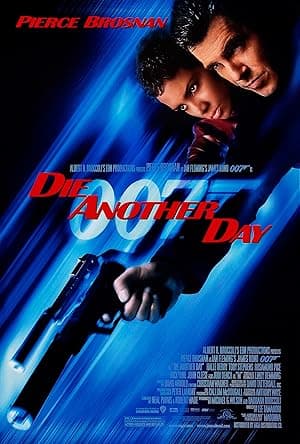
Die Another Day
A Brosnan Bond stitched back together by gadgets, identity games and one enormous ice set.
Feature presentation
Die Another Day is the Bond film that insists on being both a spy story and a CGI spectacle. It starts small—Bond captured, exchanged and suddenly under suspicion—and then spends two hours unpicking identity, betrayal and a very modern fear of weaponised technology. If you want a Bond that's equal parts procedural stubbornness and blockbuster theatre, this is the one to revisit.
THE MOVIE
James Bond is still the reason this movie works
Die Another Day opens with Bond on the Korean peninsula, a mission that goes sideways and leaves him a prisoner for more than a year. That capture, and the awkward return that follows, gives the whole film a hook: here’s a professional spy whose reputation has been dented and who now has to prove he didn’t crumble under torture.
Being exchanged and briefly disavowed by MI6 turns the story into a kind of personal investigation. Bond isn’t chasing a villain because the world will end; he’s chasing the chance to clear his name and get his 00 status back. It roots the picture in a simple, convincing motive amid the spectacle.
All of which makes Pierce Brosnan’s Bond the movie’s steady centre. Around him Lee Tamahori and the production swing between intimate betrayals—who can you trust?—and big, theatrical gestures: identity changed by gene therapy, an Icarus satellite, and even a hugely ambitious ice-palace set. It’s the collision of the small and the enormous that keeps the film interesting.
THE SETUP
The idea that sets Die Another Day in motion
The film keeps its engine simple: Bond is captured during a mission, held for 14 months, then exchanged. Back in circulation but under a cloud, he starts pulling at the threads of a smuggling chain and finds something larger than anyone expected.
That chain leads from blood diamonds to a public-facing billionaire and, eventually, to a weapons programme with a space component called Icarus. The satellite idea gives the movie a classic Bond-scale threat: not just a local crime, but something that could reach worldwide.
Identity plays through all of that. The movie introduces experimental DNA therapy and altered appearances early on—small science-fiction notes that become significant when the truth behind public faces is revealed.
So the setup works because it mixes a straightforward personal motive—clear my name—with a tangible, escalating threat. Bond follows the evidence and the plot follows him, neatly marrying the procedural and the spectacular.
THE CHARACTER
Why James Bond matters
Pierce Brosnan’s Bond is the pivot on which everything turns. In this film he’s not just a rogue agent doing clever stunts; he’s a professional with a reputation to repair. That gives him a clear direction: he must prove he didn’t break, and in doing so he reasserts what being 007 actually means.
Bond’s investigation feels methodical. It isn’t a string of unrelated chases; it’s a detective route through blood diamonds, corporate faces and a satellite programme. The personal stakes—redemption and restoring status—keep the action from becoming pure spectacle.
He also gets a credible ally in Jinx, an American agent presented as a capable counterpart. Their partnership helps position Bond as part of an international web of operatives rather than a lone theatrical showman.
Under Lee Tamahori’s direction and the film’s 132-minute running time, Bond sits at the heart of a movie that wants both polish and scale. That makes him memorable here: not because everything around him is subtle, but because his mission is.
UNDER THE SURFACE
Die Another Day has more on its mind than the plot suggests
On the surface it’s a globe-trotting spy movie; under the surface it’s preoccupied with identity. Gene therapy and altered appearances aren’t decorative; they’re the film’s way of asking who someone really is when their face can be changed.
Trust and betrayal thread through the story in a very literal way. Bond’s disavowal by his own service and the presence of double agents turn every handshake into a question. If faces lie, who do you believe?
There’s also a clear anxiety about technology. Icarus—an orbiting, high-energy weapon—turns the film into a commentary on how quickly modern tools can be turned into geopolitical threats.
All of these ideas feed Bond’s personal arc: this isn’t just about saving the world, it’s about him reclaiming his professional identity. Revenge and redemption sit hand-in-hand with the spy games.
THE FILMMAKING
How Die Another Day was put together
The production leaned into set ambition. Peter Lamont was the production designer and the decision to build a substantial ice-palace set becomes one of the film’s signature production choices—something that anchors the spectacle in a physical place.
That physical ambition signals the filmmakers’ intent: they wanted a Bond that could occupy massive, theatrical locations as convincingly as it could handle smaller, investigative scenes. Building elaborate sets was part of making the extraordinary feel tangible.
Behind that is the fact this was the franchise’s twentieth Eon entry—there was a pressure to mark the film with scale and celebration. That framing influenced how the production approached everything from design to the biggest set-pieces.
Lee Tamahori directed the whole package, guiding a film that shifts between close-up questions of trust and broad gestures of blockbuster design. The result is a James Bond that alternates intimacy with spectacle by design.
PRACTICAL EFFECTS
The effects work that gives Die Another Day its physical personality
The movie deliberately mixes large physical construction with digital augmentation. The ice-palace is a substantial, built environment, and the film pairs that kind of real set work with sequences that rely on visual effects.
Vehicles and stunts land in that middle ground. The production used real stunt work and practical cars—an Aston Martin V12 Vanquish and a Jaguar XKR among them—but then augmented those set pieces with CGI where the action demanded it.
That blend gives the film a tactile base. When something big happens, the audience often has something physical to hang on to, even if the final moment has been digitally enhanced.
So the film’s personality comes from being neither purely practical nor purely digital; it sits in between, using each approach where the sequence required it.
PURE 00s
Die Another Day could not belong to any other decade
Released in November 2002 as the series’ twentieth Eon film, Die Another Day sits squarely in the early 2000s. That period mattered: studios were pushing blockbusters toward ever-larger visual effects, and this film wears that tendency on its sleeve.
The plot’s focus on cutting-edge weaponry and satellites matches the era’s anxieties about technology outpacing control. Making the threat modern—space-based energy weapons—felt of a piece with other 00s tentpole thinking.
The producers were also openly thinking about franchise expansion at the time, even exploring a spin-off centred on Jinx. That interest in broadening intellectual property was a hallmark of the era’s studio thinking.
Read as a product of its moment, the film combines a long-running franchise’s craft with an early-2000s appetite for spectacle and franchise potential.
THE LEGACY
Why Die Another Day still matters
Part of the film’s afterlife comes from its place in the Bond timeline: it’s Brosnan’s fourth outing and the twentieth Eon picture, so it’s often referenced as the close of his era in the role.
There’s also the story of what might have been. Producers explored a Jinx spin-off after release; that cancelled development is now part of the film’s production legacy and the wider conversation about early-2000s franchise ambitions.
And then there’s the pop-cultural footnote of the title track and its big-profile music video: the song kept the movie talking beyond cinemas and remains a conspicuous part of how people remember the release.
Taken together, these elements—position in the franchise, cancelled spin-off plans, and high-profile cross-media tie-ins—help explain why it hasn’t entirely faded from discussion.
THE VERDICT
Does Die Another Day still hold up?
Yes—if you come for a Bond that balances character-driven motive with blockbuster spectacle. The film’s opening beats (Bond’s capture, lengthy imprisonment and the resulting disavowal) give it a moral engine: he’s chasing vindication as much as he is chasing a villain.
The movie piles on modern anxieties—gene therapy, hidden identities, and a space-based weapon called Icarus—but those elements are joined to a recognisable detective route: tracing blood diamonds to a public billionaire whose persona conceals a secret programme. That combination keeps the stakes both human and global.
Admit the truth: some viewers will find the picture’s tilt toward large-scale CGI spectacle pronounced. Critics at the time flagged that move; it’s part of what makes Die Another Day feel very 2002. But if you accept the film’s chosen balance of stunts, sets and high-tech threat, it delivers enough momentum to be entertaining.
So should you watch it now? If you want a Brosnan Bond who has to earn back his title while navigating identity games and a genuinely cinematic ice-palace, yes. It doesn’t hide its era or its ambitions—and in that frankness it still has a shape and purpose worth revisiting.
Share this movie
Keep watching
More movies from the 00s

2002
The Pianist
A quiet life unmade by war — and a pianist who refuses to stop listening.
Read the retrospective
→
2006
Blood Diamond
A mercenary, a fisherman and a pink diamond — and a film that still asks who pays for our jewellery.
Read the retrospective
→
2003
Kill Bill: Volume 1
A yellow jumpsuit, a long list of enemies and one woman who refuses to be finished.
Read the retrospective
→