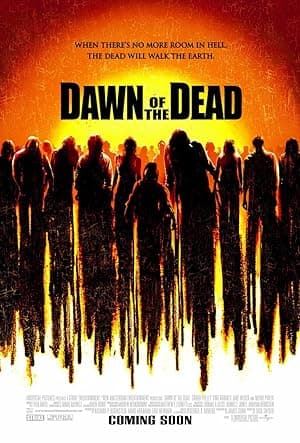
Feature presentation
There are plenty of ways to sell a 2004 zombie movie — gore, speed, clever twists. Dawn of the Dead still works because it hooks you to a person first: Ana, a nurse whose choices make the next ninety minutes click. Pull up a seat in the food court.
THE MOVIE
Ana is still the reason this movie works
It opens loud and messy: the world tips over fast and people turn into aggressive, flesh-eating threats before the credits settle. There’s no lab coat exposition, just an outbreak that sweeps the globe and forces strangers into immediate, brutal choices.
Out of that chaos comes Ana — a nurse who flees her neighbourhood and ends up with a ragged group that takes a shopping mall as refuge. Her escape and the decisions she makes are the engine of the film; she’s the viewpoint through which the story keeps moving and staying focused.
Zack Snyder’s feature debut keeps the pulse of an action-horror picture: quick, physical, and very much about survival and the logistics of staying alive together. That practical, co-operative churn — people securing space, rationing resources, deciding whom to trust — is what gives the film shape beyond the next jump or splatter set-piece.
THE CHARACTER
Why Ana matters
Ana isn’t a cipher or a horror-movie victim. She’s introduced as someone with a skill set — a nurse — and that practical background shapes how she acts. When everything falls apart, she does things that make sense: decisions aimed at keeping people alive rather than scoring dramatic moral points.
Because Ana is the primary viewpoint character, the film funnels us through her problem-solving. Her choices move the plot — the escape, the move to the mall, the day-to-day management of living under siege — so we experience the apocalypse as a series of decisions, not just a series of shocks.
That viewpoint also changes how the story treats community. Ana’s pragmatism means cooperation is not sentimental; it’s necessary. The movie asks whom you can rely on and what compromise looks like when resources and safety are scarce.
Put simply: she gives the film a human ledger to balance the action. The zombies are the threat; Ana is the ledger — keeping tabs, making plans, doing the messy business of survival.
UNDER THE SURFACE
Dawn of the Dead has more on its mind than the plot suggests
On the surface it’s a fast, splattery zombie movie; under the surface it’s interested in what people do when their pre-apocalypse roles are stripped away. James Gunn shaped the screenplay around personal redemption — characters trying to reinvent themselves or atone in a world that no longer runs on the rules they knew.
That tie to redemption keeps the film from being pure spectacle. Choices count. A character’s past or moral baggage becomes currency, and survival isn’t just physical; it’s about who people choose to be when everything they relied on has been erased.
Which brings us back to cooperation. The screenplay makes group survival a practical problem: securing the mall, dividing labour, deciding who stays and who goes. Cooperation is not romanticised; it’s organised and urgent.
Finally, this is an explicitly action-first reimagining of the zombie premise. The shifts in tone — quicker zombies, more kinetic conflict — push the movie toward inventive survival tactics rather than the brooding social satire of earlier versions.
THE FILMMAKING
How Dawn of the Dead was put together
There’s a clear stylistic stamp on the movie: Matthew F. Leonetti is credited as director of photography, and the camera work leans into high-contrast, kinetic movement to sharpen action beats.
That approach keeps scenes brisk and often muscular; the filmmaking choices push the film toward a compact, physically urgent experience rather than a slow-burn mood piece.
It’s useful for a debut: the visual energy helps sell the premise quickly, keeps the pacing taut, and makes the mall feel like a contested, functioning space rather than just a backdrop.
So when the film asks you to care about resource-management and trust, the camera is already set to make those conflicts feel immediate.
PRACTICAL EFFECTS
The effects work that gives Dawn of the Dead its physical personality
The film relies heavily on prosthetics and special makeup: the credits and production documentation list a substantial prosthetics and effects crew, and that practical work is a prominent part of the movie’s physical look.
Those hands-on effects make the gore tactile in a way that supports the film’s splatter instincts. Flesh and splatter land as physical objects in a way that keeps the chaos feeling grounded.
For scenes with very large crowds the practical work is supported by digital compositing, so the film mixes makeup-driven effects with digital tools where scale demands it.
PURE 00s
Dawn of the Dead could not belong to any other decade
Released in 2004, Dawn of the Dead arrived at the tail of an early-2000s zombie revival that included films like 28 Days Later and Resident Evil. That moment was defined by studios tentatively betting on big, effects-driven horror again.
This film’s blend of action and splatter is very much of that era: it took the zombie concept and dialled up speed and kinetic energy, aligning with the decade’s appetite for spectacle and reboots.
Its studio positioning was explicit — a re-envisioning of George A. Romero’s 1978 Dawn of the Dead — and the marketing leaned on that connection while reshaping the story for contemporary tastes.
As Zack Snyder’s feature debut, it also demonstrates the period’s pattern where commercial, effects-heavy projects became a plausible route for directors moving from commercials into mainstream features.
WATCHING IT NOW
What has aged — and what hasn't
One obvious shift is tone: commentators note the 2004 film’s relationship to Romero’s original can feel dated because this version moves away from Romero’s satirical edge rather than trying to replicate it.
That said, the movie’s visual approach — the fast-cut action and physical spectacle — reads very much like mid-2000s genre cinema, for better and worse. It’s representative of that moment in style and ambition.
Viewers today can also choose between the tight theatrical cut and an unrated director’s edition on home video that restores extra flesh and runtime, so how you watch it can affect how well it lands.
Put simply: if you come for lean action and mall-based survival playbook, it still delivers. If you want Romero-style satire, you might find it less satisfying.
THE LEGACY
Why Dawn of the Dead still matters
For one thing, it launched Zack Snyder from commercials into mainstream feature directing — it’s commonly cited as his feature debut and marked a clear career turning point.
The film also makes an explicit link to Romero’s original by featuring cameo appearances from several 1978 cast members, which is a nice nod that keeps the remake tethered to its history.
Beyond the cameos, Universal issued an unrated or extended director’s cut on home video, giving the movie a second life for viewers who wanted the gore and extra scenes restored.
And crucially for the studio system, it proved there was commercial room for costly, effects-led zombie films: it grossed over $100 million worldwide on a production budget in the low tens of millions, which mattered to green-light decisions at the time.
THE VERDICT
Does Dawn of the Dead still hold up?
Yes — with a rider. If you want a lean, action-first zombie movie about people organising to survive under siege, this is still a solid watch. The film opens with a rapid outbreak and quickly narrows to a practical problem: secure the mall, manage supplies and decide who can be trusted.
Ana, as the primary viewpoint character, keeps the film grounded; her pragmatic choices give the chaos a plausible plan. Critics at the time often singled out the ensemble for holding those dynamics together, and the casting of Ana alongside figures such as Kenneth provides a steady centre to the practical machinations of survival.
You’ll notice the differences with Romero’s version: the origin of the infection stays ambiguous here, and the tone trades satire for speed. The fast, aggressive undead and a heavy reliance on prosthetics and makeup give the film a visceral, mid-2000s flavour — and there’s also an unrated director’s cut if you want the fuller, gorier experience.
So should you watch it now? If you approach it on its own terms — a compact, vigorous action-horror that wants to show how people scrape together a functioning community under pressure — it still works. If you’re chasing Romero’s social commentary, this reboot is a different beast. Either way, Ana makes you care enough to get involved.
Share this movie
Keep watching
More movies from the 00s
2002
The Pianist
A quiet life unmade by war — and a pianist who refuses to stop listening.
Read the retrospective
→
2006
Blood Diamond
A mercenary, a fisherman and a pink diamond — and a film that still asks who pays for our jewellery.
Read the retrospective
→
2003
Kill Bill: Volume 1
A yellow jumpsuit, a long list of enemies and one woman who refuses to be finished.
Read the retrospective
→