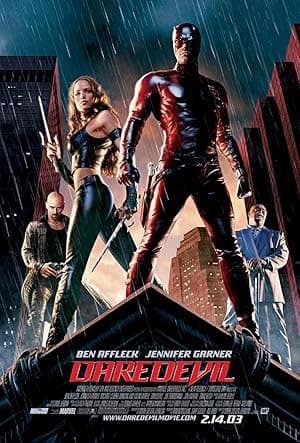
Daredevil
A blind lawyer who punches above his case — revisiting Daredevil's messy, earnest attempt at comic‑book tragedy.
Feature presentation
Daredevil is the sort of superhero movie that insists it’s serious: courtroom arguments by day, brutal street justice by night. It’s messy, occasionally clumsy, but Matt Murdock’s split life — and the guilt that fuels it — is the reason people still put this film in the conversation when they talk about early‑00s comic‑book cinema.
THE MOVIE
Matt Murdock / Daredevil is still the reason this movie works
The film gives us a clear, stubborn centre: Matt Murdock, a man blinded as a child who channels the loss into heightened senses and a night life as the masked vigilante Daredevil. That setup alone promises two films — one about law, one about violence — and it mostly keeps both in play.
There’s an emotional engine under the spandex: the murder of Murdock’s father, which isn’t just backstory but the moral furnace steering his choices. It’s guilt, plain and simple, and Mark Steven Johnson’s movie keeps circling how that guilt justifies, and then corrodes, Matt’s double life.
All of this is wrapped in the early‑noughties superhero package: Ben Affleck as the lead, Jennifer Garner and Michael Clarke Duncan alongside him, and a director unafraid of mixing courtroom drama with punchy action beats in a 103‑minute runtime.
THE SETUP
The idea that sets Daredevil in motion
Keep it simple: by day Matt Murdock is a lawyer; by night he’s a vigilante. The film uses that split to stage a basic argument about whether the law is enough when the system is corrupted or compromised.
On the other side is Wilson Fisk, the Kingpin — a crime lord whose secrecy and reach make him less a gangster with a face and more an institutional threat to the city and to Matt’s faith in lawyering.
From there the plot piles on familiar comic‑book complications: Daredevil is framed for murder, a deadly outsider called Bullseye turns up, and Elektra’s personal story becomes tangled with Fisk’s plans. It’s tidy scaffolding for a story that wants both tense thriller beats and a doomed romance.
Worth noting for anyone rewatching: the theatrical cut was later followed by a home‑video director’s cut that restores nearly half an hour of material, so there are two ways to experience Johnson’s version of the film.
THE CHARACTER
Why Matt Murdock / Daredevil matters
Matt Murdock is the movie’s lodestone. Ben Affleck’s Matt is not a swaggering caped crusader; he’s a man whose life is split into two forms of service: arguing for justice in court and enforcing it on the streets. That tension gives the film somewhere to stand, even when the script wanders.
The father’s murder isn’t a line on a résumé — it’s the thing that explains why Matt won’t let the legal system be the final word. Everything he does, lawyering or beating up criminals, reads as an attempt to atone.
Because the film keeps returning to that internal conflict, Murdock remains interesting to watch. He’s not simply a hero with powers; he’s someone wrestling with whether his mission makes him better or worse than the people he fights.
UNDER THE SURFACE
Daredevil has more on its mind than the plot suggests
On the surface it’s a superhero action movie. Underneath it’s quietly argumentative: it keeps throwing the courtroom up against the back alleys to ask whether formal justice is enough when power is hidden and systemic.
A second theme is secrecy and identity. Matt’s double life makes ordinary relationships fragile; secrecy becomes a kind of moral tax that he pays in loneliness and compromised choices.
And the film leans on a romantic tragedy to raise the stakes. The doomed relationship at the heart of the story turns personal conflicts into dramatic consequences — not just for the lovers, but for the city they both try to protect.
THE FILMMAKING
How Daredevil was put together
Visually the film leans into comic‑book stylings. The cinematography favours bold, stylised framing and lighting that treat the city as something like a graphic novel brought to life, and the rooftop sequences are a recurring motif.
That approach gives the movie a distinctive identity: even when the script wobbles between courtroom scenes and action, the visual design keeps a consistent, noirish texture running through both.
PRACTICAL EFFECTS
The effects work that gives Daredevil its physical personality
Small production choices matter. For scenes where Matt appears blind, the lead actor wore contact lenses designed to simulate cataracts — a tactile, visible decision that anchors those moments.
At the same time, the film mixes that hands‑on approach with digital work. Stylised sequences and some action set‑pieces were created with visual effects produced by an external VFX house, so the movie blends practical touches with digital finish.
PURE 00s
Daredevil could not belong to any other decade
Daredevil arrived during the early‑2000s surge of comic‑book adaptations — an era when studios were still feeling their way through how to turn Marvel characters into big movies. That context explains a lot about its ambitions and its unevenness.
The way the film was positioned and released belongs to that pre‑Marvel‑Studios moment: studios were experimenting with tone and marketing for Marvel properties rather than running a unified franchise strategy.
It’s very much a 2003 film in the way it mixes action, drama and martial arts beats into a single package, and its life continued after theatres: there’s a longer R‑rated director’s cut on home video and a spin‑off focused on Elektra two years later.
WATCHING IT NOW
What has aged — and what hasn't
If you’re wondering how it plays today, two practical facts matter: the director’s cut restores almost thirty minutes of material, and there was an Elektra spin‑off that followed. Both change how viewers might approach the movie now.
The existence of a longer version means a different pacing and tone are available depending on whether you pick the theatrical edit or the director’s cut — so some of the film’s rougher edges were smoothed, or at least altered, in the later release.
Likewise, the Elektra spin‑off signals that certain characters were seen as strong enough to continue, which affects how we read the original film in retrospect.
THE LEGACY
Why Daredevil still matters
Daredevil’s afterlife is modest but tangible. It spawned a spin‑off, and the director’s cut — which restored significant footage — has persisted as an alternative way to see the film and is often treated by the director as his preferred version.
The movie also sits in the pre‑Marvel‑Studios era: its rights eventually moved back to Marvel, and the character has since been reintroduced in later screen projects. That puts this Daredevil in a specific historical slot: a stepping stone rather than an end point.
That history is why the film still matters to fans and to anyone tracing how Marvel characters were handled before the studio built its current model. It’s not definitive, but it’s a clear piece of the larger puzzle.
THE VERDICT
Does Daredevil still hold up?
Yes — with reservations. If you care about a recognisable comic‑book character treated with seriousness and a clear moral obsession, Daredevil still offers that: a blind lawyer haunted by his father’s murder who oscillates between pleading cases and administering street justice.
The film’s central conflicts — Fisk as an institutional threat, the framing plot, the arrival of Bullseye and the doomed Elektra relationship — keep it dramatic in ways that reward attention even when the screenplay’s shifts in tone feel clunky.
There are two viewing options now: the theatrical edit, which foregrounds the tragic romance, and the longer director’s cut that restores roughly thirty minutes and changes the shape of the story. If you’re curious to reassess, the director’s cut is the version that often gives the film more room to breathe.
In short: watch it for the character work — Matt’s guilt and double life, Foggy’s role as his legal tether, and the film’s attempt to marry a superhero thriller to a personal tragedy. It doesn’t always land, but when it does, it’s oddly affecting.
Share this movie
Keep watching
More movies from the 00s

2002
The Pianist
A quiet life unmade by war — and a pianist who refuses to stop listening.
Read the retrospective
→
2006
Blood Diamond
A mercenary, a fisherman and a pink diamond — and a film that still asks who pays for our jewellery.
Read the retrospective
→
2003
Kill Bill: Volume 1
A yellow jumpsuit, a long list of enemies and one woman who refuses to be finished.
Read the retrospective
→