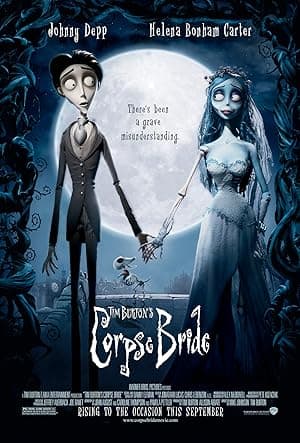
Corpse Bride
A tiny, gothic love story where vows, class and an accidental wedding ring decide who gets to be alive.
Feature presentation
There’s a peculiar little engine at the heart of Corpse Bride: a nervous young groom, a literal risen bride and a wedding ritual that refuses to be merely ceremonial. Co-directed by Tim Burton and Mike Johnson, the film turns a folktale premise into a compact stop-motion musical that likes to argue — gently and sometimes grimly — about what ‘being honest’ actually costs.
THE MOVIE
Victor Van Dort is still the reason this movie works
Corpse Bride hooks you not with spectacle but with a simple, stagey moment: a nervous young man rehearsing wedding vows in the woods and, in one clumsy beat, slipping a ring on what he thinks is a twig. That 'twig' is in fact the skeletal hand of Emily—the corpse bride—and the joke quickly becomes the engine of the whole film.
What follows is a compact, clearly drawn world split into two registers: the muted, manners-first land of the living and a livelier, rule-bound land of the dead. Victor Van Dort sits in the middle of both, played on the soundtrack by Johnny Depp, and his desire to do the 'right' thing is what keeps the story honest and oddly touching.
Co-directed by Tim Burton and Mike Johnson and running to just seventy-seven minutes, Corpse Bride is economical in everything it does — story, songs and visual personality — which is one reason people keep returning to it.
THE SETUP
The idea that sets Corpse Bride in motion
At its simplest, the film rests on a single, tidy conceit: Victor is a timid son of newfound wealth who is expected to marry into an established family, and his rehearsal of vows accidentally binds him to a dead woman. That misstep creates the story’s central strain without needing a labyrinth of plot to explain it.
Structurally the film plays that strain like a see-saw. On one end you have obligations — family expectation, social climbing and the formalities of an arranged match. On the other end is Emily and a dead world that, paradoxically, exposes emotion in ways the living cannot.
The movie uses formal vows, a symbolic wedding ring and a legal/magical reading of marriage as recurring mechanics. Those repeated rituals help the narrative keep returning to the same question: who’s actually bound by these promises, and what do they mean when the rules cross realms?
There’s also a revealing twist about a supporting character’s past that reframes motive and keeps the stakes grounded in personal history rather than supernatural spectacle.
THE CHARACTER
Why Victor Van Dort matters
Victor isn’t memorable because he’s dashing. He’s memorable because he’s anxious in a way you can hear in his footsteps: terrified of failing his parents, awkward in company and desperate to be proper. That mixture makes him a reliable barometer for the film’s moral questions.
He is, in short, the polite hinge the story needs. When the accidental marriage happens his instinct to 'do the right thing' becomes complicated by guilt and confusion — and the film trusts those small, interior struggles to carry weight.
Johnny Depp supplies Victor’s voice on the soundtrack, and the casting keeps the character rooted as a specific, human nervousness rather than a cartoonish type.
Because Victor is simultaneously bound to family expectation and to the unexpected claims of Emily, he becomes the movie’s conscience: the performer caught between scripts and what he actually feels.
THE PERFORMANCE
Why Johnny Depp's performance matters
Contemporary commentary singled out the voice work as crucial to the film’s tone, and Depp’s contribution is part of that thread. Reviews noted his convincingly English, diffident vocal take on Victor, which helps sell the character’s social awkwardness.
In a movie where much of the storytelling is visual and ritualised, the vocal line is a primary way to register private nerves. Depp’s reading steadies Victor as a recognisable type — not a punchline, but someone who worries in public.
That steadiness is important because the film asks the audience to care about a lot of unusual circumstances; the voice work is one of the bridges between the strange and the sympathetic.
The rest of the cast supply a supporting chorus of character voices, which keeps the sound-world rounded and theatrical in a way the stop-motion visuals complement.
UNDER THE SURFACE
Corpse Bride has more on its mind than the plot suggests
Underneath the jokes and songs the film is quietly occupied with a handful of ideas: life versus death, how social class and arranged marriage shape identity, and what happens when ritual outlives its original meaning.
The split between the living and the dead isn’t just visual; it’s a way of testing honesty. The living world is polite and constrained; the land of the dead is rule-bound but emotionally frank. The contrast allows the film to use the afterlife as a mirror for what the living refuse to admit.
Rituals — wedding vows, rings, formal promises — recur until they lose their theatrical gloss and reveal a simpler core: consent and understanding. The film keeps nudging at the difference between performing a part and actually being yourself.
There’s also a through-line of love and release: relationships in the story aren’t only about possession or social advantage but about letting go when the story asks for it.
THE FILMMAKING
How Corpse Bride was put together
This is stop-motion with obvious pride in its handiwork. The picture was co-directed by Tim Burton and Mike Johnson, with Burton providing the principal creative push while Johnson described the process as more organic and collaborative.
Production design leaned on miniature sets, elaborate puppets and a deliberately gothic palette that plays the living world as muted and the underworld as higher-contrast and more revealing. That contrast is part of the movie’s shorthand for emotional truth.
A technical footnote: the production used Canon EOS-1D Mark II digital SLR cameras for the stop-motion capture rather than the 35 mm film cameras used on some earlier projects. That choice was intended to smooth shooting workflow and increase shot smoothness.
The film’s production took place at 3 Mills Studios in London — a tidy, focused environment for the labour-intensive work the crew undertook.
PRACTICAL EFFECTS
The effects work that gives Corpse Bride its physical personality
The film’s physical personality is a handcrafted one: articulated puppets with internal armatures formed the backbone of the animation, maintained by a team of model-makers and puppet wranglers.
Large-scale miniature sets and hand-crafted costumes were used throughout, with specialised departments handling armatures, facial replacements and on-set fabrication to keep continuity and expression tight frame by frame.
Rather than traditional film cameras, the crew used digital still cameras to photograph incremental puppet motion. That technical choice was meant to increase shot smoothness and streamline what is otherwise a painstaking process.
All of which is to say the movie feels built — not rendered — and that construction shows in the tactile behaviour of characters and sets.
PURE 00s
Corpse Bride could not belong to any other decade
Released in 2005, Corpse Bride arrived at a moment when stop-motion was enjoying a modest revival; the film was often mentioned at the time as part of that renewed interest in handcrafted animation.
For Tim Burton it marked a return to puppet-driven storytelling after a period focused on live-action projects, and it sat alongside other Burton work from 2005 as part of a focused burst of activity.
The soundtrack, composed by Danny Elfman and released in September 2005, underlines the film’s musical ambitions and theatrical leanings — it’s as much a sung-through folktale as a visual one.
The project also traces back to an older folktale that Burton encountered during development, which he cultivated while juggling other mid-2000s projects; that folktale feeling helps explain the film’s compact, storybook shape.
THE LEGACY
Why Corpse Bride still matters
One concrete reason the film remains in circulation is awards recognition: it was nominated for the Academy Award for Best Animated Feature at the 78th Academy Awards.
Beyond nominations, the movie keeps turning up in anniversary pieces and industry commentary that praise its puppet-making and stop-motion craft — that practical expertise is part of why practitioners and fans still refer to it.
It’s also regularly named in conversations about Tim Burton’s stop-motion work and the 21st-century effort to sustain hand-crafted animation, which gives it a stable place in discussions about technique and taste.
Put simply: the film matters in part because it’s frequently used as an example when people talk about keeping puppetry and miniature work alive in contemporary animation.
THE VERDICT
Does Corpse Bride still hold up?
Yes — and for a simple reason: it trades on a tight set of choices and follows them through. The accidental ring, Victor’s divided loyalties and the movie’s split worlds give it an internal logic that keeps the plot brisk across its seventy-seven minutes.
If you care about character and idea over spectacle, the film rewards you. Victor’s anxiety, Emily’s claim and the social pressure of an arranged marriage are compact but resonant narrative moves, and the voice work — singled out in contemporary commentary — helps keep those moves emotionally intelligible.
On top of that, the production’s commitment to miniature sets, puppets and a handcrafted approach gives Corpse Bride a physical personality you don’t see in every animated movie. That craft is one of the reasons the film keeps being discussed in retrospectives of stop-motion work.
So should you watch it today? Absolutely — it’s a neat, idiosyncratic little fable: courteous, a bit macabre and properly alive where it matters.
Share this movie
Keep watching
More movies from the 00s
2002
The Pianist
A quiet life unmade by war — and a pianist who refuses to stop listening.
Read the retrospective
→
2006
Blood Diamond
A mercenary, a fisherman and a pink diamond — and a film that still asks who pays for our jewellery.
Read the retrospective
→
2003
Kill Bill: Volume 1
A yellow jumpsuit, a long list of enemies and one woman who refuses to be finished.
Read the retrospective
→