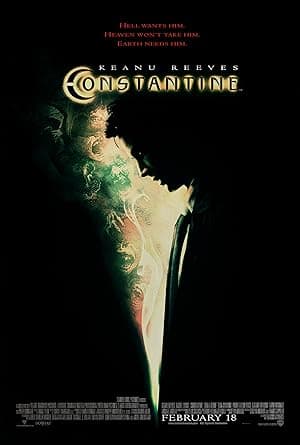
Constantine
A chain‑smoking demon‑hunter, a missing sister, and a theological tug‑of‑war — with Keanu Reeves in the middle of it all.
Feature presentation
Constantine isn’t a cape-and-lightsabre superhero movie. It’s a grimy, genre-blending oddball: an occult detective story that wants to be a horror film, a faith drama and a comic‑book adaptation at once. What keeps it moving is John Constantine himself — a haunted, pragmatically hostile antihero played by Keanu Reeves — and a handful of ideas about guilt, salvation and who gets to call the shots between Heaven and Hell.
THE MOVIE
John Constantine is still the reason this movie works
There is something immediately recognisable about a film that opens with a protagonist who sees angels and demons tucked into the seams of everyday life. Constantine gives us that straight away: a chain‑smoking occult detective who perceives half‑angels and half‑demons living unseen among humans.
That eye for the unseen is only half the point. Constantine is also terminally ill and carrying the kind of guilt that looks like action — a man haunted by a past suicide attempt whose attempts at redemption drive everything he does. It’s grim, but it keeps the movie honest; the stakes are personal even when the plot goes big‑scale.
Keanu Reeves plays Constantine, and Francis Lawrence — on his feature directorial debut — builds a film around that moody, antiheroic figure. Rachel Weisz, Tilda Swinton, Djimon Hounsou and Peter Stormare orbit him, but the movie’s personality is keyed to Constantine’s particular brand of world‑weariness and pragmatic hostility toward both Heaven and Hell.
THE SETUP
The idea that sets Constantine in motion
At its simplest the film is propelled by a single, tidy engine: the investigation of a woman’s apparent suicide. That inciting incident pulls Constantine into a case that isn’t what it first seems.
The investigation reveals a much larger danger — a demonic plan to use human vessels to cross into and rule the living world. It’s a classic horror premise dressed up in comic‑book clothing: a private practitioner against an organised, supernatural threat.
To stop that crossing the film leans on recognisably Christian instruments — relics and exorcism rituals — even building elements of the plot around a specific relic, the Spear/Lance of the Passion. Those religious mechanics give the action a distinct texture and a set of rules the characters must play by.
So the set‑up works because it keeps the story urgent (someone died) while steadily raising the play‑for‑keeps stakes: this isn’t just about a single murder, it’s about stopping a demonic invasion that would rewrite the rules of the world.
THE CHARACTER
Why John Constantine matters
The film hangs on the fact that John Constantine is not your standard white‑hat hero. Keanu Reeves plays him, yes, but more importantly the character is structured as an antihero: driven by guilt, obsessed with redemption, and deeply suspicious of both Heaven and Hell.
That combination makes him a useful guide through the film’s moral mess. He isn’t trying to prove a point about doctrine; he’s trying to do penance in the only language he knows — action. That keeps scenes from becoming abstract sermons: the ethical questions are lived, not lectured.
The plot’s personal angle — Constantine teaming up with an LAPD detective to investigate her twin’s death — keeps the character grounded. He’s not a remote, mythic figure; he’s a flawed, sometimes abrasive presence in the middle of someone else’s tragedy.
Finally, the character’s comic‑book origins matter only insofar as they supply attitude. The movie doesn’t try to make Constantine into a conventional superhero. He remains, at heart, a haunted pragmatic fixer, and the film benefits from letting that particular temperament run the show.
THE PERFORMANCE
Why Keanu Reeves's performance matters
Contemporary notices of the film often pointed to Reeves’ casting as a defining choice: his presence helps set the movie’s tone. That is the safest, most defensible performance claim — not about talent or invisibility, but about the film’s personality being keyed to him.
Reviews at the time were split on whether that version of Constantine matched the Hellblazer comic‑book character fans knew. Some accepted the tonal pivot; others wished for a closer translation. Either way, you can’t separate the film’s feel from Reeves’ casting.
That split matters because it explains a lot of the chatter the movie still attracts. If the lead defines the film’s attitude, people who liked that attitude will defend it; people who wanted a different take on the comic will notice the departures.
So when you watch Constantine now, pay attention to how the film uses Reeves as an anchor rather than a blank page. The casting choice is the lens through which the film asks you to read everything else.
UNDER THE SURFACE
Constantine has more on its mind than the plot suggests
Under the demon fights and exorcisms the movie keeps nudging at one stubborn question: can someone who’s deeply flawed buy their way back into grace? Redemption is the engine that makes Constantine move from set‑piece to something with emotional weight.
Faith and doubt sit cheek‑by‑jowl here. The film stages believers and sceptics, angels who are bureaucratic and demons who bargain, and leaves its characters — and the audience — to negotiate faith in the gaps between spectacle.
There’s also a tug‑of‑war built into the story: free will versus divine plan. That argument isn’t broadcast as theology class. Instead it lives in small choices: who becomes a vessel, who resists, who gets to decide the shape of salvation.
Finally, identity and possession show up as literal and symbolic concerns. The idea that someone’s body can be taken over reflects a larger worry about agency; the film uses possession to ask who’s really in control, and whether identity can be reclaimed.
THE FILMMAKING
How Constantine was put together
Francis Lawrence arrived from music videos, and critics at the time frequently linked the film’s visual approach to that background. Saying so isn’t sneering — it’s noting that the director favoured a bold, stylised eye over a plainer, documentary approach.
Behind that eye were experienced collaborators: Philippe Rousselot is credited as cinematographer and Wayne Wahrman as editor, with Naomi Shohan on production design. Those names give the film a professional spine — a crew capable of translating the director’s ideas into a consistent screen world.
The result is a picture where craft often shows more than restraint. The filmmaking choices insist on mood and texture; the movie wants you to feel its atmosphere as much as follow its beats.
And because it was Lawrence’s first feature, Constantine reads as a director staking out a space — ambitious, visually minded and willing to let style and story jockey for position.
PRACTICAL EFFECTS
The effects work that gives Constantine its physical personality
Constantine’s creature work is a physical hybrid: Stan Winston Studio supplied maquettes and practical creature elements that grounded many of the designs, while Tippett Studio handled a large share of the creature and hell‑environment visual effects.
One striking example is the Vermin Man, realised as a particle‑based creature intended to read as swarms of insects. That’s not just a flashy idea; it’s an attempt to give a monstrous concept a tactile, swarm‑like logic on screen.
The film’s possession and exorcism scenes also combine approaches. Prosthetic makeups and practical plates were married to CG so creatures could meaningfully interact with actors’ bodies — teams modelled cloth and skin interactions to make a CG presence look like it was physically pushing against someone.
The mixed workflow gives the film a physical personality: sometimes gruesome, sometimes near‑operatic, and often insisting that the supernatural occupy real, manipulable space rather than floating as pure CGI ornament.
PURE 00s
Constantine could not belong to any other decade
You can hear the mid‑2000s in what the film tries to do: it’s a big‑budget adaptation of Vertigo/DC’s Hellblazer that leans into horror and genre mash‑ups rather than pure capes‑and‑carnage. That hybrid impulse felt like the era’s way of experimenting with comic‑book material.
Released in 2005, Constantine sits among other attempts to translate darker, stranger comics for the multiplex. It isn’t a period piece; it’s a moment when studios were still discovering how far a comic adaptation could stretch its genre boundaries.
Even the score’s release in February 2005 and the film’s early year opening underline how it was positioned: not a summer blockbuster, but a mood piece hoping to find an audience that wanted atmosphere with their spectacle.
And the fact that the property later returned to television shows the decade’s growing appetite for different formats — Constantine belongs to a 00s moment when comic‑book worlds were being tried out in many tones and platforms.
THE LEGACY
Why Constantine still matters
Constantine keeps turning up in conversations because it quietly built a modest, persistent base of appreciation. Retrospectives note it has a cult following and there has been intermittent sequel‑talk involving original filmmakers — not blockbuster dominance, but a steady afterlife.
Part of that persistence comes from how the film combined a distinctive lead, ambitious effects work and a thematic seriousness about sin and salvation. For some viewers that mix is exactly what they wanted from a comic adaptation.
The character’s return in the 2014 TV series and later Arrowverse appearances also helped keep the name in circulation. Those adaptations are separate projects, but they kept public attention on the Hellblazer property as a screenable, revisitable world.
So Constantine’s legacy is less about sweeping influence and more about staying interesting to a particular audience: people who liked its uneasy blend of horror, theology and comic‑book swagger.
THE VERDICT
Does Constantine still hold up?
Short answer: yes, if you’re watching for personality, atmosphere and a character who’s doing something morally complicated. The movie gives us a John Constantine who sees the hidden world of half‑angels and half‑demons, and it keeps his quest for redemption front and centre. That personal throughline gives the film weight when other elements go loud.
It helps that the plot keeps the stakes concrete: a detective’s search into her sister’s apparent suicide reveals a demonic effort to use human vessels to cross over, and the film uses relics and exorcism rituals — even the Spear/Lance of the Passion — as tangible mechanics to block that plan. The story gives you rules and lets the characters play within them.
Expect mixture. The production combined practical creature maquettes and prosthetics with significant CG work, and the filmmaking is clearly a product of its director’s visual instincts; contemporary reaction was mixed, with praise for visuals and supporting turns but criticism for narrative clarity and comic‑book departures. If you prize airtight plotting above mood, this might frustrate you.
But if you want a 2005 movie that takes theology seriously without becoming a sermon, that centres an antihero wrestling with guilt and possible salvation, and that prefers atmosphere over faithful page‑by‑page adaptation, Constantine is still worth your time. It’s a film that wears its contradictions on its sleeve — and, oddly, that’s part of its appeal.
Share this movie
Keep watching
More movies from the 00s
2002
The Pianist
A quiet life unmade by war — and a pianist who refuses to stop listening.
Read the retrospective
→
2006
Blood Diamond
A mercenary, a fisherman and a pink diamond — and a film that still asks who pays for our jewellery.
Read the retrospective
→
2003
Kill Bill: Volume 1
A yellow jumpsuit, a long list of enemies and one woman who refuses to be finished.
Read the retrospective
→