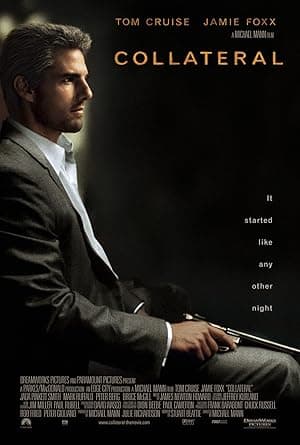
Collateral
One night, one cab, one quietly terrible professional — and the city watching.
Feature presentation
Collateral still feels like a film that turned up to work at night and refused to phone in a single scene. Michael Mann gives us a predatory, oddly polite killer and a taxi driver whose ordinary plans crash into something clinical and immovable. If you remember one image from the movie, it’s usually Vincent — and for good reason.
THE MOVIE
Vincent is still the reason this movie works
Talk about Collateral and most conversations orbit the same thing: a professional who treats murder like an appointment. The film hooks you immediately by turning a routine taxi fare into a hostage situation — Max Durocher accepts a high-paying ride and finds himself trapped when his passenger, Vincent, reveals he's a contract killer.
That shock arrives in an utterly Mann-ish practical beat: a dead body lands on the cab roof, and suddenly the night isn't anonymous anymore. Vincent's calm, methodical way of working — his precision and the philosophical asides that come with it — pumps the movie's tension like a metronome.
Around that central fact the film builds its mood: the night city as a place where things happen without bystanders stepping in, where chance encounters rearrange lives. Mann directs the whole thing — it was released in 2004 — and he keeps returning to Vincent because, frankly, Vincent gives the film a spine.
THE SETUP
The idea that sets Collateral in motion
The premise is as tidy as it is effective: Max, an L.A. taxi driver, takes a fare and is forced to chauffeur a man who turns out to be a hitman. That single night becomes the film's clock — one fare after another, each stop a small scene that raises the stakes.
What keeps the premise taut is the way the central conflict is framed. Max isn't just trying to escape; he's trying to keep hold of his own choices, his sense of decency, while an absolute professional drags him through a series of killings across the city.
The screenplay began life as Stuart Beattie's treatment and was bought by DreamWorks, which nudged the idea into the hands of Michael Mann. Mann then set out to let a simple, almost theatrical conceit — one driver, one passenger, one night — play out in the sprawling, indifferent city around them.
THE CHARACTER
Why Vincent matters
Vincent exists as a blunt centre of gravity. Tom Cruise plays him: not a caricatured villain but a professional with rules. That methodical quality — the way he organises his world and speaks about it — is the engine of the film's unease.
He matters because he makes everything around him look precarious. Max, the everyman who dreams of running a limo service, is shoved into choices he never wanted to face; those choices reveal how ordinary plans can be wrecked by someone who treats life like a timetable.
Vincent also works as a foil to the people Max cares about. Annie Farrell, Max’s romantic interest and a federal prosecutor, stands on the opposite side of the ledger: law, procedure and a different kind of moral seriousness. Their presence sharpens what Vincent removes.
THE PERFORMANCE
Why Tom Cruise's performance matters
Casting Tom Cruise as Vincent was a deliberate gamble: critics at the time pointed out how the film sets him against type, and that decision is central to the movie's menace. The unusualness of seeing Cruise inhabit a controlled antagonist gives the character bite.
Because Vincent isn't a cartoon villain, the part works as a study in professional detachment: he talks like someone who has rehearsed his own ethics and keeps his cool while the city around him frays. That coolness is what turns ordinary moments into threats.
If the film succeeds at creating a hum of tension, a fair portion of that hum comes from the decision to let Cruise be quietly, efficiently frightening rather than loud and broad.
UNDER THE SURFACE
Collateral has more on its mind than the plot suggests
On one level Collateral is a taut thriller. On another it’s a nocturnal essay about city life: the film uses Los Angeles at night to show how anonymity and urban distance allow extremes to occur with little immediate interference.
The single-night structure matters. By compressing everything into hours, Mann lets chance and contingency feel decisive; an accidental fare becomes a moral crossroads that forces Max to make choices he couldn't have imagined earlier that day.
There’s also a quiet game of masks in play. People perform roles — driver, hitman, prosecutor, cop — and the movie lingers on those performances enough to ask whether identity is what you do or what you intend. Professionalism bumps against morality repeatedly, and the clash is never purely rhetorical.
THE FILMMAKING
How Collateral was put together
One of the things that gives Collateral its personality is how it was shot. The production leaned hard on high-definition digital cameras — including systems like the Viper and CineAlta — for its night exteriors, and then used a digital intermediate workflow before outputting back to 35mm. That technical route helped the film achieve a particular clarity and colour control in its nocturnal scenes.
Mann kept the production tight and street-level: location shooting across Los Angeles — scenes at LAX and in Koreatown among them — roots the film in real urban geography rather than studio gloss.
The cutting is another part of the craft. Editors Jim Miller and Paul Rubell shaped the film's intercutting rhythms, a contribution recognised by an Academy Award nomination for Best Film Editing, and the work of cinematographers Dion Beebe and Paul Cameron was later honoured with a BAFTA for Best Cinematography.
PRACTICAL EFFECTS
The effects work that gives Collateral its physical personality
Collateral isn't a film about spectacle for spectacle's sake; it mixes digital-camera techniques with traditional 35mm shooting rather than relying on large-scale optical or miniature tricks for its night sequences.
That hybrid approach was also a creative choice: the production used a digital intermediate and colour-timing process to shape the saturated night colours and final look before outputting back to film, which helped the movie maintain a tactile, physical presence even when the cameras and workflows were modern.
PURE 00s
Collateral could not belong to any other decade
Collateral sits very much in the early 2000s because it was part of a moment when major-studio filmmaking began to seriously experiment with high-definition digital capture for night work. Using cameras like the Viper on a mainstream feature was a statement: this was how the decade would start to be shot.
The film’s 2004 release places it at that pivot — Mann adopted the technology not as a gimmick but to serve a specific look, one that keeps the city sharp and immediate after dark.
Critics and organisations of the year took notice — the National Board of Review named it one of the top ten films of 2004 — which is a reminder that the picture arrived at a time when technique and storytelling were actively being reassessed.
THE LEGACY
Why Collateral still matters
Collateral kept certain technical conversations moving forward. Its early, prominent use of the Viper FilmStream camera on a big feature is often mentioned in histories of digital cinematography, and the film helped normalise the idea that HD tools could do serious, artful night work.
On the awards front, the film picked up recognition that reflected both craft and performance: the cinematography team received a BAFTA, and it earned Academy Award nominations — for Jamie Foxx’s supporting turn and for the film’s editing.
The National Board of Review included Collateral in its top ten films of 2004, which is a tidy bit of evidence that the movie registered at the time as one of the year’s more notable releases.
THE VERDICT
Does Collateral still hold up?
Yes — and the reason is simple: Collateral is built around a compact, relentless dramatic engine. The setup is economical (Max takes a fare and a dead body on the cab forces him to reckon with the truth about his passenger) and the film uses that engine to move through a series of stops that ratchet tension while showing different faces of the city.
What keeps it watchable now is the clarity of the collision. You have Max, an everyman with modest ambitions, forced into survival-driven decisions, and Vincent, a professional whose calm philosophy turns ordinary actions into moral pressure. That structure — episodic stops that never quite resolve the moral collision immediately — makes for a compelling two-hour ride.
Technically and narratively it’s a product of its time: Mann’s direction, a script that began with Stuart Beattie’s treatment, and the digital-to-film workflow all give Collateral a particular 2004 fingerprint. But those fingerprints are part of its personality rather than distractions.
If you’re deciding whether to watch it: for a tightly constructed, night-time neo-noir where character and profession collide, Collateral still delivers. Vincent remains the reason many viewers remember the film — and the rest of the movie does its job of showing why the city’s anonymity is a dangerous thing.
Share this movie
Keep watching
More movies from the 00s

2002
The Pianist
A quiet life unmade by war — and a pianist who refuses to stop listening.
Read the retrospective
→
2006
Blood Diamond
A mercenary, a fisherman and a pink diamond — and a film that still asks who pays for our jewellery.
Read the retrospective
→
2003
Kill Bill: Volume 1
A yellow jumpsuit, a long list of enemies and one woman who refuses to be finished.
Read the retrospective
→