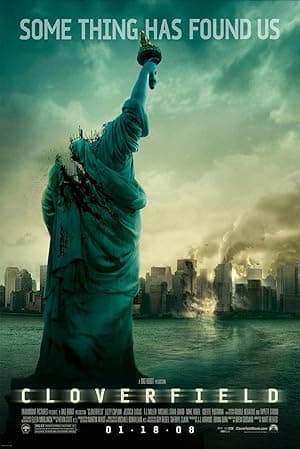
Cloverfield
A monster movie that’s really about friendship, an old camcorder and a city that suddenly feels fragile.
Feature presentation
Cloverfield still hooks you by refusing the usual monster trappings: it opens with a going‑away party and a handheld camera, and it keeps the human story — Rob and his friends — absolutely front and centre. Matt Reeves uses that simple domestic start as a way into a big, terrifying collapse, and the film’s nerve comes from watching ordinary people try to be decent when the world gets suddenly, grotesquely small.
THE MOVIE
Rob Hawkins is still the reason this movie works
Cloverfield begins not with a military briefing or a scientist at a blackboard, but with a going‑away party for Rob Hawkins — and that small, human choice is what keeps the film tethered to us. The party footage is literally why the camera exists: Hud records his friend, and the handheld perspective is written into the story from the first frame.
That intimacy matters because the film turns a private night into public chaos. A large, mysterious creature attacks Manhattan during the party’s immediate aftermath, and the movie follows Rob, his brother Jason and their friends as they try to find Rob’s girlfriend Beth and get out of the city. It’s a rescue mission and a scramble, and everything we learn is filtered through that single tape.
Put simply: the film’s emotional engine is Rob. The party frames him as someone about to leave, and his tie to Beth gives the group a reason to risk the obvious. Matt Reeves keeps the camera close to ordinary people making urgent, messy decisions — and that’s what makes Cloverfield worth revisiting.
THE SETUP
The idea that sets Cloverfield in motion
At its clearest, Cloverfield is straightforward: a party, a camera and a city suddenly under attack. The movie follows a small group — Rob, his brother Jason and friends — as they move through the wreckage trying to find Beth and escape Manhattan.
The way the story is presented is part of the idea: everything comes to us as a single videotape recorded by Hud. That diegetic choice gives the whole film a documentary shape and explains why the camera never stops rolling even when it would be sensible to put it down.
That constraint does two useful things. It keeps the running time brisk and tense, and it forces the film to suggest scale through fragments — a glimpse of wreckage, a shot through smoke, a trembling hand — rather than long, staged set‑pieces.
So the setup works because the familiar monster spectacle is wrapped in a very specific personal framing: one physical tape, one point of view, and a rescue that feels immediate because it’s being recorded by someone who’s part of the night, not a bystander with a tripod.
THE CHARACTER
Why Rob Hawkins matters
Rob Hawkins is written into the film as the thing everyone orbits: the party is for him, he’s about to leave town, and his relationship with Beth gives the group a single, human objective. Michael Stahl‑David is the credited actor, and that structural role is the reason Rob stays memorable.
Because Rob is the person the night is built around, his stakes feel simple and convincing. The movie isn’t trying to turn him into a symbolic everyman; it’s asking whether friends will put themselves in danger for the person who matters to one of them.
Jason Hawkins turns up as an older brother and a secondary leader in the escape and rescue decisions, which gives the film a small hierarchy of responsibility — it’s not chaos for chaos’s sake, it’s people trying to organise themselves amid breakdown.
All of this locks the movie into its central theme: friendship and loyalty under crisis. Rob’s presence gives the run toward the monster an emotional intention, and that intention is why the personal beats hold even when the city is unrealistically loud and dangerous.
UNDER THE SURFACE
Cloverfield has more on its mind than the plot suggests
Beneath the smashed cars and collapsing facades, Cloverfield is unusually interested in how we witness catastrophe. Presenting the action as a single personal recording turns every shot into an eyewitness account — subjective, shaky, partial — and the film treats that limitation as a theme rather than a shortcoming.
That mediation of catastrophe feels contemporary to the late 00s: disaster becomes something you experience on a personal device before it is framed by news or experts. The tape’s subjectivity constantly reminds us that what we see is a single point of view, and that affects how scale and horror are communicated.
Connected to that is urban vulnerability. Manhattan isn’t a backdrop you can rely on; it is fragile, exposed and suddenly hostile. The city’s infrastructure gives way in a few brutal scenes, which makes the rescue feel less like a heroic set‑piece and more like a practical problem for a group of friends.
Finally, there’s the emotional core: friendship and loyalty under crisis. The choice to centre ordinary people who make hard, often muddled decisions — and sometimes still choose each other — gives the spectacle a human anchor. And given the era in which the film arrived, those resonances of public trauma and spectacle are hard to ignore.
THE FILMMAKING
How Cloverfield was put together
Cinematography here has a specific brief: don’t look like a film. Michael Bonvillain and the production deliberately simulated consumer handheld video, and that consistent decision gives the picture its documentary feel. The entire movie rests on the idea that this is something filmed by one of the people caught up in the night.
That choice changes how tension is built. Instead of smooth, omniscient clarity, you get fragments and the sense of discovery — someone runs toward a sound, someone turns the camera away in panic — and those moments keep the audience off balance.
Contemporary critics noticed that cinéma‑vérité approach and the sense of scale that comes from showing a huge event through tiny, interruptible glimpses. Some reviewers liked the immediacy; others found the real‑time handheld work divisive, a style that can sharpen immersion or make information hard to read.
What matters is that the film’s identity is inseparable from that deliberate look. It’s not a convention lazily attached; it’s the mechanism the movie chose to make its story feel as close and immediate as possible.
PRACTICAL EFFECTS
The effects work that gives Cloverfield its physical personality
Cloverfield’s creature moments come from a mix of established visual‑effects houses and on‑set choices rather than a single trick. Vendors such as Double Negative and Tippett Studio contributed VFX, which provided the film’s larger‑than‑life passages.
Neville Page is credited as the lead creature designer, and his work shaped the look of the monster and the smaller parasitic creatures that feature in the film’s later scenes.
Crucially, the production combined digital visual effects with practical on‑set special effects and stunt coordination to sell the close interactions between actors and a damaged environment. That combination helps the found‑footage conceit feel tactile: you can believe the camera is showing real proximity to danger.
The result is a hybrid approach that supports the film’s documentary pretence — digital spectacle gives scale, practical tricks and stunts give immediacy up close.
PURE 00s
Cloverfield could not belong to any other decade
Cloverfield arrived at a moment when studios were experimenting with viral marketing and ARG techniques to build mystery before release. The film’s launch strategy — teasing a date and keeping the title secret — is very much a late‑00s studio gambit.
It also hybridised two contemporary trends into a studio release: the found‑footage mode that had made an earlier career for movies like The Blair Witch Project, and the era’s appetite for large‑scale VFX creature spectacles. Combining those approaches into a modest studio film — a low‑budget, roughly $25 million model — felt like a 2000s solution to modern blockbuster problems.
Put another way: Cloverfield is a child of its era because it mixes internet‑era marketing and DIY camerawork with proper visual effects, then asks a mainstream audience to accept that hybrid. That blend reads very 2008 in both practice and ambition.
So when you watch it now you can still feel that mix of DIY urgency and studio muscle — which is exactly what made it a distinctive example of late‑00s genre tinkering.
THE LEGACY
Why Cloverfield still matters
Cloverfield left a tidy trace: it launched a loose anthology that later included 10 Cloverfield Lane and The Cloverfield Paradox. That afterlife matters because the film became less a single story and more a brand that could be flexed in different directions.
The film’s marketing — the secrecy, the date‑only teaser and ARG elements — is itself often brought up in discussions of studio viral marketing. The campaign is now a reference point for how to build pre‑release curiosity without giving much away.
On the creature front, Neville Page’s designs for the monster raised his profile and led to more concept and creature design work on subsequent projects. In practical terms, the look of the creatures helped the film stand out among other big‑screen monsters.
Those are quiet afterlives, not grand claims: a franchise model, a marketing case study and a design credit that opened doors. Together they explain why Cloverfield still gets mentioned when people talk about late‑00s genre movies.
THE VERDICT
Does Cloverfield still hold up?
Yes — but with a couple of caveats. If you come for a neat origin story or long, unblocked monster set‑pieces, this isn’t that film: Cloverfield keeps the creature’s origins unexplained and prefers scattered, obstructed images to widescreen exposition. That choice is deliberate and it asks you to accept impression over explanation.
Where the film still works is in its scale of intimacy. The entire story is presented as a single videotape recorded by Hud, and that framing keeps the running time brisk (about 85 minutes) and the tension immediate. You feel like a companion to the group rather than an omniscient spectator.
Rob’s motivation — the party that marks his impending departure and his tie to Beth — supplies a steady human reason to keep moving through the destruction. The rescue focus keeps the story personal, and that’s what gives the spectacle emotional weight.
So if you want a compact, high‑anxiety monster movie that privileges the experience of collapse over neat answers, it still delivers. Watch it as what it is: a late‑00s experiment in mixing found footage and creature spectacle that keeps ordinary people at its centre.
Share this movie
Keep watching
More movies from the 00s

2002
The Pianist
A quiet life unmade by war — and a pianist who refuses to stop listening.
Read the retrospective
→
2006
Blood Diamond
A mercenary, a fisherman and a pink diamond — and a film that still asks who pays for our jewellery.
Read the retrospective
→
2003
Kill Bill: Volume 1
A yellow jumpsuit, a long list of enemies and one woman who refuses to be finished.
Read the retrospective
→