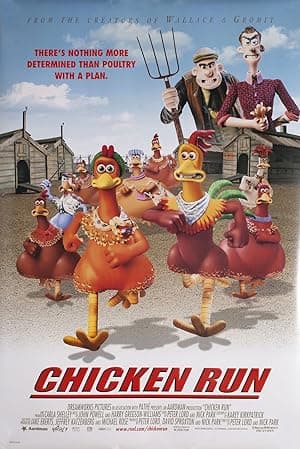
Chicken Run
Ginger leads, the flock follows — and those chickens still make a terrific getaway.
Feature presentation
There aren’t many family films where a hen doubles as a resistance leader, but Chicken Run wears that idea like a battle scarlet scarf. It’s a stop-motion caper that turns a classic prison-escape template into something cheeky, warm and surprisingly tense — all centred on Ginger and her refusal to accept life as pie-filling.
THE MOVIE
Ginger is still the reason this movie works
Remember Ginger? She’s the hen who won't stop trying. The whole film pivots on her refusal to accept the fate the Tweedys have in mind — and that single-mindedness gives the story its pulse.
Everything else arrives to support her: a brash rooster who literally crash-lands with an escape promise, a flock that must be taught to think and act together, and a creeping machine that makes freedom suddenly urgent. That mix — leadership, daring and an approaching deadline — is what makes the movie click.
Peter Lord and Nick Park steer the thing, turning Aardman’s particular brand of stop-motion into a full-length adventure that keeps you watching for exactly 84 minutes of mischief, invention and outright stubbornness.
THE SETUP
The idea that sets Chicken Run in motion
At its simplest: Ginger discovers the Tweedys plan to convert the flock into meat pies, and that knowledge forces her hand. The danger isn’t abstract — it’s a real deadline that makes every attempt to get away matter.
The story doesn’t ride on a lone hero. Ginger is the organiser, but escape depends on training, clever gadgets and the participation of the whole barnyard. That collective effort keeps the stakes clear and the action believable within the film’s comic logic.
The screenplay credits reflect the collaboration behind the camera too: a story from the directors shaped into a feature script with additional dialogue to sharpen the ensemble voices.
All of this sits inside Aardman’s painstaking physical work: the production built numerous puppets and models to give the film its distinct stop-motion presence.
THE CHARACTER
Why Ginger matters
Ginger is the film’s organising voice. She’s not just the protagonist; she’s the person who keeps trying when everyone else grows resigned, and that refusal to accept the farm’s fate turns a simple plot into a drama with urgency.
That urgency reframes the escape movie. Rather than a macho breakout led by a single mastermind, this is a story where the leader is a hen convincing neighbours to believe in the impossible — and then to help build it.
As a family film, that makes Ginger an easy point of entry: kids can root for someone who won’t give up, while adults can appreciate the structural twist on a familiar template.
And yes, she’s also the engine that keeps the flock moving from one clever attempt to the next — which is exactly what the story needs.
THE PERFORMANCE
Why Julia Sawalha's performance matters
Contemporary reviewers singled out Julia Sawalha’s work as the film’s central vocal through-line. Her voice gives Ginger a plausible blend of grit and vulnerability, which is crucial when a puppet has to carry emotional stakes.
Put simply: the vocal performance roots the audience in Ginger’s determination, so the stop-motion craft around her can do the rest without losing the viewer’s sympathy.
UNDER THE SURFACE
Chicken Run has more on its mind than the plot suggests
On paper it’s a prison-escape caper with chickens. Under the surface it’s a neat bundle of ideas about running toward freedom and what that actually asks of a community.
Collective solidarity is presented as a practical necessity: different hens contribute different skills, and those contributions are what make escape possible. It’s teamwork as invention.
Female leadership and resilience steer the tone. By putting a hen in the organiser’s role, the film shifts the usual escape-film template onto a different set of dynamics and expectations.
There’s also a satirical edge: the looming pie machine and the Tweedys’ plan turn mechanised food production into an unmistakable threat, which helps the film balance its comedy with a sharper social bite.
THE FILMMAKING
How Chicken Run was put together
The film’s look and movement come from traditional stop-motion practice: a dedicated photography team shot frame-by-frame, capturing subtle puppet adjustments that give each character a physical presence.
That process is purposeful — it treats the miniature world as a real place where timing and composition matter, and where small gestures carry weight because they were crafted by hand.
It’s also why the film’s humour often lands in tactile details: the animation pipeline lets gestures and sight-gags read clearly, which is essential in a movie that mixes action set-pieces with ensemble comedy.
PRACTICAL EFFECTS
The effects work that gives Chicken Run its physical personality
Aardman didn’t rely on painted puppets alone. They sculpted plasticine originals, made moulds and then produced latex skins fitted over silicone cores with internal armatures — a construction that allowed for lifelike movement while keeping the characters robust enough for weeks of shooting.
The studio built hundreds of distinct puppet assets to populate the farm: principal characters and background hens alike required different models so the sets felt lived-in and varied.
Even the materials have a bit of studio lore — a custom plasticine mix and repeated fabrication runs helped the team manage the chickens’ round bodies and the delicate mechanics of thin legs and flapping bits.
PURE 00s
Chicken Run could not belong to any other decade
Chicken Run arrived at the very start of the 2000s after being conceived in the late 1990s, and that timing matters: it’s the moment Aardman stepped from celebrated shorts and Wallace & Gromit projects into a Hollywood-scale feature collaboration.
The partnership with larger distributors and co-producers helped the studio bring stop-motion onto a bigger commercial stage while keeping the tactile craft very much at the centre.
Music and soundtrack planning were also part of that transition — the score was released alongside the film in June 2000, a sign the project was being treated like a mainstream feature rather than a niche animation curiosity.
WATCHING IT NOW
What has aged — and what hasn't
One clear thing that tends to survive the years is the film’s tactile workmanship. Retrospectives often point to Aardman’s hands-on stop-motion as something that still reads as distinct and satisfying on modern screens.
The prison-escape template adapted for family audiences also continues to work: serial attempts, contraptions and the ticking deadline give the story a structure that’s straightforward but still engaging.
Voice casting keeps its bite too — reviews at the time singled out vocal characterisation for attention, which helps the characters remain lively now that many viewers first encounter them in streaming or repeat airings.
All told, the elements people still enjoy are the ones that are baked into the film’s DNA: craft, structure and clear vocal personalities.
THE LEGACY
Why Chicken Run still matters
As Aardman’s first theatrical feature, Chicken Run marked a moment when the studio graduated into full-length storytelling on a commercial scale — and it became the company’s best-known early feature for that reason alone.
It also enjoyed notable commercial success at release, earning well into the hundreds of millions worldwide and establishing stop-motion’s potential as a viable big-screen medium.
Critically and academically, one of the film’s enduring talking points is its formal nod to prison-escape cinema. Calling it 'The Great Escape with chickens' wasn’t mere publicity; that reference has shaped how people explain its tone and plot choices in essays and discussions.
Between the production leap, the box-office performance and the clearly signalled homage to an older genre, Chicken Run left a footprint that explains why it still gets revisited.
THE VERDICT
Does Chicken Run still hold up?
Yes — and for simple reasons. The central engine is straightforward: Ginger organises escape attempts because the Tweedys’ pie plan is an urgent threat, and that urgency keeps the story moving from one clever attempt to the next.
The film thrives because it balances a recognisable escape structure with communal problem-solving: it’s not just one hero pulling everyone out, but a whole flock contributing skills and inventions toward a single goal.
The voice work and clear character beats help too — contemporary coverage singled out the cast for strong vocal characterisation, which still makes the characters easy to care about on repeat viewings.
If you’re thinking of watching it now, expect a movie that still entertains: a handmade adventure about refusal, resourcefulness and getting off the ground — with a hen at the helm.
Share this movie
Keep watching
More movies from the 00s

2002
The Pianist
A quiet life unmade by war — and a pianist who refuses to stop listening.
Read the retrospective
→
2006
Blood Diamond
A mercenary, a fisherman and a pink diamond — and a film that still asks who pays for our jewellery.
Read the retrospective
→
2003
Kill Bill: Volume 1
A yellow jumpsuit, a long list of enemies and one woman who refuses to be finished.
Read the retrospective
→